Kenya has secured €102 million (Sh15.37 billion) in new European Union-backed funding under the EU-Kenya Digital Partnership, a move aimed at accelerating digital transformation, expanding connectivity and creating new opportunities for businesses and young people.
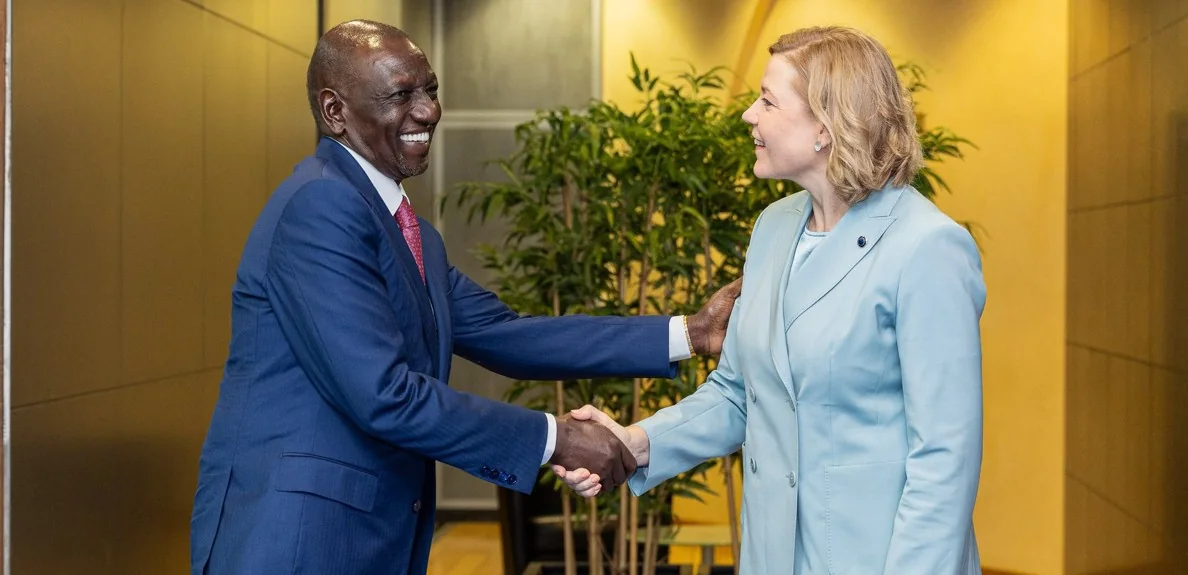
Speaking on Monday during high-level talks in Brussels, President William Ruto said the funding would strengthen Kenya’s digital economy and broaden access to opportunities across various sectors.
He also announced an additional €37 million (Sh5.58 billion) in EU support for the extension of the Blue Raman submarine cable linking Djibouti, Somalia, Kenya and Tanzania. According to Ruto, the project will enhance regional connectivity, lower internet costs and reinforce Kenya’s position as a regional digital hub.
During his visit, the President held discussions with European Commission Executive Vice-President Henna Virkkunen, focusing on strengthening Kenya-EU cooperation in trade, innovation and the digital economy.
Ruto highlighted progress in implementing the EU-Kenya Economic Partnership Agreement, noting that Kenyan exports to the EU have increased by more than 20 per cent since the deal took effect, creating jobs and opening up new opportunities for farmers and manufacturers.
He said the partnership continues to unlock investment and innovation opportunities, adding that Belgium was among the first European countries to recognise Kenya’s sovereignty in 1963.
The President also used the platform to call for a new approach to Africa-Europe relations, arguing that the continent should be viewed as a strategic partner rather than a challenge to be managed.
“For too long, that relationship has rested on a misunderstanding. Africa has been seen as a problem to be managed. It is not, and it has never been. Africa is an opportunity to be harnessed. Africa is not part of the problem the world is trying to solve. On the defining challenges of our time - food, energy, climate, demography- Africa is in fact the larger part of the solution," he said.
“Consider what the continent holds: abundant natural resources, vast clean-energy potential, two-thirds of the world’s remaining arable land, and the youngest population on earth- at once the workforce and the market of the century.”
Ruto said the world’s future prosperity is closely linked to Africa’s growth and productivity.
“The world cannot feed itself, now and going into the future, without Africa’s land, nor can it power its future without Africa’s energy, or grow without Africa’s people," he said, while calling for a reset in global cooperation.
“So let us be clear about the partnership we propose today. It is not built on dependency but on sovereign equality, not built on aid but on partnership that is mutually beneficial; and not built on extraction but on investment that generates value for all.”
He argued that Africa’s development potential continues to be constrained by a global financial system designed for a different era. He cited limited access to concessional financing, high borrowing costs and credit ratings that, in his view, overstate the continent’s risk profile.
“The failure to build a fair international financial architecture, a representative system of global governance, and honest credit-rating mechanisms is not Africa’s loss alone. It is a loss to the whole world because it leaves the century’s single greatest source of growth underfunded and unbuilt. A world that misprices Africa is not only failing Africa; it is failing itself. The capital that sees this first- that invests ahead of the ratings rather than behind them- will earn the greatest reward. That is the opportunity I bring to Brussels today," he said.
Turning to investment, Ruto said Kenya offers direct access to continental and global markets through the African Continental Free Trade Area, making the country a gateway to the wider African market.
He added that Kenya provides investors with greater certainty through its trade agreement with the European Union.
Despite these advantages, he noted that Kenya-Belgium trade stood at about $335 million in 2024 and challenged both sides to raise it to $1 billion by 2030.
The President outlined four key areas for deeper cooperation. In agribusiness and agro-processing, he proposed a Nairobi-Antwerp Green Produce Corridor to strengthen cold-chain infrastructure and boost value addition for exports such as flowers, tea, avocados and macadamia nuts.
He also called for closer collaboration between the Port of Mombasa and the Port of Antwerp-Bruges to improve logistics efficiency and reduce post-harvest losses.
In technology and the digital economy, Ruto proposed a Konza-Leuven Silicon Bridge to connect Kenya’s digital talent with Belgium’s semiconductor ecosystem, while fostering partnerships in cloud computing, artificial intelligence and cybersecurity.
On clean energy and the circular economy, he noted that more than 90 per cent of Kenya’s electricity comes from renewable sources and proposed an Elementaita Carbon Removal Cluster to expand carbon capture and recycling initiatives.
Ruto said Europe’s Carbon Border Adjustment Mechanism is reshaping global production and presents a competitive advantage for Kenya because of its clean energy base.
“Come and build with us. Process Kenya’s minerals in Kenya and Africa, on clean power, and help Europe secure the supply chains it needs. Make it in Kenya. Make it in Africa. Make it clean. Sell it in Europe and to the world," he said.
The President also announced plans to establish the Kenya-Benelux Chamber of Commerce to strengthen long-term trade and investment ties with Belgium, the Netherlands and Luxembourg.
He urged investors and businesses to expand their footprint in Kenya, setting a target of doubling the number of Benelux companies operating in the country and increasing bilateral trade to $1 billion by 2030.




















Comments
Sign in with Google to comment, reply, and like comments.
Continue with Google