Police recruitment in Coast counties marred by corruption, fraud and manipulation - report
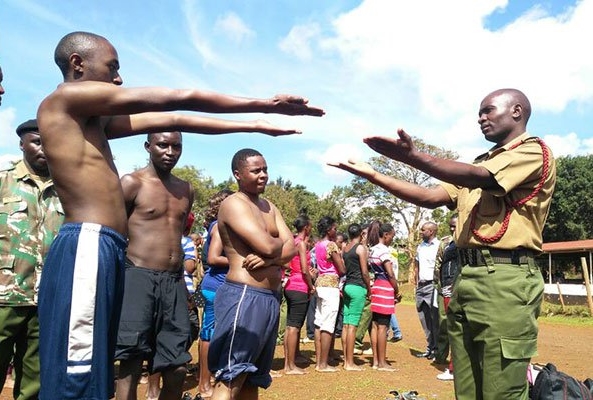
Panels were forced to improvise, often deviating from statutory requirements and relying on locally determined procedures instead of uniform guidance from the National Police Service Commission (NPSC).
Police recruitment exercises in Coast counties such as Kwale, Kilifi and Mombasa were marred by corruption, manipulation and academic fraud, a new report shows.
The report dubbed ‘‘Policing the Police: Safeguarding Transparency and Merit in Kenya’s Recruitment Process’’ by Human Rights Agenda (Huria) shows that observers witnessed widespread procedural violations, including arbitrary candidate removals, forged academic documents and weak oversight that undermined fairness and transparency in the process.
More To Read
- Man held in Kilimani over Sh2.5 million police recruitment scheme
- IPOA decries low turnout in police recruitment, recommends two-day exercise
- IPOA launches nationwide monitoring of police recruitment to ensure fairness, transparency
- Construction works force last-minute shift in Kamukunji police recruitment venue
- Court lifts orders that stopped police recruitment, exercise to continue Monday
- Audit reveals 200,000 police officer shortfall amid rising security demands
Huria deployed observers to 10 of the 21 recruitment centres across the Coast region and found persistent non-compliance with constitutional standards, statutory procedures and judicial directives governing public recruitment. The report noted that the November 2025 recruitment, conducted under unusual constraints after conservatory court orders were lifted just three days before the scheduled date, limited outreach to potential applicants and caused confusion at several centres.
Panels were forced to improvise, often deviating from statutory requirements and relying on locally determined procedures instead of uniform guidance from the National Police Service Commission (NPSC).
Huria Executive Director Yusuf Lule Mwatsefu said field observations in Kwale, Kilifi and Mombasa counties confirmed failures highlighted in past petitions, noting that oversight remained largely unaddressed.
“Even in the presence of well-trained observers, the process revealed systemic deficiencies that undermine fairness, transparency, and public trust in the National Police Service (NPS),” he said.
The report also revealed serious panel composition failures, particularly the systemic absence of Education Officers, which contributed to academic fraud.
“This year, the gap directly contributed to academic fraud, including a documented incident involving forged certificates at the Vigurungani/Kinango recruitment centre. Independent observers have historically noted that the absence of technical experts not only undermines the authenticity of academic vetting but also exposes panels to manipulation and undue influence. The 2025 recruitment confirmed the persistence of this risk,” reads the report.
Integrity safeguards were also inconsistently applied. Huria notes that the Oath of Integrity, emphasised by courts and oversight bodies as a critical governance tool, was administered in only two of the 10 observed centres.
“The majority of the centres proceeded without taking the oath,” reads the report.
The group also documented attempts to reintroduce disqualified candidates, renewed allegations of bribery and the presence of brokers near recruitment grounds.
“Predictably, the gaps in integrity safeguards coincided with renewed allegations of bribery, the presence of brokers near recruitment grounds, suspicious interactions involving panel members, and apparent attempts to reintroduce disqualified candidates,” Mwatsefu said.
The report also cited ethnic-based discrimination at Vigurungani, where candidates were removed because their community was deemed “too many,” violating Article 27 of the Constitution. In Msambweni, the report notes, a successful candidate’s selection was reversed without documentation or explanation.
“Courts have repeatedly ruled that recruitment decisions must be accompanied by clear reasons and proper documentation, yet this principle remains unimplemented,” reads the report.
Observers noted that recruitment centres lacked complaint desks, registers or formal avenues for appeal. Centres abandoned the official online system without formal authorisation, introducing Inspector-General-issued forms that contradicted NPSC procedures. Candidates were also reportedly forced to print documents at their own cost, violating regulations prohibiting financial burdens on applicants.
The report, however, notes that operational capacity varied across centres. Kikambala and Changamwe were well organised, with clear demarcation of spaces, efficient candidate flow and unrestricted observer access. Msambweni provided an on-site ambulance, while Mvita ensured first-aid support. In contrast, Vigurungani was disorganised, Likoni lacked toilets and a complaint desk, and Baraza Park allowed unauthorised individuals into verification areas. Physical testing, medical assessments and documentation of results were inconsistently applied, undermining fairness and credibility.
Huria further states that gender and diversity outcomes were inconsistent. For instance, Kikambala fell short of the two-thirds gender requirement under Articles 27 and 232, while some centres admitted orphans and children of fallen officers. At Vigurungani, two candidates were removed for being part of an overrepresented ethnic community, violating constitutional protections.
The group highlighted pervasive documentation weaknesses such as no formal registers of complaints or disqualifications, no written explanations for decisions and no published final results.
“These gaps undermined the legal validity and auditability of the recruitment process,” reads the report.
Huria has now called on the National Police Service Commission (NPSC) to publish the complete vacancy allocations and the reinstatement of shortlisting procedures to ensure fairness.
Education Officers, the report noted, must be deployed to every recruitment centre to guarantee credible academic verification, while panels should receive uniform training and be required to take the Oath of Integrity.
Huria also recommended that the NPSC implement systematic gender and diversity policies, and institutionalise formal complaint-handling mechanisms with proper documentation and clear escalation processes. Anti-corruption safeguards, including improved oversight, surveillance and independent reviews, should be strengthened, and officers should no longer be deployed in their home sub-counties to reduce conflicts of interest.
The civil society group further advised the inclusion of community stakeholders in oversight, allocation monitoring and strategic litigation where breaches occur. Recruitment criteria, it said, should adopt context-sensitive height and weight standards and transition from a purely physical assessment to a competency-based model evaluating integrity, psychological readiness and decision-making capacity.
It also recommended that medical screening be streamlined through pre-recruitment checks at accredited government facilities, while mini-recruitments be conducted locally in centres that fail to meet quotas.
Top Stories Today