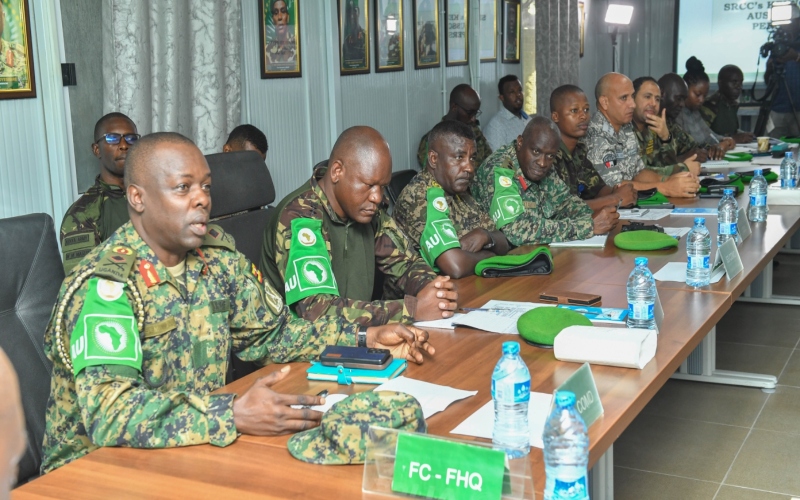
A decision by the United States to oppose continued UN logistical support for the African Union Support and Stabilisation Mission in Somalia (AUSSOM) could effectively bring the mission to an end, according to a new analysis that warns it is unlikely to survive beyond December 2026 without UN backing.
In a letter to the African Union dated July 1, the US said that “despite more than a decade of international support, Somalia has been unable to sustain progress against al-Shabaab, take ownership of its security functions, or undertake serious security sector reform.”
The letter cited internal rivalries and political infighting as factors undermining the fight against al-Shabaab and ISIS. It added that unless Somalia's leaders unite to address the country's security and governance challenges, international support will continue to have a limited impact.
Although the US has not formally commented on the contents of the letter, recent remarks by the head of the US Africa Command, General David Anderson, suggest a broader shift in Washington's approach. Anderson said the US would increasingly play a supporting role by providing capabilities that African partners may lack while allowing long-term solutions to be driven by African countries themselves, signalling a strategy focused more on conflict containment across the continent.
Speaking specifically about the fight against Al-Shabaab, Anderson said that beyond the ongoing air campaign — which has seen AFRICOM conduct 69 airstrikes alongside Somali forces this year — "there has to be a Somali solution and a regional solution to that problem."
The United Nations Support Office in Somalia (UNSOS) currently provides non-lethal logistical support to AUSSOM personnel deployed across south-central Somalia.
Its assistance includes food, water, fuel, medical care and emergency evacuations, engineering, transport, aviation, communications, equipment maintenance, training, environmental support, and the deployment, rotation and repatriation of troops.
UNSOS also reimburses troop-contributing countries for self-sustainment costs and equipment, while supporting explosive hazard management through the UN Mine Action Service (UNMAS).
Without that support, independent pan-African policy research and training think tank Amani Africa says the AU is unlikely to sustain the mission beyond December 2026, when its current mandate ends.
In its analysis, Amani Africa argues that the planned transition and gradual drawdown outlined in AUSSOM's Concept of Operations (CONOPS), which envisioned a final exit in December 2029, is now unlikely to be achieved because of persistent financial constraints that have affected the mission since its inception.
“The announcement by the US has come at a time when financial, operational and political sustenance of the mission has increasingly become a major area of policy concern on the part of the AU, as revealed in the analysis of the 1342nd session of the Peace and Security Council (PSC). Financially, despite the conservative USD 166.5 million budget of the mission for the June 2025 to July 2026 period, only a fraction of the budget was raised, even after various efforts.”
“To make matters worse, AUSSOM inherited substantial debt from its predecessor, the African Union Transition Mission in Somalia (ATMIS). Outstanding arrears owed to TCCs from 2022 to 2024 amount to USD 93.9million.
The mission had to find ways of accommodating the USD 130 million reduction from the approved UNSOS budget of USD 520 million for the financial year June 2025 to July 2026,” Amani Africa notes.
During the Peace and Security Council session, members expressed deep concern over the lack of predictable, adequate and sustainable financing for AUSSOM.
They recommended using part of the interest generated from investments held in the AU Peace Fund, including the Crisis Reserve Facility (CRF), to "substantially" help bridge funding gaps in the mission's 2025 and 2026 budgets.
Even so, the think tank argues that “any amount of such manoeuvre on the part of the AU is therefore unlikely to save the mission beyond December 2026.”
It recommends that the AU use the remaining months before December 2026 to prepare an orderly exit plan for AUSSOM while exploring a short-term transitional security arrangement with the United Nations, troop-contributing countries and the Somali government.
Amani Africa further notes that if AUSSOM ends, Somalia is likely to rely more heavily on bilateral partners, including Turkey, to help fill the resulting security gaps.
“Thus, beyond managing the consequences of the end of UNSOS, the notice that the US gave could be used as an opportunity for the much-needed shift of the primary focus of AU support to be on the primacy of politics in the search for resolving the crisis in Somalia. This would mean adopting as part of the existing plan a strategy for transitioning AUSSOM into a political mission in the same way the AU transitioned its mission in Mali into the AU Mission in Mali and the Sahel (MISAHL),” the analysis adds.
Under such a transition, the mission would shift its focus towards national reconciliation, security sector reform and a Somali-led political settlement aimed at preserving the gains made against al-Shabaab.










































Comments
Sign in with Google to comment, reply, and like comments.
Continue with Google