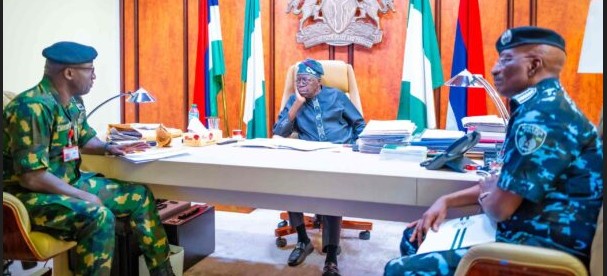
Nigeria’s President Bola Ahmed Tinubu has said the country’s military has killed more than 13,000 fighters over the past year in ongoing operations against armed groups and criminal gangs.
In a national address marking the country’s Democracy Day on Friday, Tinubu said security conditions had improved since he assumed office in 2023, claiming an 81 per cent drop in violence during that period.
Democracy Day, observed annually on June 12, marks Nigeria’s return to civilian rule in 1999 after years of military dictatorship and is often used by political leaders to reflect on governance, national stability and institutional progress.
“124,000 fighters and dependants have laid down their arms since 2023 through Operation Safe Corridor,” Tinubu said, according to Al Jazeera, referring to a government rehabilitation programme for former militants who surrender voluntarily.
Nigeria has long been a hotspot for insurgent activity, with extremist groups including Boko Haram and Islamic State West Africa Province (ISWAP) conducting attacks against civilians, security forces, and infrastructure for more than a decade.
Kidnappings have also become a persistent tactic used by armed groups and criminal gangs, with schools, rural communities and travellers frequently targeted for ransom across parts of the northwest and northeast, contributing to widespread insecurity and displacement.
Earlier this week, the Nigerian army reported rescuing over 360 people kidnapped by Boko Haram militants earlier this year.
Military operations in the area have intensified in recent years as Nigerian authorities, supported by international partners, including the US, attempt to contain the insurgency and prevent its spread across the Lake Chad Basin.
In February, nearly 100 US troops were deployed to Nigeria as part of a limited support mission aimed at strengthening the country’s counterinsurgency capabilities. On Thursday, for instance, Nigeria, alongside the US Africa Command (AFRICOM), reported killing over 200 fighters aligned to ISIS.
The deployment involved personnel and equipment sent to the north-eastern region of Bauchi State, where they were integrated into training and intelligence-sharing arrangements with Nigerian forces.
According to Nigerian officials, the deployment was carried out at the request of the Nigerian government and was designed to improve coordination in ongoing operations against armed groups operating across the country’s north and northeast.















Comments
Sign in with Google to comment, reply, and like comments.
Continue with Google