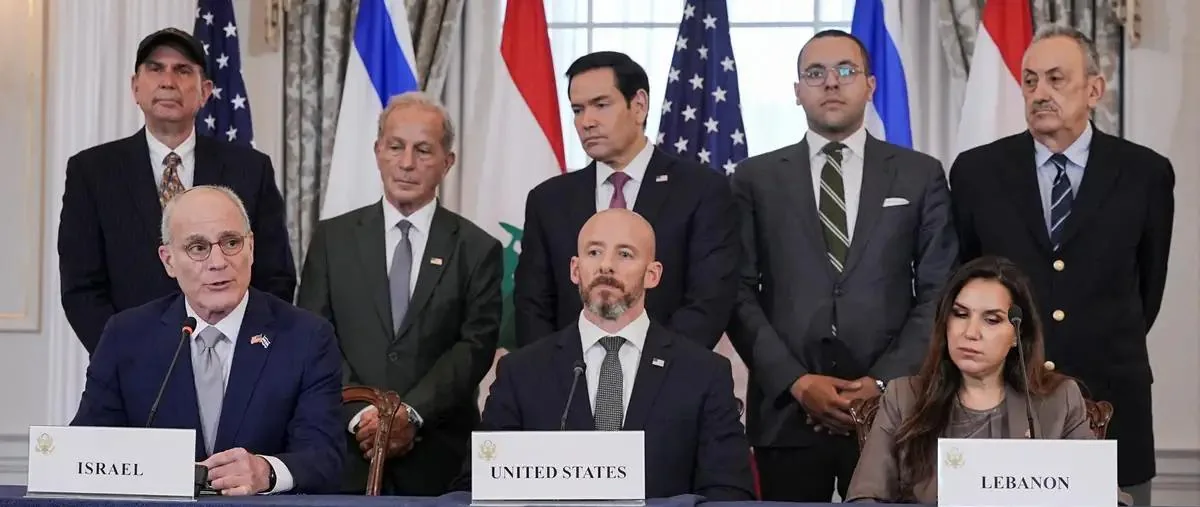
US Secretary of State Marco Rubio on Friday announced a framework agreement between Israel and Lebanon following several days of talks in Washington.
"We are happy to announce a framework agreement between the sovereign government of Lebanon and, of course, the government of Israel, with the mediation and support of the United States of America," Rubio said at the signing ceremony.
He added that the agreement "begins to put in place a framework for lasting peace and security."
The US-mediated talks aimed at ending the fighting between Israel and Hezbollah, an Iran-backed Shiite militant group in Lebanon.
Lebanon was drawn into the Middle East war on March 2, when Hezbollah launched rockets into Israel in retaliation for US-Israeli strikes on Iran.
Hezbollah has dismissed the peace initiative and was not part of the US-mediated talks.
What's in the framework agreement between Lebanon and Israel?
The officials did not share details of the agreement and did not say how its terms would be different from those set in an April 16 ceasefire deal.
Nada Hamadeh, the ambassador of Lebanon to the United States and Yechiel Leiter, the Israeli ambassador to the United States, signed the trilateral document with the US at the State Department in Washington.
The agreement is the result of five rounds of negotiations in Washington - the first direct political-level talks between the two sides since 1983.
Earlier, the Reuters news agency reported that the negotiations included discussions on a proposal for Israeli forces to hand over some of the territory they occupy in southern Lebanon to the Lebanese military.
Israel has maintained what it described as a security buffer zone extending about 10 kilometres (six miles) into southern Lebanon. Israel recognises Hezbollah as a terror organisation and believes the security zone is necessary to protect northern Israeli communities from Hezbollah attacks.
Lebanese authorities have condemned the security zone as an occupation and infringement on Lebanese sovereignty.
Lebanese President Joseph Aoun said the "framework agreement signed today is a first step" that will help Lebanese "to return to their fully liberated lands and to their certainly rebuilt homes... under the sovereignty of the Lebanese state that has no partner in its sovereignty over its land and people."
Israel's ongoing operations in Lebanon
Shortly after the agreement was announced, Israeli Prime Minister Benjamin Netanyahu said in a pre-recorded video shared with Israeli media that "we are maintaining the original security zone at all times, outside the range of anti-tank fire. We are not allowing Hezbollah to enter it, nor are we allowing the civilian population to enter."
Israel and Hezbollah have accused each other of violating the ceasefire that was announced in April and has since been extended several times.
Ahead of the latest round of talks in Washington, both sides agreed to halt fire.
The interim agreement between the US and Iran— Hezbollah's main backer — also stipulates "the immediate and permanent termination of military operations on all fronts, including in Lebanon."
Hezbollah says Lebanese authorities cannot enforce deal without 'civil war'
Hassan Fadlallah, a Lebanese Hezbollah lawmaker, strongly criticised the deal.
Fadlallah said the Lebanese government "will be unable to impose the implementation of the agreement signed in Washington unless they go, with American support, to civil war."
Fadlallah said, "What happened in Washington is an attempt to disrupt the Islamabad path," referring to the initial US-Iran deal brokered by Pakistan. Point 1 of the US-Israel Memorandum of Understanding ensures the "territorial integrity and sovereignty of Lebanon."


































Comments
Sign in with Google to comment, reply, and like comments.
Continue with Google