Google raises AI stakes as OpenAI struggles to stay on top
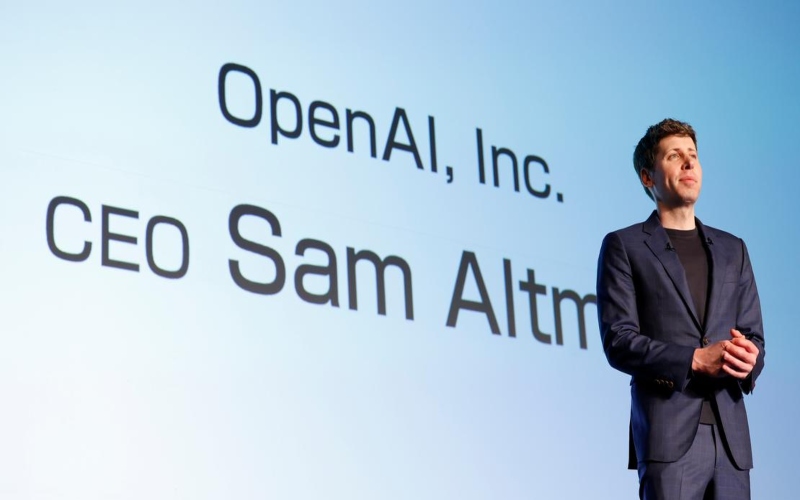
Google's new Gemini 3 model challenges OpenAI's dominance in the global artificial intelligence (AI) race. As rivals invest billions and competition grows, OpenAI faces pressure to innovate - and finally turn a profit.
According to media reports, OpenAI plans to unveil a new artificial-intelligence reasoning model this week that is reportedly surpassing Google's latest, most advanced family of AI models, Gemini 3.
Online tech magazine The Decoder cites industry insiders who claim the launch is intended to counter Google's recent advances in state-of-the-art reasoning, deep multimodal understanding of text, images and video, as well as Gemini 3's powerful coding capabilities.
More To Read
- Google Photos rolls out redesigned video editor for Android and iOS
- Google launches Workspace Studio, enabling anyone to build Gemini-powered AI agents
- ChatGPT could soon tap into Apple Health data for personalised wellness insights
- Gulf region paves the way to become digital data hub
- Apple names new AI chief amid pressure to catch up
- Google tests dual-band hotspot for Android phones
Google's parent company, Alphabet, introduced Gemini 3 in November, boasting benchmark results that surpassed OpenAI's flagship model ChatGPT in key categories.
The outcome rattled OpenAI, which has been viewed as the industry front-runner since ChatGPT's debut in 2022 transformed public awareness of generative AI and briefly left competitors scrambling.
Now, OpenAI's lead is no longer assured.
A 'code red' moment for OpenAI
The reaction inside OpenAI has been urgent, with CEO Sam Altman reportedly declaring a "code red" in an internal message, instructing teams to focus on improving the quality of ChatGPT and delaying other products as a result, according to the memo cited by the US business newspaper The Wall Street Journal.
"We've reached a point where it's not only about having the best model, but also about access to computing power and the ability to turn that technology into revenue," Adrian Cox, an analyst at Deutsche Bank Research, told DW.
OpenAI gained an early edge thanks to a period in which its models outperformed any alternatives, he added, but competitors are quickly closing the gap - and many are backed by companies with enormous distribution networks and cloud infrastructure.
"Models like Gemini benefit from being tightly integrated into products that already reach huge online audiences, along with access to vast data-centre capacity," said Cox.
According to Altman, ChatGPT attracts more than 800 million weekly users. But Alphabet can deploy Gemini directly within Google Search, its most profitable product.
The Gemini app already reaches more than 650 million monthly users, Alphabet CEO Sundar Pichai wrote on Google's blog, adding that more than 70 per cent of its cloud customers are using AI tools.
"[Thirteen] million developers have built with our generative models, and that is just a snippet of the impact we're seeing," he wrote on November 18.
OpenAI still not carving a profit
While Google generates revenue across a wide portfolio of operations, OpenAI must monetise its AI models directly. It currently relies on premium ChatGPT subscriptions and enterprise licensing. Microsoft, a major shareholder, also pays to embed OpenAI technology into its products.
Other Topics To Read
Even so, Altman has acknowledged that the company is not yet profitable.
OpenAI does not disclose financials. But according to Cox, investors were told over the summer that 2030 could be the first profitable year for OpenAI.
HSBC analysts take a dimmer view, as the British financial newspaper, Financial Times, reported recently.
The bank projects revenue could reach $213 billion (Sh27.5 trillion) by 2030 - but still this would likely result in a loss of more than $70 billion (Sh9 trillion) due to soaring infrastructure costs.
Massive AI investment needs
Training and running cutting-edge AI systems demand huge outlays for data-centre capacity.
Google plans to invest up to $93 billion (Sh12 trillion) in AI this year alone, with "significant increases" earmarked for the years to come. The fourth-quarter revenue of its parent Alphabet exceeded $100 billion, fueled largely by advertising and growing cloud demand.
Google also has a hardware advantage, as its proprietary AI chips support model training inside company-owned data centres, thus avoiding purchases of more expensive semiconductors from AI-chip market leader Nvidia.
Facebook's parent company, Meta, has reportedly expressed interest in using Google's processors for its own AI infrastructure.
Given those strengths, Adrian Cox sees "a very high probability" Google will have the leading model at least into next year - not OpenAI. OpenAI's priority, he said, is identifying a business model capable of funding a user base that could soon approach a billion people per week.
"It's uncertain how that will work in practice. Subscription revenues alone may not be enough to cover costs," he said, noting the company is exploring other revenue streams.
Competition widens beyond Big Tech
Meanwhile, the race for AI leadership is no longer limited to the two Silicon Valley contenders. "Competition has intensified significantly since 2022. We now see strong challengers for the best model like Anthropic alongside established companies like Google," Cox said.
Open-source models from the US, China, and Europe - including from European startup Mistral - are also gaining traction. These systems are smaller and cheaper than OpenAI's offerings, designed for targeted applications rather than broad capability.
"Customers today have a very wide range of options — from highly advanced models to lightweight, fast, cost-efficient open-source systems," said Cox, and added that forthcoming ChatGPT-5 may be the most versatile model currently in development, but its complexity makes it "expensive to operate and less tailored to specific user groups."
Additionally, China's AI companies are also pushing forward. In September, search-engine provider Baidu unveiled its DeepSeek model, claiming performance on par with ChatGPT-5 and Google's Gemini 2.5 Pro.
Can Europe keep up with the US, China in the high-tech race?
Analysts say the country is once again leaning on aggressive pricing strategies to undermine competitors in foreign markets — a tactic previously used in solar, steel and electric vehicles.
Nvidia CEO Jensen Huang warned in November that China is "only nanoseconds behind America in AI."
Across the industry, Cox sees a diverging ecosystem forming as the market is splitting between "smaller, customizable open-source models that are cheap to run, and the large, sophisticated proprietary models."
Yet, he doesn't expect a winner-take-all outcome. "The more [artificial] intelligence becomes available, the more user applications will emerge."
Top Stories Today