The African Union has welcomed a landmark vote at the United Nations General Assembly recognising the transatlantic slave trade and the trafficking of enslaved Africans as crimes against humanity, in what it describes as a step toward long-delayed historical justice.
In a statement issued on Thursday from Addis Ababa, the AU Commission Chairperson, Mahmoud Youssouf, praised Ghanaian President John Dramani Mahama for spearheading the resolution, saying his leadership reflects Africa’s “longstanding and principled call” for full recognition of slavery and its enduring consequences.
“This historic decision marks an important step toward truth, justice and healing,” the Chairperson said, framing the vote not as an endpoint, but as part of a wider continental push to confront the legacy of slavery.
That push has been formalised. The African Union has designated the period from 2025 to 2035 as the Decade of Reparations, an effort to consolidate a common African position on historical justice and press the international community to move beyond symbolic acknowledgement toward material redress.
The strategy is deliberate and layered. Individual African states, often constrained by economic dependencies and asymmetries with Western powers, have historically hesitated to pursue reparations claims unilaterally.
Acting collectively through multilateral platforms allows the continent to amplify its voice while diffusing political risk.
The UN resolution is one such instrument. Though non-binding, General Assembly decisions shape global norms and legal framing.
By defining slavery and the transatlantic trade in the strongest moral and legal terms, African states are laying the groundwork for future claims rooted in international law.
The vote itself revealed both unity and fault lines.
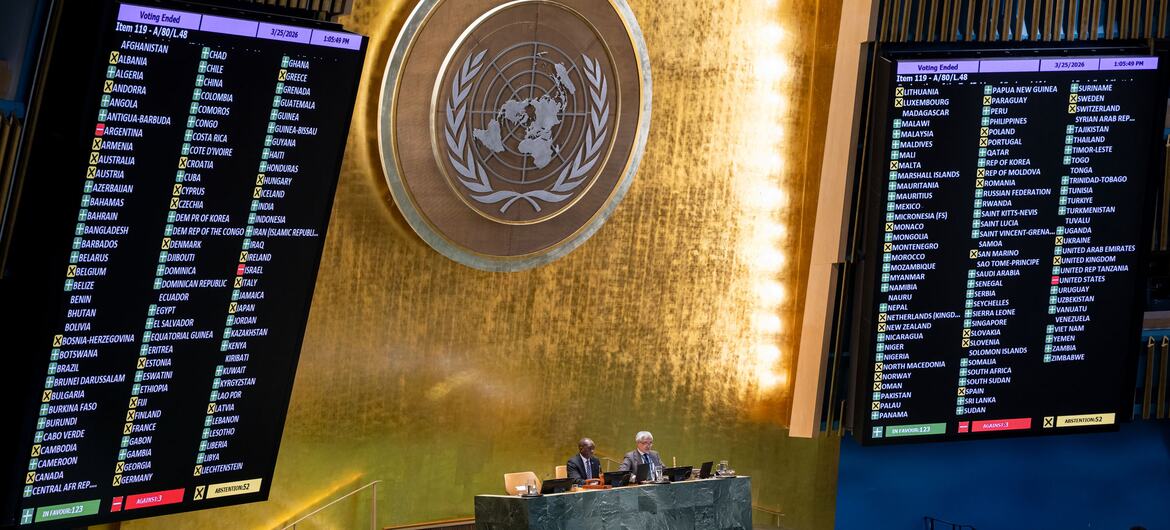
African countries voted overwhelmingly in favour, joined by a broad coalition across Latin America, the Caribbean and parts of Asia.
But resistance came from some of the world’s most powerful states. The United States, Argentina and Israel opposed the resolution, while several European countries abstained — a sign of unease over the potential legal and financial implications of such recognition.
Within Africa, the unity was nearly complete but not absolute.
Out of 54 African states, only Madagascar and Benin were absent when the vote was taken.
Their absence, recorded as blank entries in the UN’s official voting register, means they neither supported nor opposed the resolution.
Diplomatically, absence is softer than abstention. It avoids taking a formal position.
Yet in a vote so closely tied to Africa’s historical experience, even silence carries weight.
The irony is difficult to ignore. Benin, whose territory once formed the Kingdom of Dahomey, a central node in the transatlantic slave trade, has in recent years sought to confront that past, including initiatives to reconnect with descendants of enslaved Africans.
Madagascar, too, was historically embedded in systems of slavery, both as a source and site of enslavement.
Their empty seats, in a chamber otherwise aligned, highlight a broader truth about multilateral politics: unity is often strong, but rarely perfect.




















Comments
Sign in with Google to comment, reply, and like comments.
Continue with Google