Kenyan households sent a total of Sh40.5 billion in remittances during the period between June 2024 and May 2025, with students studying abroad receiving the bulk of the funds.
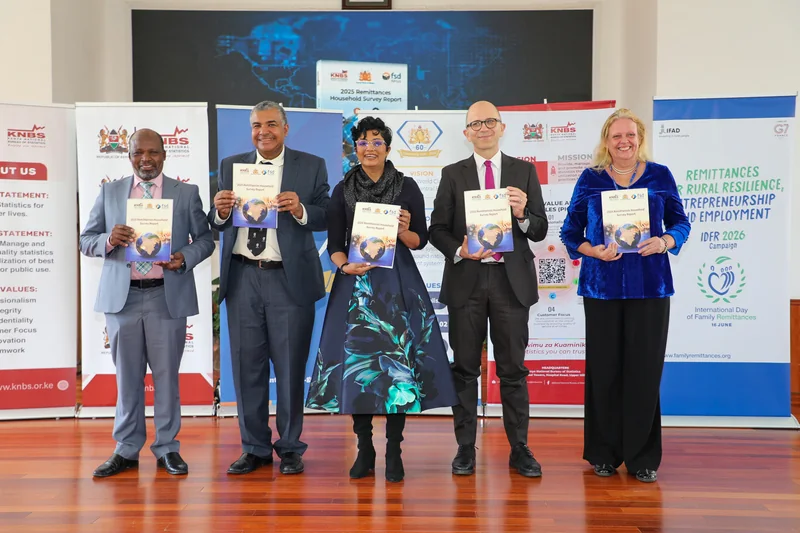
According to the 2025 Remittances Household Survey released by the Central Bank of Kenya (CBK) and the Kenya National Bureau of Statistics (KNBS), the students received more than two-thirds of the total share.
“These remittance flows were primarily directed to students abroad, who received more than two-thirds of the total, highlighting education as a major driver of outflows from Kenya,” reads the report.
Notably, the funds are largely used to cover tuition fees, living expenses, and settlement costs for relatives studying abroad.
Cash transfers accounted for 89.5 per cent of the total remittance outflows.
While households sent Sh40.5 billion abroad, they received a far larger amount of Sh931.8 billion in remittance inflows during the same period.
Cash transfers accounted for 91 per cent of inflows, with in-kind remittances making up the remaining nine per cent.
The United States remained the largest source of remittances into Kenya, contributing 43.5 per cent of total inflows, followed by Germany and Australia.
Formal financial channels continued to dominate remittance transfers, with banks and mobile money platforms accounting for more than 92 per cent of inflows.
The survey also identifies the United States, Saudi Arabia and Qatar as the fastest remittance corridors, with most transfers reaching recipients on the same day they were sent.
The report highlights that remittances remain a critical source of livelihood for many households.
About 42.3 per cent of households reported remittances as a supplementary source of income, while 36.4 per cent described them as additional income.
For 22.3 per cent of households, remittances were the main source of livelihood.
The survey further reveals a strong link between remittances and financial inclusion, with 82.5 per cent of recipients owning mobile money accounts and 55.4 per cent holding bank accounts.
However, uptake of investment-focused financial products remains low.
The findings underscore the need for policies that lower transfer costs, expand access to formal remittance channels and encourage the use of remittances in education, health and productive investments while strengthening diaspora engagement in Kenya’s economic development.
The survey, conducted in August 2025 by KNBS in collaboration with CBK and Financial Sector Deepening Kenya (FSD Kenya), is the first comprehensive effort to capture both remittance inflows and outflows at the household level.
The data complements existing administrative records from banks and mobile money operators and provides a broader picture of the role remittances play in household welfare and economic activity.


















































Comments
Sign in with Google to comment, reply, and like comments.
Continue with Google