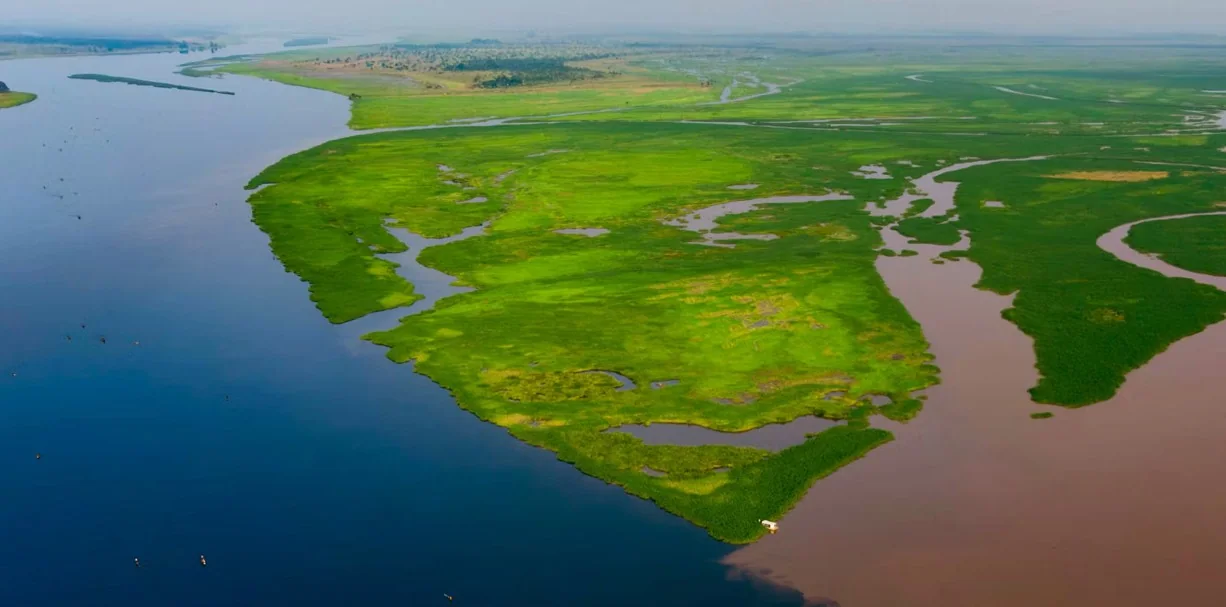
In the heart of the Congo Basin’s Cuvette Centrale, a large depression hosting the world’s biggest tropical wetland complex, lie two vast, shallow blackwater lakes,
Lake Tumba and Lake Mai Ndombe. Together, they are roughly the size of 420,000 football fields.
These lakes include extensive swamp forests and
peatlands that store enormous amounts of carbon and regulate water flows in the Democratic Republic of Congo. The floodplain lakes are shaped by rivers, wetlands and changing water levels over thousands of years.
The lakes’ waters are so dark because of dissolved organic matter that has seeped in from the surrounding swamp forests, very much like black tea. Underlying the swamp forests is peat – highly organic soil which has accumulated over millennia from the slow decomposition of waterlogged plant material.
These important
peatlands cover only 3 per cent to 5 per cent of the global land surface. But they are estimated to store about
a third of the world’s soil carbon.
We are scientists who investigate how ecosystems respond when forests, grasslands and other natural areas are converted to different uses.
Together with our co-author Jose N. Wabakanghanzi of Congo’s Atomic Energy Commission, we travelled to
Mai Ndombe and Tumba to take samples of sediments from the bottom of the lakes.
We also took samples of the greenhouse gases and dissolved carbon from the lake water.
We stumbled upon a surprise: the lake water contained large quantities of ancient carbon dioxide. After various complex chemical analyses, we found that this ancient carbon dioxide must be from the surrounding peat, which is leaking carbon into the lake. (By analysing the chemical signature of the carbon, we could tell it came from peat that had been stored underground for thousands of years rather than from recently decayed plants.)
The ancient carbon dioxide leaks are not dangerous, but are worth investigating because it is important to monitor the ecological health of this important area.
About two million people live in and around this region and depend on it for fishing, transport, household water, farming and harvesting forest products such as fruits, medicinal plants and timber.
The lakes and connected rivers are important transport routes linking remote settlements. The region is also home to rich biodiversity, including hundreds of fish species, crocodiles, hippos, forest elephants and a wide variety of birds.
Their ecological health matters not only to people living nearby but also to efforts to conserve biodiversity and address climate change.
What our study found
Scientists have long believed that peatlands lock away carbon for thousands of years. This is because they are waterlogged, which slows down the way that plant matter decomposes.
But if those conditions change, microbes can start breaking down the stored carbon and release greenhouse gases such as methane and carbon dioxide into the atmosphere.
Our results show that these blackwater lakes in the peatland act like chimneys, constantly releasing a small fraction of this ancient carbon back into the atmosphere. We have not found this documented in any other scientific studies.
Although these results were surprising, we emphasise that this discovery is likely not a climate emergency.
While environmental changes have the potential to destabilise the surrounding peatlands, it is more likely that this release is part of a perfectly natural cycle, one where a very tiny amount of carbon is lost but is balanced by more peat forming and locking in more carbon.
We don’t know if this is unique to the Congo Basin or occurs in other major peatland regions. And we don’t know exactly what it implies for the carbon dynamics in the Cuvette Centrale.
The discovery of this natural pathway for releasing ancient carbon from the peatland underscores how much scientists still need to learn to achieve a sustainable balance between human development and the long-term conservation of these natural ecosystems.
Greenhouse gases being released by Congolese lakes pose no risk
The greenhouse gases released by these Congolese lakes are not toxic in these quantities.
Very rarely, other kinds of tropical lakes do release large plumes of carbon dioxide or methane. These are mainly very deep lakes connected to volcanic sources of greenhouse gases that can experience an abrupt lake overturn.
This is a sporadic natural event that releases dissolved gases into the lake, potentially causing suffocation in people and livestock.
It happened in Cameroon in
1984, at Lake Monoun, killing 37 people, and in
1986 at Lake Nyos, where 1,800 people died of suffocation.
Lake Tumba and Mai-Ndombe in the DRC are a different kind of lake, much too shallow for extreme gas concentrations to build in their depths and result in this abrupt outgassing.
When we released
our research recently, there was a worrying amount of misinterpretation of our results.
Yahoo News wrongly described our research as a warning that an “‘ancient’ threat could soon be released”. Even a local Congolese publication
falsely reported that a toxic gas leak had happened one hour from Kinshasa.
Whether this clear misinformation was spread due to “sensation” seeking journalism or because of a fundamental misunderstanding of the science presented cannot be said.
What is important here is that careful science communication, which serves to bridge the gap between scientists and the public, is essential for science-based practices and policies.
To avoid misunderstanding, science and media should collaborate to clearly communicate the key nuances and limitations of complex findings. Readers can also help by critically evaluating media coverage through tracing back the sources, looking at the original press release and ideally, reading the scientific paper itself.
***
Matti Barthel, Research Technician,
ETH Zurich;
Antoine de Clippele, Scientist,
ETH Zurich;
Johan Six, Professor of Sustainable Agrosystems,
ETH Zurich, and
Travis Drake, Postdoctoral Researcher,
ETH Zurich
This article is republished from
The Conversation under a Creative Commons license. Read the
original article.




































Comments
Sign in with Google to comment, reply, and like comments.
Continue with Google