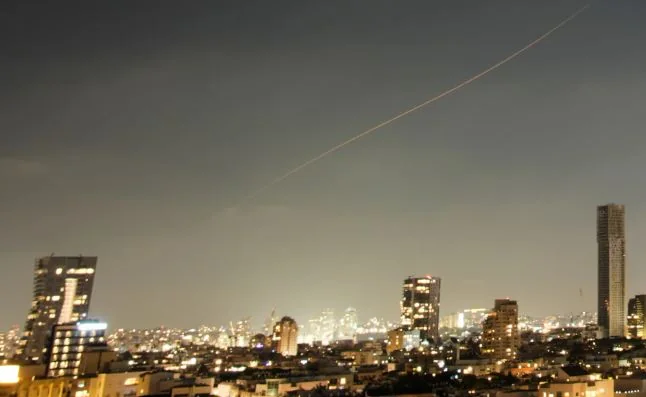
Explosions rocked Iran’s capital, Tehran, and the cities of Tabriz and Isfahan early Monday after Israel’s military launched attacks on the country.
The bombardment comes after Iran launched a wave of missiles at northern Israel, accusing Israel of repeated violations of the ceasefire with its attacks on Lebanon.
Iran had closed the airspace over the west of the country on Sunday following its attacks on Israel in response to the latest strike on Lebanon.
Iran's attacks came after Israel launched airstrikes on Beirut's southern suburbs earlier in the day, which Lebanon's Public Health Emergency Operations Centre said killed at least two people and injured 20 others.
"Due to safety and security assessments... the western part of the country's airspace was declared closed until further notice," said Majid Akhavan, the spokesman for the National Civil Aviation Organisation, in a statement carried by the news agency IRNA.
According to Iran's Tasnim News Agency, Iran announced on Sunday night the closure of its western airspace until further notice. An IRNA report said that Iran also suspended flights at Imam Khomeini International Airport.
Amidst the renewed regional tensions, Iraq announced on Sunday night the temporary closure of its airspace to all flights for 72 hours as a precautionary measure. Syria said it had closed its southern air routes for 12 hours and suspended operations at Damascus International Airport.
Iran's Islamic Revolution Guard Corps confirmed in a statement that it targeted Israel's Ramat David Airbase with ballistic missiles in response to its "widespread crimes" in Lebanon.
According to Iran's semi-official Fars news agency, Chief Commander of Iran's Khatam al-Anbiya Central Headquarters Ali Abdollahi said Sunday night that if Israel expands its attacks on southern Lebanon and the Dahieh district south of Beirut, or responds to Iran's actions, it will face more "crushing and regret-inducing blows."
In a statement released in the wee hours of Monday, Iran's Foreign Ministry said that the Iranian armed forces struck several targets inside Israel the night before, within the framework of the country's legitimate right to self-defence, following Israel's repeated "aggressive actions" against Lebanon and Iran and frequent violations of the April ceasefire.
IDF spokesperson Effie Defrin said that Iran has made "a grave mistake" by firing missiles at Israel, adding that the military is prepared for more possible missiles.
Following the Iranian attacks, Israel's Home Front Command tightened civil defense restrictions across the country, banning gatherings of more than 200 people in open areas.
Indoor gatherings are limited to up to 500 people in venues with a standard protected space, while schools and beaches are also closed, it said, noting that the instructions took effect immediately.
Israel's Coordinator of Government Activities in the Territories announced later that several crossings into Gaza have been closed until further notice following the Iranian missile attacks.
Also on Sunday evening, Iran's Foreign Minister Seyed Abbas Araghchi discussed the latest developments in the region with his counterparts in Britain, France, and Türkiye, as well as with Qatar's leader and Pakistani mediators, according to Iran's IRNA news agency.
During the separate conversations, they discussed Iran's response to Israel's "repeated violations of the ceasefire in Lebanon," according to the reports.
Also on Sunday, Jordanian Minister of Government Communication Mohammad Al Momani said on the social media platform X that Jordan's airspace was breached by several missiles at night.
Iraqi militia Kata'ib Hezbollah, an ally of Iran, threatened on Sunday night to attack US military bases and interests if the United States strikes Iran, while Yemen's Houthi group voiced support for the Iranian attacks against Israel.
In response to the Iranian attack, US President Donald Trump said on Sunday that he would call Israeli Prime Minister Benjamin Netanyahu to urge him not to strike back because he did not want US-Iran ceasefire negotiations to collapse, according to Israel's Channel 12 News.
On February 28, the United States and Israel launched a large-scale military campaign against Iran, plunging the Middle East into renewed warfare and sending shockwaves across the world.
In early April, the parties reached a ceasefire, yet the situation has remained tense. Iran insists that the ceasefire should also include an ending of fighting in Lebanon, but Israel has recently escalated its military campaign in Lebanon in pursuit of Hezbollah.
Following the latest flare-up, the IDF said it would continue to operate "across Lebanon" and intensify its operation against the Iran-backed militant group.


































Comments
Sign in with Google to comment, reply, and like comments.
Continue with Google