Childhood on Edge: How shrinking play spaces put Kenyan children in danger on the roads
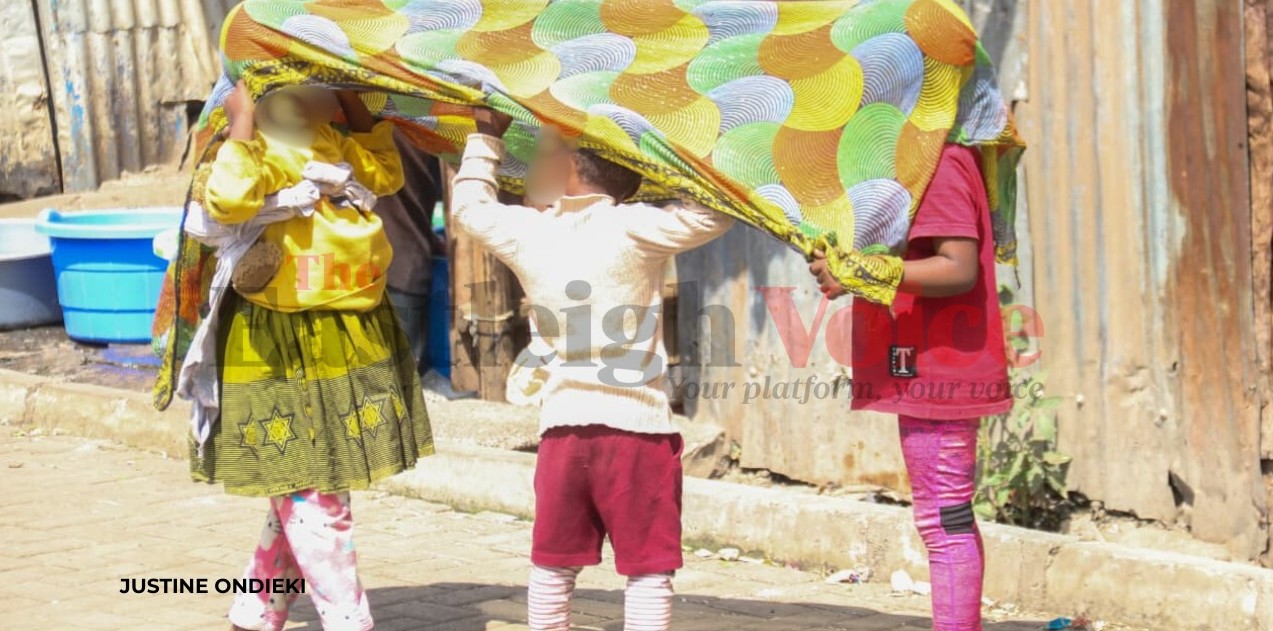
As playgrounds disappear in Kenyan cities, children are pushed onto roads to play, heightening crash risks. Parents, riders and hospitals now face growing safety, cost and responsibility pressures.
As cities expand and concrete replaces open fields, childhood itself is being pushed to the margins. Spaces where children once ran freely have shrunk into narrow corridors of apartments, fenced plots and paved streets.
With nowhere else to play, children now spill onto the roads—quietly transformed into their makeshift playgrounds. They run between cars, chalk games on the tarmac, and chase footballs that bounce dangerously close to moving traffic.
More To Read
- 62 PSV drivers suspended over safety violations, ordered to re-test by NTSA
- High-rise living in Nairobi’s Pipeline estate is stressful: How men and women cope
- The hidden risks of sharing children’s lives online
- Omtatah pushes Senate to act on road safety as deaths surge past 4,000
- Regional transport chiefs meet in Mombasa as road deaths surge across Africa
- Kamukunji security meeting targets drug abuse, boda boda crime and juvenile delinquency
For many families, these roads have become the most accessible—and, sadly, the cheapest—option for play.
For Aziza Osman, this reality brings a constant ache in her chest. Almost every day, she finds herself shouting, pleading, and sometimes even punishing her sons to keep them off the road. Yet despite all her warnings, she occasionally discovers them laughing with other children, kicking a ball near the road, or racing along as if danger does not exist.
Aziza knows danger all too well.
Living with a disability, she understands how quickly life can change in an instant. But as a single mother, she faces a painful dilemma. If she stays home to watch her children, there is no food.
If she goes to the market to earn a living, she risks returning to find them playing inches from passing vehicles. She carries the entire weight of survival alone, forced each day to choose which risk is greater.
Group comfort
“In our estate, children always move in groups, and sometimes that’s the only comfort,” she says. “But one day, I found my son standing in the middle of the road like a little boss, and other children were cheering for him. As a mother, I was shaken. My heart almost stopped.”
The safe spaces that once existed have either disappeared or been turned into private grounds. The few that remain now demand monthly fees—something Aziza can barely afford. She wants her children to have safe places to play, but survival does not always allow such luxuries.
“My son recently told me that the field they were using now charges 1,000 shillings for regular access,” she recalls. “When I went to see for myself, I found a crowd of children playing outside the gate, in the road, because they couldn’t afford to go in.”
Even schools, she says, have begun requesting extra money for play activities—another small but painful burden on families already stretched thin.
“While I might want to watch my children every moment, I’m torn,” she says. “I have to look for food, pay school fees… and I don’t want to lock them inside with nothing but the TV. It’s a tough balance, and it breaks me sometimes.”
 With playgrounds disappearing, children are forced to play on busy streets, putting their safety at risk. (Photo: Justine Ondieki)
Safe childhood now a commodity
Her reality echoes through many homes—mothers holding fear in their throats, children chasing joy in unsafe spaces, and communities struggling as safe childhood becomes a commodity. It is a daily struggle between danger and necessity, survival and childhood, a mother’s love and a world shrinking around her children.
Maurice Oloo, a boda boda rider in Nairobi, has witnessed the trend growing. Every evening, as the sun sets and roads fill with commuters, children surge into the streets.
Some kick footballs across lanes; others dare each other to run in front of passing motorcycles—as if testing whether riders will hit them or swerve in time. What troubles Oloo most is that, in many of these moments, not a single guardian is in sight.
To him, the danger is twofold. First, the children are exposed to life-threatening accidents. Second, the riders—people simply trying to earn a living—often become targets of community anger when something goes wrong. In those moments, he says, no one asks the hardest question: Why was the child playing on the road in the first place?
“There was a time I had a minor accident,” he recalls. “Thank God the child wasn’t badly hurt. But when the parents came, they demanded that I take the child to the hospital and pay for everything… without stopping to consider their own responsibility.”
Recording social media content
Oloo has also noticed a new trend among teenagers, which leaves him even more uneasy. Many now crowd the roads with phones in hand, recording riders for social media content. They dart onto the tarmac to get the “perfect shot,” behaving as if the roads belong entirely to them, unaware that one wrong move could end in tragedy.
“When schools are in session, it’s a bit easier,” he says. “But now, children are everywhere—on main roads, estate roads, all over. And it’s dangerous for them and for us. Because if you hit a child, even by accident, you’re immediately blamed.”
Oloo speaks with the weight of someone who has witnessed too many close calls—too many small bodies running too fast, too many parents arriving only after an accident has occurred.
He urges caregivers to be present, to take responsibility, and to protect their children, especially when they gather in large, unmanaged groups.
“These children are not guarded most of the time,” he says. “And by the time we notice them, it could already be too late.”
A study conducted at Kenyatta National Hospital, titled “Pattern and Outcomes of Injuries Following Motorcycle Accidents in Children in Kenya”, reviewed cases of children under 18 treated for motorcycle-related accidents between 2014 and 2019.
Published through the University of Nairobi’s digital repository, the research analysed 254 cases and found that over half—approximately 51 per cent—were pedestrians struck by motorcycles, mostly while crossing the road.
 Caregivers are urged to watch over children, especially in large, unsupervised groups. (Photo: Justine Ondieki)
Severe injuries
The injuries were often severe. Head trauma was the most common, affecting around 43 per cent of the children, while fractures occurred in about 44 per cent of cases.
Nearly a third of patients sustained multiple injuries, and over 70 per cent required hospitalisation. The study also noted a small but significant proportion of deaths and lifelong disabilities.
Children involved in pedestrian accidents often face lifelong challenges affecting their bodies, minds, and social lives. Physically, they may suffer permanent disabilities, chronic pain, head injuries, or scarring that limits mobility and daily activities.
Psychologically, many experience PTSD, anxiety, depression, or a fear of roads, while social stigma and exclusion can erode self-esteem.
Heavy financial burdens
Education and play are often disrupted, and families bear heavy financial burdens from medical care and rehabilitation. These accidents create lasting ripple effects, underscoring the need for prevention and long-term support to help children recover and thrive.
According to the National Transport and Safety Authority, pedestrians remain the most vulnerable users on Kenyan roads, with 1,591 deaths recorded in 2023, only slightly lower than the 1,682 fatalities reported in 2022.
Boda boda riders also remain heavily affected, accounting for 1,133 deaths, while 739 passengers lost their lives, representing an increase from the previous year.
The overall picture is bleak: in 2023, 22,885 people were involved in road accidents—a significant rise from the previous year. Of these, 4,324 died, while thousands more sustained injuries, many of which will have long-term, life-altering effects.
NTSA statistics reveal a disturbing trend: pedestrians—ordinary Kenyans walking to school, work, or around their neighbourhoods—remain the most exposed and least protected on increasingly hazardous roads.
Top Stories Today