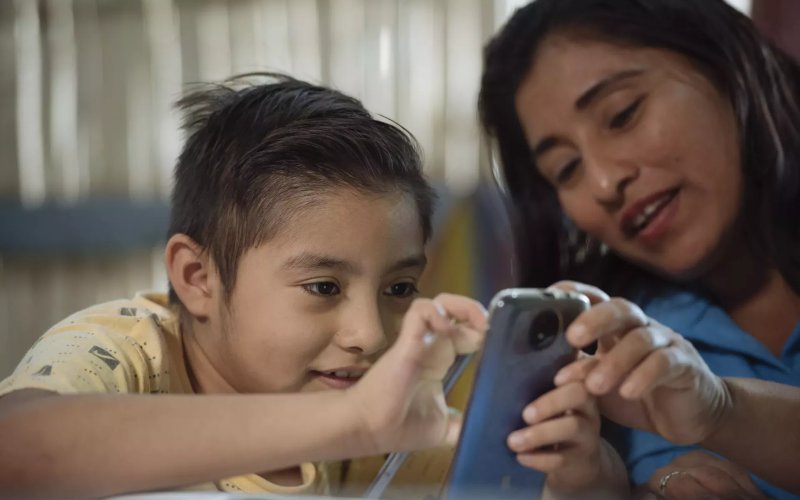
The UN agency mandated with providing humanitarian and developmental aid to children worldwide, UNICEF, has warned that children are outpacing adults in the adoption of artificial intelligence (AI), a technology that could shape their childhood for better or worse.
The agency's assessment follows an analysis of new data drawn from 10 countries, which revealed that at least 20 million children have used AI, with many adopting it at rates more than three times faster than adults, including their parents and caregivers.
“New evidence is laying bare the scale and speed of its uptake by children worldwide, while exposing the risks and divides emerging alongside it. More than 2 million children, or 1 in 10, said they turn to AI for advice on things that worry them, and an estimated 13 million children said they use it to support their learning and homework," the agency said.
The analysis adds that as children’s use of AI accelerates, the rules governing its use, including protections for children, are struggling to keep pace.
For instance, up to 50 per cent of surveyed children were found to already be using AI, with millions relying on it for homework and one in 10 turning to it for advice about things that worry them.
It, however, points out that while AI uptake is substantial among many children in the study, it remains uneven.
“AI is here. It is a growing part of all of our lives. And it is already shaping childhood around the world for better and for worse. Children are more exposed to AI systems, including how they are designed, their underlying business models, and how their own data is used, yet have far less power to avoid or challenge them. They feel the effects of weak governance first and will live with the consequences the longest. Yet most AI governance does not prioritise children,” the analysis adds.
UNICEF further notes that while AI has the potential to create opportunities for children to learn, play and be creative, evidence on its impact on cognitive development, emotional dependency, and exposure to harm is only beginning to emerge. In effect, a generation is growing up inside a global experiment.
Children themselves recognise the risks. Across the 10 countries, a third of children reported concerns about AI being used to scam and trick others or spread misinformation, while a quarter feared having their images or videos manipulated into sexually explicit deepfakes. Too many systems are reaching children with no guardrails, with safety seemingly an afterthought.
According to recent estimates published by UNICEF, AI was used to create fake sexual images or videos of at least 1.2 million children across 11 surveyed countries within the span of one year.
The agency is thus calling on governments, the private sector and partners to embed child rights, especially the right to safety and protection, in global AI governance by investing in research on AI's impact on children’s development and well-being, particularly the risks.
It also calls for the strengthening of laws, governance frameworks and corporate accountability to stop AI-enabled sexual exploitation and abuse and ensuring AI systems are designed with maximum safety and transparency so that all children are protected while benefiting from the opportunities AI offers.
UNICEF also urges governments and partners to build AI literacy, support children and their parents or caregivers to thrive in the digital environment, and invest in digital infrastructure and meaningful connectivity at home and at school to close the AI divide between and within countries.
“This is a decisive moment. The choices made about AI now will shape children’s safety, privacy, well-being, and equal access to opportunities for decades to come,” UNICEF added.
The countries included in the brief are Armenia, Brazil, Colombia, the Dominican Republic, Jordan, Mexico, Montenegro, North Macedonia, Pakistan and Serbia.

















































Comments
Sign in with Google to comment, reply, and like comments.
Continue with Google