Spain defeated defending champions Argentina 1-0 after extra time to win the 2026 FIFA World Cup, claiming the biggest prize in international football for the second time, exactly 16 years after lifting their maiden title in South Africa in 2010.
Ferran Torres scored the decisive goal in the 106th minute at New York New Jersey Stadium, converting from close range after Nico Williams' header fell kindly into his path, ending Argentina's resistance in a final that was dominated by Spain from start to finish.
Luis de la Fuente's side were deserved winners after controlling possession, creating the better chances and producing one of the finest defensive campaigns in World Cup history. Spain conceded just one goal throughout the entire tournament, the fewest by any World Cup-winning team, and extended their unbeaten run in all competitions to 38 matches, the longest ever recorded by a European or South American national team.
The triumph also completed an extraordinary period for Spanish football. Having won the UEFA Nations League in 2023 and the UEFA European Championship in 2024, Spain added the FIFA World Cup to make it three consecutive major international titles and six major honours across two golden eras, following their famous Euro 2008, 2010 World Cup and Euro 2012 triumphs.
The final itself, however, fell well short of the attacking spectacle many had anticipated.
Despite featuring Lionel Messi in what was expected to be his final World Cup appearance and teenage sensation Lamine Yamal playing in his first final, the match developed into a tactical battle filled with fouls, stoppages and defensive discipline.
Spain dictated the opening exchanges and repeatedly threatened through Lamine Yamal and Mikel Oyarzabal, both of whom forced important saves from Emiliano Martínez before halftime.
Argentina, meanwhile, struggled to create anything meaningful.
For the first time since detailed records began in 1966, the opening 45 minutes of a World Cup final produced only three total shots. More remarkably, Argentina failed to register a single attempt throughout the first half.
That trend continued after the break.
Lionel Scaloni's side spent long periods defending deep as Spain patiently searched for an opening.
By the end of normal time, Argentina had become the first team in FIFA World Cup final history to finish 90 minutes without recording a single shot, while also posting an expected goals (xG) figure of exactly 0.00.
Spain continued to push forward but repeatedly found Martínez in inspired form.
The Aston Villa goalkeeper denied Yamal, Oyarzabal and later produced outstanding saves from Nico Williams during extra time to keep Argentina alive.
Williams even thought he had scored late in extra time before his effort was ruled out following a foul by substitute Mikel Merino in the build-up.
The contest also became increasingly physical.
Spain repeatedly complained to referee Slavko Vinčić about what they believed was Argentina's aggressive approach.
The first booking arrived in the 41st minute when Lisandro Martínez brought down Oyarzabal. Moments later, the Manchester United defender was forced off injured after suffering a knock, ending his World Cup final after just 44 minutes. Nicolás Otamendi replaced him in central defence.
The decisive turning point arrived in stoppage time of normal time.
Already on a yellow card, Enzo Fernández launched into a reckless challenge on 19-year-old defender Pau Cubarsí. Referee Vinčić immediately showed the midfielder a second yellow card, reducing Argentina to ten men just before extra time.
With the numerical advantage, Spain intensified their pressure.
Their persistence was finally rewarded in the 106th minute.
Nico Williams rose highest to meet a cross and directed his header toward goal. Martínez made another brilliant save, but the rebound fell kindly to Ferran Torres, who smashed home from close range to spark wild celebrations among the Spanish players and supporters.
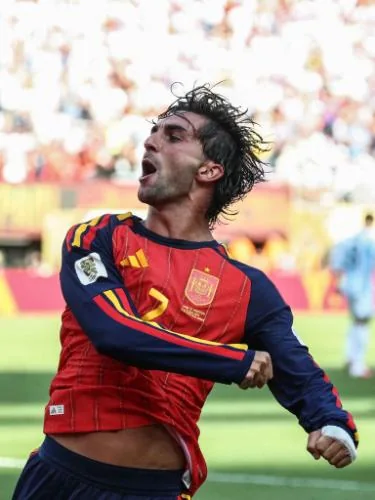 Spain goalscorer Ferran Torres. (Photo: FIFA)
Torres' strike also entered the history books.
He became only the second substitute ever to score the winning goal in a FIFA World Cup final after Germany's Mario Götze, who achieved the feat against Argentina in the 2014 final.
Argentina were unable to respond during the closing stages despite the presence of captain Lionel Messi.
The 39-year-old, playing in what is widely expected to be his final World Cup match, was well contained by Spain's disciplined midfield and defence. He managed just one shot throughout the contest, and it failed to hit the target.
Although he had inspired Argentina with eight goals during the tournament and masterminded their semi-final victory over England, he was unable to influence the final as Spain restricted him to one of his quietest performances of the competition.
The match nevertheless added another historic milestone to Messi's legendary career.
He became only the second footballer in history to appear in three FIFA World Cup finals after Brazil's Cafu and, at 39 years old, became the oldest outfield player ever to feature in the tournament's showpiece match.
The final also symbolised football's changing generations.
Before kickoff, Messi and Spain's teenage sensation Lamine Yamal shared an iconic embrace in what many described as a symbolic passing of the torch from one global superstar to another.
The two started on opposite sides with an age difference of 20 years and 19 days, the first time in World Cup final history that opposing starters had been separated by more than 20 years.
Yamal also made history by becoming the first player ever to feature in both a UEFA European Championship final and a FIFA World Cup final while still a teenager.
Alongside him, fellow 19-year-old Pau Cubarsí produced one of the standout performances of the final.
The Barcelona defender finished with a match-high 139 touches, completed 121 successful passes at an outstanding 96 per cent accuracy, delivered 21 line-breaking passes and made six clearances to marshal Spain's defence with remarkable composure.
Cubarsí and Yamal became only the fourth and fifth teenagers ever to start a FIFA World Cup final after Pelé in 1958, Giuseppe Bergomi in 1982 and Kylian Mbappé in 2018. Like all three before them, they ended the night as World Cup winners.
Spain's dominance throughout the tournament was reflected in the individual awards.
Rodri was named the Best Player of the Tournament after another commanding midfield display, while goalkeeper Unai Simón received the Golden Glove award following a campaign in which Spain conceded only one goal in eight matches.
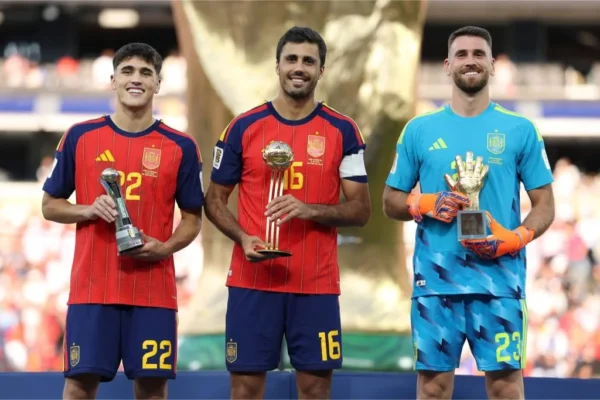 Pau Cubarsi, Rodri and Unai Simons of Spain. (Photo: FIFA)
Cubarsí completed a memorable tournament by being named the Young Player of the Tournament.
For Argentina, the defeat ended hopes of becoming the first nation since Brazil in 1962 to successfully defend the FIFA World Cup.
It also marked the country's fourth runners-up finish after previous final defeats in 1930, 1990 and 2014, equalling Germany for the most World Cup final losses.
Spain, meanwhile, added a second star above their badge and joined Brazil (five titles), Germany (four), Italy (four), Argentina (three), Uruguay (two) and France (two) as multiple FIFA World Cup champions.
Their campaign began quietly with a goalless draw against Cape Verde but gathered momentum with each passing match. By the time Ferran Torres struck in extra time in New Jersey, there was little doubt that the best team at the tournament had become world champions once again.
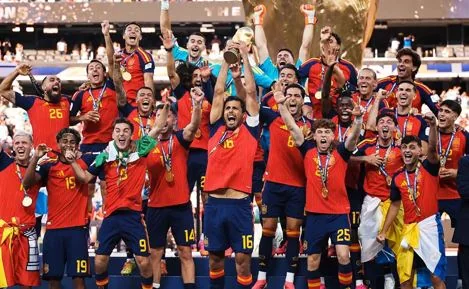
Sixteen years after conquering the world in South Africa, Spain reached the summit again this time led by a new generation featuring Lamine Yamal, Pau Cubarsí, Rodri and Unai Simón, proving that La Roja's golden era has not only returned but may only just be beginning.

































Comments
Sign in with Google to comment, reply, and like comments.
Continue with Google