Few sporting events have shaped global culture quite like the FIFA World Cup.
Since Uruguay hosted the inaugural tournament in 1930, football's greatest spectacle has produced unforgettable champions, iconic players, tactical masterminds and goalscorers whose exploits continue to define generations.
As the 2026 edition reaches its climax, the World Cup's nearly century-long journey tells the story of how the beautiful game evolved into the world's biggest sporting event.
The tournament began modestly with just 13 teams in Montevideo, where hosts Uruguay defeated Argentina 4-2 at the Estadio Centenario to become football's first world champions. Italy soon established the competition's first dynasty, winning consecutive titles in 1934 and 1938 under Vittorio Pozzo, who remains the only coach to successfully defend the World Cup trophy.
Following a 12-year interruption caused by the Second World War, the tournament returned in 1950 with one of its greatest upsets. Uruguay silenced a packed Maracanã Stadium by defeating hosts Brazil 2-1 in the match forever remembered as the "Maracanazo".
Brazil responded by building the most successful World Cup legacy in history. After abandoning their white shirts following the heartbreak of 1950, the Seleção introduced the now-iconic yellow jersey and went on to lift the trophy in 1958, 1962, 1970, 1994 and 2002. Pelé became the face of football's golden generation, while later stars such as Ronaldo ensured Brazil's dominance stretched across decades.
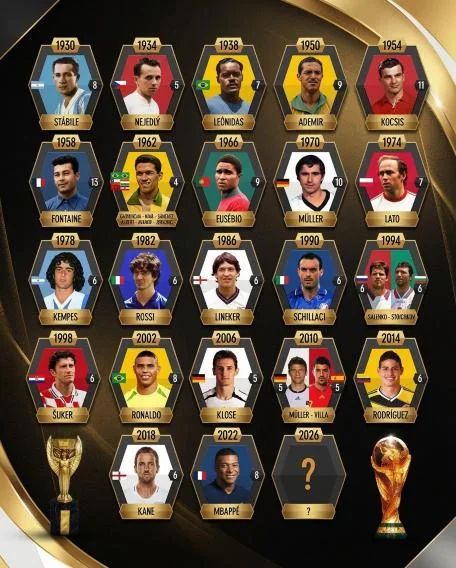 Photo shows FIFA World Cup golden boot winners since 1930-2022 © FIFA World Cup stats X
Germany and Italy emerged as Brazil's closest rivals. Germany's triumphs in 1954, 1974, 1990 and 2014 reflected remarkable consistency across different eras, while Italy matched four titles through victories in 1934, 1938, 1982 and 2006. Argentina joined the elite with titles in 1978, 1986 and 2022, inspired by Diego Maradona before Lionel Messi completed one of football's greatest redemption stories in Qatar.
The World Cup has also been defined by the players who consistently found the back of the net. Argentina's Guillermo Stábile became the first Golden Boot winner with eight goals in 1930, but no striker has ever surpassed the astonishing 13 goals scored by France's Just Fontaine at the 1958 tournament, a record that still stands more than six decades later.
Over time, scoring became increasingly difficult as tactics evolved and defensive organisation improved. While the early tournaments regularly produced double-digit tallies, modern Golden Boot winners typically finish with between five and eight goals. Legends including Eusébio, Gerd Müller, Ronaldo Nazário, Miroslav Klose, James Rodríguez, Harry Kane and Kylian Mbappé all left their mark by finishing as the tournament's leading scorer.
The dugout has produced its own icons. Pozzo's back-to-back triumphs remain unmatched, while Alberto Suppici became the youngest World Cup-winning coach at just 31 years old when he guided Uruguay to glory in 1930. Vicente del Bosque, meanwhile, became the oldest winner at 59 after leading Spain to their historic first title in 2010. Remarkably, every World Cup-winning coach has lifted the trophy with their own country, underlining the importance of national identity on football's biggest stage.
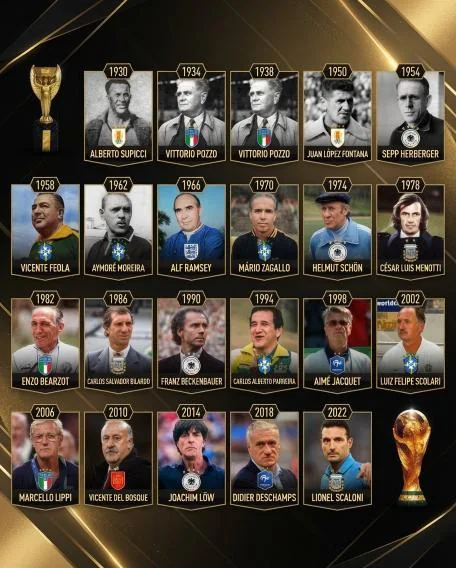 Photo shows coaches that have won the World Cup since 1930-2022 © FIFA World Cup stats X
Beyond statistics, the World Cup has always belonged to its legends. Pelé inspired Brazil's rise, Garrincha dazzled defenders, Bobby Charlton carried England to their only title, Maradona produced arguably the greatest individual tournament in 1986, Zinedine Zidane defined France's golden era, and Messi finally completed his extraordinary career by lifting the trophy in 2022.
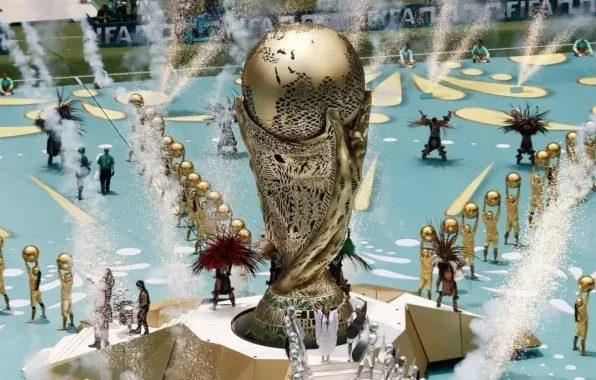
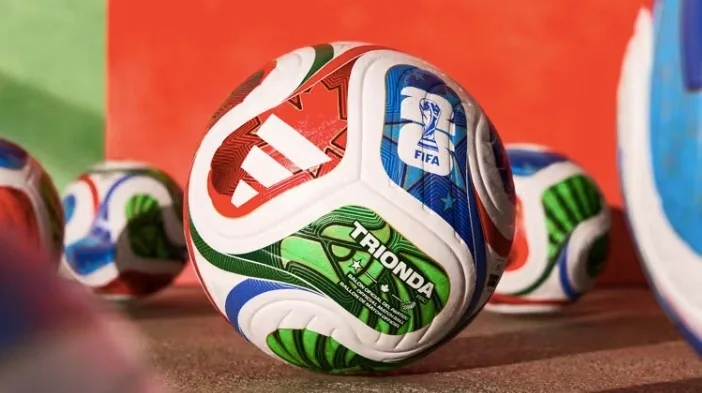
The competition itself has transformed dramatically. What began as a 13-team event has expanded into a 48-team tournament in 2026, jointly hosted by the United States, Canada and Mexico. A record 104 matches have showcased football's global growth while preserving the drama that has captivated generations.
Yet despite the expansion and changing eras, one fact remains unchanged: only eight nations have ever been crowned world champions. Every edition has added new heroes, unforgettable moments and lasting memories to football's richest history.
As the 2026 World Cup prepares to crown another champion, another Golden Boot winner and perhaps another legendary manager, the tournament stands ready to write the next chapter in a story that began in Montevideo 96 years ago, a story of dreams realised, records broken and immortality earned on football's grandest stage.































Comments
Sign in with Google to comment, reply, and like comments.
Continue with Google