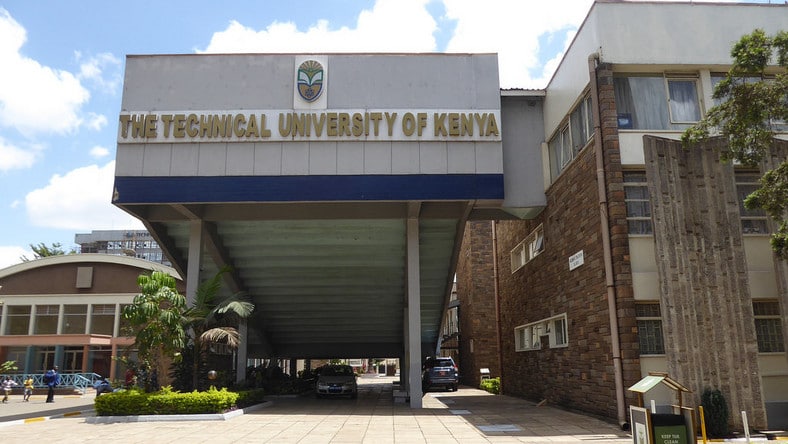
The Court of Appeal has reduced compensation awarded to 21 former students of the Technical University of Kenya (TUK) over missing examination scripts, while upholding the finding that the university violated their constitutional right to fair administrative action by failing to act promptly.
In a judgment delivered by Justices Daniel Musinga, Mumbi Ngugi and Francis Tuiyott, the appellate court overturned the High Court’s finding that the students’ right to dignity had been violated and reduced the compensation from Sh148,764 to Sh50,000 for each student.
The case arose after the students, who were pursuing a diploma in Mechanical and Mechatronics Engineering, sat a compulsory mathematics examination in 2012. Their lecturer allegedly failed to return the examination scripts or submit the marks, prompting the university to order all 72 affected students to re-sit the paper, a move that delayed their graduation.
The Court of Appeal, however, found that TUK failed to take timely action despite having sufficient opportunity to resolve the matter before the students completed their studies.
"It is a settled principle of good administrative action, codified in Article 47, that it must be expeditious and efficient," the court said.
The judges noted that while the university had a legitimate interest in tracing the missing scripts, it was also required to ensure that its actions did not interfere with the students’ expectation of graduating on time.
"The University should have always kept its eye on the clock so that whatever action it took would not jeopardise the students' expectation to graduate on time," the judges stated.
The court further observed that criminal charges against the lecturer were only initiated about one and a half years after the examinations, describing the delay as evidence of "laxity and inefficiency."
However, the appellate judges disagreed with the High Court’s conclusion that the delayed graduation amounted to a violation of the students’ constitutional right to dignity.
The students had argued that missing graduation made them appear as failures before their families, friends and society. The Court of Appeal held that although the claim had been pleaded, the students failed to provide sufficient evidence to support it.
On compensation, the court found that the High Court’s award was speculative because there was no evidence to support the assumption that the graduates would take seven months to secure employment.
"There was no material at all that was placed before the court upon which it could work a vindicatory or compensatory relief," the judges said.
The appellate court consequently substituted the award with Sh50,000 for each of the 21 students for the violation of their right to fair administrative action under Article 47 of the Constitution.
The court upheld the High Court’s decision awarding costs to the students but ordered each party to bear its own costs of the appeal, giving both sides a partial victory.














































Comments
Sign in with Google to comment, reply, and like comments.
Continue with Google