Kenya's digital news landscape is undergoing a dramatic transformation, with TikTok emerging as one of the fastest-growing sources of news, while YouTube and Facebook continue to dominate how millions of Kenyans access information online.
According to the
Digital News Report 2026 published by the Reuters Institute for the Study of Journalism, Kenya remains one of the world's most socially connected news markets, with audiences increasingly turning to video-based and private messaging platforms for news consumption.
The report shows that YouTube has become the leading social platform for news in Kenya, rising from 54 per cent in 2025 to 66 per cent in 2026. Facebook follows closely at 63 per cent, up from 52 per cent a year earlier.
However, the most remarkable growth has been recorded by TikTok, whose use for news consumption surged from 38 per cent in 2025 to 58 per cent in 2026, representing a 20-percentage-point increase within a single year.
The figures underscore a major shift in audience behaviour, with younger consumers increasingly preferring short-form video content over traditional text-based news feeds.
YouTube takes the lead
The report indicates that YouTube has overtaken Facebook as Kenya's most influential digital news platform. At 66 per cent, YouTube's news reach is nearly double the global average of 34 per cent recorded across all markets surveyed.
Media analysts attribute the platform's growing popularity to the rise of video journalism, live-streamed news events, explainers, podcasts, and creator-driven news content that appeal to mobile-first audiences.
 Digital News Report 2026 was published by the Reuters Institute. (Photo: Reuters)
Digital News Report 2026 published by the Reuters Institute
Facebook, despite losing its long-held position as the top social platform for news, continues to maintain a strong presence. News consumption through Facebook climbed from 52 per cent in 2025 to 63 per cent in 2026, significantly above the global average of 43 per cent.
TikTok's explosive growth
TikTok's rapid rise represents one of the most significant developments highlighted in the report.
In just one year, the platform's news usage jumped by 20 percentage points, reaching 58 per cent. This places TikTok ahead of X (formerly Twitter) and within striking distance of Facebook and YouTube.
Globally, only 20 per cent of respondents reported using TikTok for news, making Kenya's 58 per cent figure nearly three times higher than the international average.
The findings suggest that short-form videos, influencer-led reporting, and algorithm-driven content discovery are becoming increasingly important sources of information for Kenyan audiences.
WhatsApp emerges as a major news hub
The report also highlights the growing role of private messaging platforms in news distribution.
WhatsApp recorded one of the largest increases among all platforms, rising from 46 per cent in 2025 to 62 per cent in 2026.
The growth reflects an increasing reliance on private groups, family chats, community forums, and peer-to-peer sharing for news consumption.
Kenya's WhatsApp news usage stands far above the global average of 26 per cent, reinforcing the country's reputation as a highly social and mobile-first digital market.
Telegram also recorded notable growth, rising from 19 per cent to 29 per cent over the same period.
Instagram continues to gain ground
Instagram's role in news consumption is also expanding rapidly.
The platform grew from 26 per cent in 2025 to 42 per cent in 2026, reflecting increasing adoption among younger audiences who consume news through visual storytelling, reels, and creator content.
The figure is considerably higher than the global average of 26 per cent.
X (Twitter) reduction
While nearly every major social platform recorded significant growth in Kenya, X was the notable exception.
The platform's news reach declined from 42 per cent in 2025 to 38 per cent in 2026, making it the only major social network to lose news users during the period under review.
The decline comes as users increasingly migrate toward video-focused platforms such as TikTok, Instagram, and YouTube, which offer richer multimedia experiences and broader content discovery mechanisms.
One of the report's key findings is the extent to which Kenya surpasses global averages across nearly every major social platform.
2026 at a glance
YouTube reached 66 per cent in Kenya compared to 34 per cent globally.
Facebook reached 63 per cent compared to 43 per cent globally.
WhatsApp reached 62 per cent compared to 26 per cent globally.
TikTok reached 58 per cent compared to 20 per cent globally.
Instagram reached 42 per cent compared to 26 per cent globally.
X reached 38 per cent compared to 11 per cent globally.
The figures position Kenya among the world's most socially engaged news markets, where social and messaging platforms play a central role in news discovery and distribution.
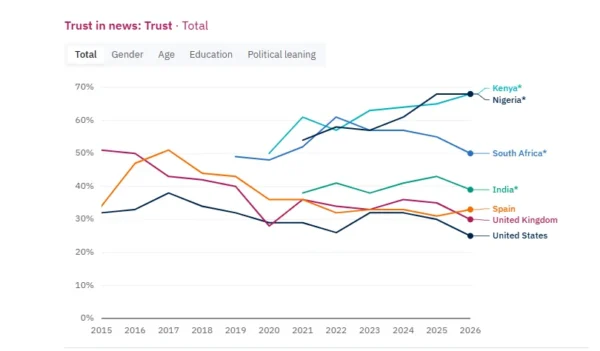
Despite concerns about misinformation and the rapid spread of content on social media, the Reuters Institute report found that Kenya continues to enjoy relatively high levels of trust in news.
Overall, 68 per cent of Kenyans surveyed said they trust most news most of the time, the highest level recorded among African countries included in the study.
The finding places Kenya ahead of several regional peers and suggests that audiences continue to value credible journalism even as consumption habits shift toward digital and social platforms.
As YouTube cements its leadership position and TikTok continues its meteoric rise, traditional news organisations are likely to face growing pressure to adapt their content strategies for mobile-first, video-driven audiences.
For publishers, broadcasters, and journalists, the message is clear: the future of news in Kenya is increasingly social, visual, and mobile.


















































Comments
Sign in with Google to comment, reply, and like comments.
Continue with Google