A diplomatic exchange between the United States (US) and China has thrust South Africa’s foreign policy under renewed scrutiny after Washington publicly questioned Pretoria’s claim of non-alignment while Beijing defended its sovereign right to engage partners of its choosing.
The debate unfolded after South Africa hosted Iran’s Deputy Foreign Minister and sent Deputy President Paul Mashatile to Beijing, where he attended the 4th China International Supply Chain Expo and reaffirmed ties with China.
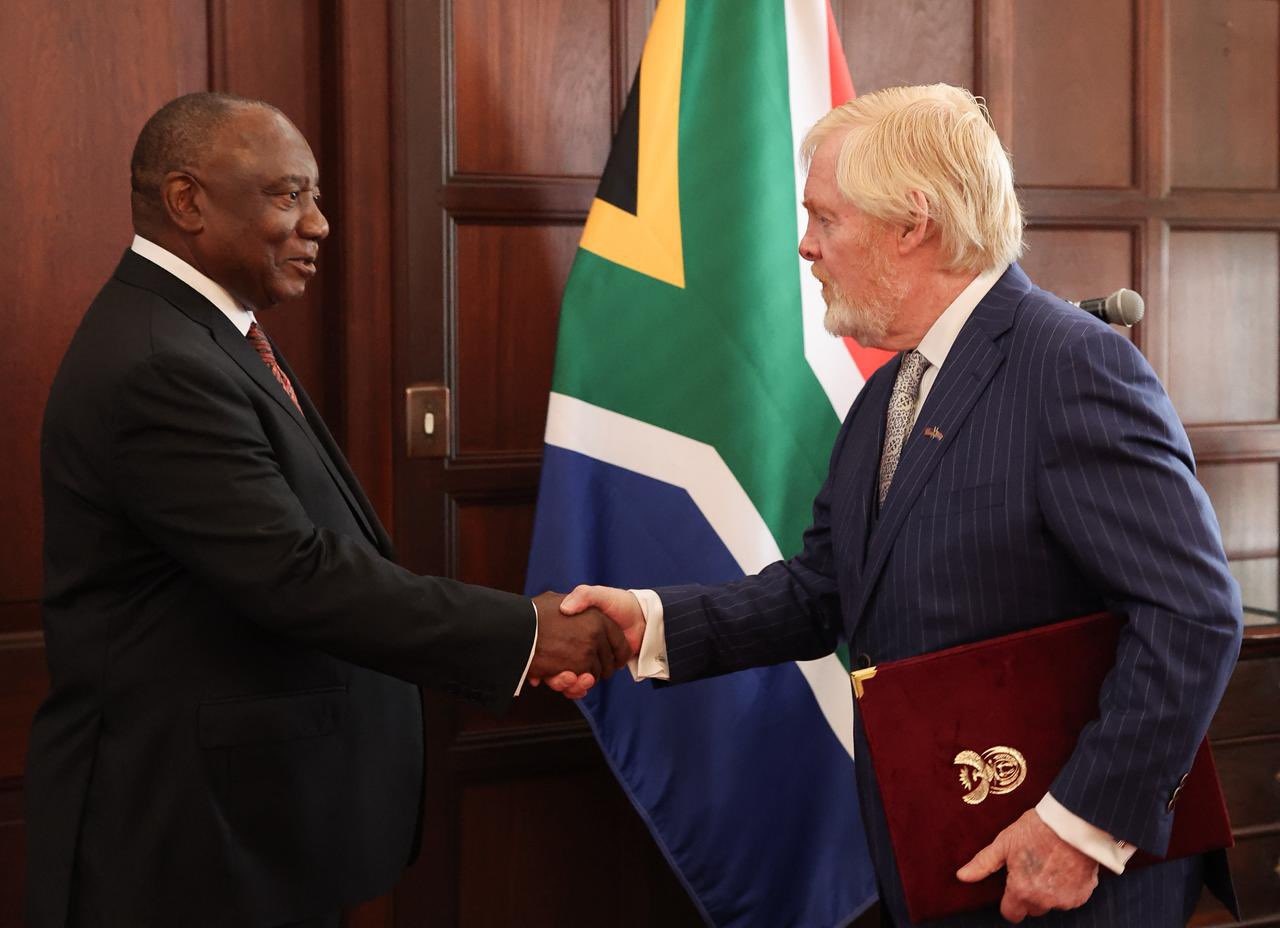
US Ambassador to South Africa Leo Brent Bozell III on Wednesday argued that Pretoria’s growing engagement with China and Iran reflected a geopolitical choice rather than neutrality.
“The government of South Africa rolls out the red carpet for Iran’s Deputy Foreign Minister, while Deputy President Mashatile is in Beijing deepening ties with China,” Bozell wrote on X.
“Pretoria calls this ‘non-alignment’. We call it what it is: a choice. The South African people deserve an honest conversation about who their government is choosing to stand with.”
South Africa’s Department of International Relations and Cooperation (DIRCO) has consistently rejected suggestions that its foreign policy aligns with any major power bloc, describing non-alignment as an active, independent diplomatic strategy rather than passive neutrality.
In Beijing, Mashatile reiterated Pretoria’s commitment to its partnership with China.
“South Africa and China enjoy a deep and enduring strategic partnership founded on mutual respect, solidarity, and a shared vision for development,” he said.
Bozell’s criticism is consistent with broader concerns in Washington that South Africa’s engagement with China, Russia and Iran is increasingly placing it at odds with Western interests, despite its stated policy of strategic neutrality.
China’s ambassador to South Africa, Wu Peng, responded indirectly but pointedly, saying Beijing does not comment on South Africa’s relations with third countries and respects Pretoria’s sovereign diplomatic choices.
The exchange highlights competing interpretations of non-alignment in an increasingly polarised international system.
While Washington appears increasingly sceptical of countries claiming neutrality while deepening ties with powers challenging the Western-led order, Beijing continues to frame its partnerships through the language of sovereignty, strategic autonomy and non-interference.
For South Africa, the episode highlights a challenge facing many middle powers seeking to navigate great-power competition without formally aligning with either side.
The debate is far from unique to Pretoria.
Countries such as India, Indonesia and Brazil have similarly sought to maintain strategic autonomy while engaging competing centres of power.
Indonesian foreign policy scholar Professor Yanyan Mochamad Yani has previously described Jakarta’s approach as a form of “pseudo non-alignment”, allowing states to engage multiple powers simultaneously when interests converge.
The great-power rivalry between Washington and Beijing puts South Africa’s balancing act to the test of whether non-alignment remains viable in a world where major powers are demanding clearer choices from their partners.
































Comments
Sign in with Google to comment, reply, and like comments.
Continue with Google