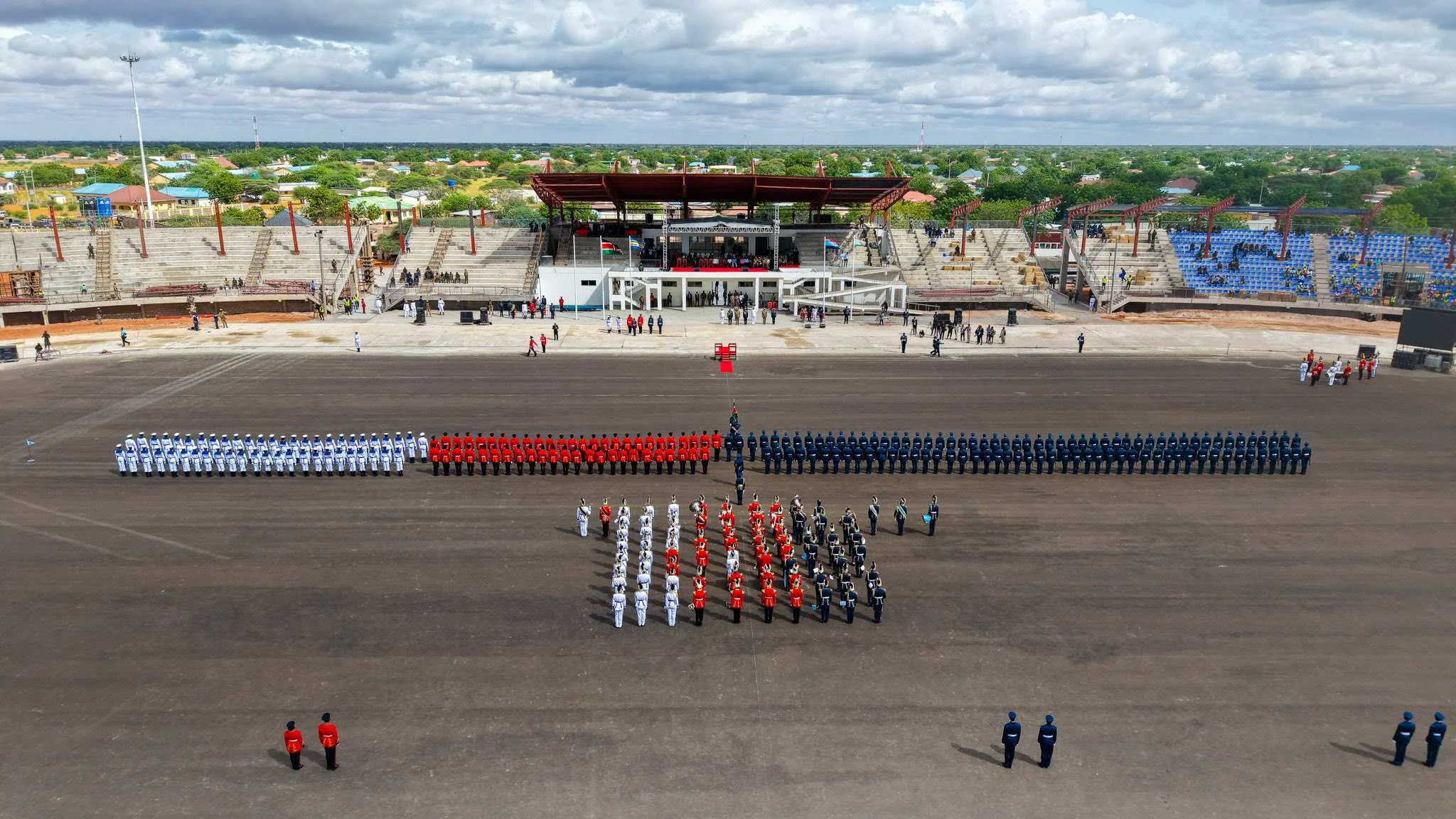
Military jets are hovering around Wajir town in preparation for the Madaraka Day, as Kenya Defence Forces personnel march to brave the scorching hot sun in readiness as well.
For the first time since independence in 1963, Kenya’s national Madaraka Day celebrations will be held in Wajir County on June 1, 2026, a historic milestone that many residents here describe not simply as a state function, but as a long-awaited moment of recognition.
Across Wajir town, the signs of transformation are impossible to miss.
Freshly paved roads cut through neighbourhoods that once struggled with poor accessibility.
New streetlights are illuminating roads that traditionally fell silent after sunset.
At the heart of this transformation stands the newly built 10,000-seater stadium, now the most visible symbol of Wajir’s emergence onto the national stage.
For many residents, the celebrations carry emotional and political significance beyond the ceremony.
For decades, Northern Kenya has often existed at the margins of national development conversations, shaped by historical neglect, insecurity, recurring drought and limited infrastructure. Successive governments faced criticism over uneven development implementation between Kenya’s central regions and the arid north.
President William Ruto’s decision to host the national event in Wajir has been welcomed by leaders across the county as a symbolic gesture of inclusion and national cohesion.
Wajir South Member of Parliament Adow Mohammed, in an interview with The Eastleigh Voice, said the occasion symbolises something profound; the coming in from the cold of a people and a region that for decades stood at the periphery of the Kenyan story.
"For more than 60 years, the people of North Eastern Kenya endured marginalisation, exclusion, underinvestment, and suspicion. Many generations grew up feeling distant from the centre of national life - not because they loved Kenya any less, but because Kenya sometimes seemed unsure how fully to embrace them," he narrated.
Adow recalls that the residents of Northern Kenya, through all those decades, remained resilient, patriotic and hopeful.
"They built families, businesses, schools, mosques, and communities under difficult circumstances. They defended this nation’s borders. They contributed to its economy. They enriched its culture. And despite every hardship, they never stopped believing that one day they too would be fully seen, fully heard, and fully included in the promise of Kenya," added Adow.
He believes it is President William Ruto who has made it possible for the people of North Eastern Kenya to increasingly feel seen, heard, and included in the national conversation and in the ongoing massive infrastructural development
"The message from this Madaraka to the entire country is that no region is too remote to matter, no community is too small to be recognised, and no Kenyan should ever feel excluded from the national family," Adow added.
According to Mandera South MP Abdul Haro, this is a truly historic moment for the North Eastern region, given that it is the first time since Kenya attained independence.
"This event is also a manifestation of inclusion, recognition, and national unity, and an affirmation that the people of Northeastern are Kenyans and a valued pillar of Kenyan nationhood," said Haro.
The presence of security personnel, especially soldiers, gives a cold nostalgia of the Wagalla massacre at the Wagalla Airstrip that occurred in what is presently Wajir County in 1984. However, this time round, the military is in Wajir for celebration and not bloodletting.
The bloodbath began in the small hours of February 10, ending with a stampede and a shootout on the chilly morning of February 14, 1984. All men and boys over the age of 12 years belonging to the Degodia sub-clan of the Somali tribe in north-eastern Kenya were rounded up and detained at the newly constructed airstrip in Wagalla, nine miles from Wajir town.
According to Annalenna Tonelli, 1,000 people were killed, but according to various community groups, the number is closer to 5,000.
Annalena is the heroine of Wagalla. An Italian volunteer and Catholic lay sister, Annalena, had lived in Wajir for 15 years before the massacre, assisting the less fortunate, running a tuberculosis and rehabilitation centre.
The Wagalla massacre destroyed a community, changed its social cohesion, and placed the burden of regenerating the dead society on the shoulders of widows. Those murdered were husbands, fathers, brothers or guardians, citizens of this sovereign republic who had a right to have their lives protected by the state. If indeed the state had a case against these people, natural justice would have dictated that they be brought before the courts and charged according to the laws of the land. That was not the case.
This is the worst massacre recorded in Kenyan history. Previously, the government had said that only 57 people had died. However, on Wednesday, October 18, 2000, when he was minister in the Office of the President, William Ruto told parliament that 380 people had died in what has been called the Wagalla massacre.



























Comments
Sign in with Google to comment, reply, and like comments.
Continue with Google