The African armyworm is a highly
destructive migratory pest that damages maize, sorghum, millet and sugarcane. These caterpillars also cause
indirect damage to livestock as they destroy grazing lands and pastures.
The last major
outbreak of armyworm in southern Africa was from February to April 2025. It affected South Africa’s KwaZulu-Natal, Limpopo, Gauteng and Mpumalanga provinces and neighbouring Zimbabwe.
Controlling armyworm has proved a major challenge. The most common method has been the application of a pyrethroid-based synthetic
chemical insecticide. But the method has proved to be less effective in achieving complete control, as the insecticide is only effective against the larval instars (caterpillars) when they are about 1- 5 mm in length, as they are more susceptible to the poison than the grown larvae. The insect has a complete metamorphosis consisting of the egg, larvae (caterpillar), pupae and adult stage, which is a moth. The caterpillar stage is the most damaging.
I am an entomologist, and my work focuses mainly on integrated pest management of economically important agricultural insect pests. Specifically, it looks at the use of disease-causing (entomopathogenic) fungi and nematodes as biological control agents of insects in agro-ecosystems. In a recent
paper, I set out my findings on a fungus that naturally infects and kills the larval instars of the African armyworm. This is the first report of the presence and successful isolation of the fungus in South Africa.
African armyworm killer fungus discovered in South Africa
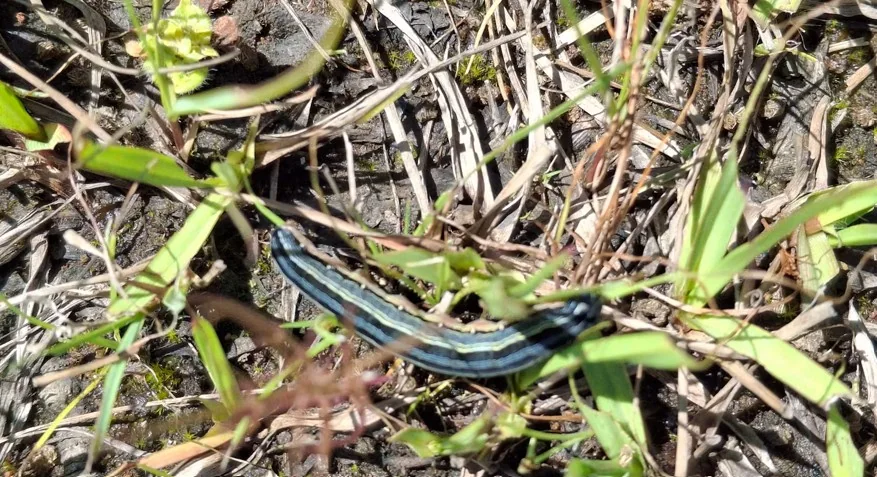
Outbreaks of the African armyworm are mainly characterised by high densities of the larval instars of the insect: they form dense armies that move across the ground together.
It feeds on plants and can completely strip the leaves of crops to ground level. Damage to kikuyu grass pastures also means there’s less for livestock to eat, and they can get sick from poisoning. This is because when the larvae feed on the grass, the grass releases a cyanogenic chemical compound as a defence mechanism against the insect. The cyanide compound is
toxic to livestock, mostly cattle.
Clinical signs of kikuyu grass poisoning in affected cattle during outbreaks of the insect include abdominal pain, dehydration, excessive drooling of saliva, sham drinking – where the affected animals fail to drink even if they put their mouth into the water – incoordination (loss of muscle control, resulting in unsteady and involuntary movements), and cardiac and respiratory distress.
When I inspected Kikuyu grass pastures infested with the insect in KwaZulu-Natal, I observed that something was killing the larval instars of the African armyworm. It turned out to be an isolate of the fungus Metarhizium rileyi.
This fungus lives in soil and is one of many entomopathogens that infect and kill various insect pests. They are often used in agriculture to manage pests that cause severe damage to crops. Several fungus-based insecticides are commercially available and have proven to be effective.
I found that dead African armyworm larvae were covering large areas of the fields, mostly attached to blades of grass and some on the soil surface. They were infected with Metarhizium rileyi. The infection was visible as white and green conidia, which are asexual spores on the cuticle surface of the insects.
This was the first observation and report of the efficacy of this fungus against the African armyworm. Previously, the fungus was
reported to be an effective biological control agent of the fall armyworm in countries such as the Philippines.
The discovery opens an opportunity to explore and develop this organism as a potential biological control agent product to be used during outbreak seasons in South Africa and in other regions globally.
Mass production of this particular fungal species on a commercial scale and registration of the fungus as a biopesticide of the insect would be the next step. It could add to the management strategies that can be effectively used during outbreak seasons of the insect.
***
Letodi Luki Mathulwe, Research Entomologist, Department of Conservation Ecology and Entomology, Stellenbosch University
This article is republished from The Conversation under a Creative Commons license. Read the original article.




















































Comments
Sign in with Google to comment, reply, and like comments.
Continue with Google