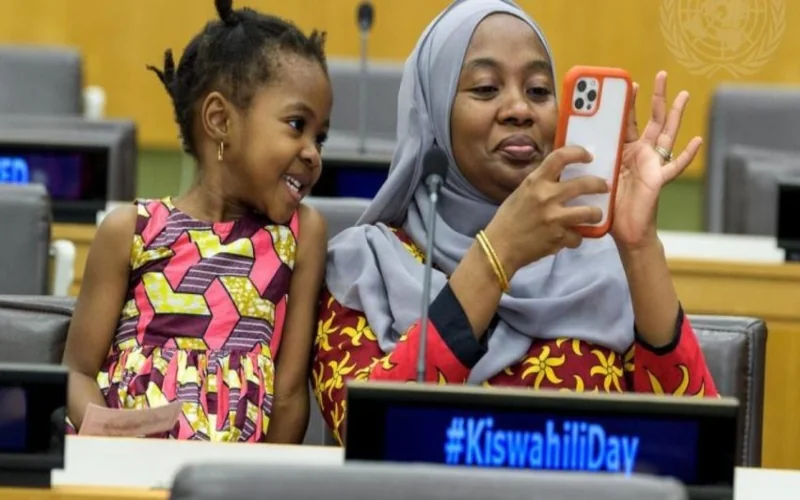
Kenya today joined the world in marking World Kiswahili Language Day, even as scholars and experts urged the government to move with speed to constitute the National Kiswahili Council, aimed at promoting and developing the language.
Celebrated on July 7 each year, the day honours Kiswahili as one of the most widely spoken languages in Africa and across the world, with over 200 million speakers.
Speaking exclusively to The Eastleigh Voice, Juma Namlola, a Kiswahili expert, said that although the government has approved its establishment, no leader since Aisha Jumwa’s departure from the Arts and Heritage docket has taken an active interest in the Council.
“Our leaders know that Article 7 of the Constitution states that Swahili is the national language. But since Aisha Jumwa vacated office, which leader have you seen taking an active interest in this?” the former Taifa Leo editor posed. “Tusitarajie watu wanaodhani mzungumzaji Kiswahili ni mshamba na mtu ambaye hajasoma, wawe mstari wa mbele kuunda Baraza la Kiswahili.”
Bitugi Matundura, a Kiswahili lecturer at Chuka University, added that regional governments need to develop policies that will make the language an “economic tool”.
“Kutokana na umaarufu wa Kiswahili, mataifa ya Afrika Mashariki yanapaswa kuimarisha uundaji na utekelezaji wa sera murua zinazofanikisha michakato ya kukifanya Kiswahili kuwa bidhaa kwa minajili ya kujitajirisha kiuchumi, kama yanavyofanya mataifa mengine kuhusu lugha zao,” said Matundura.
When he tabled the motion on the Council before Parliament in 2022, Kamukunji Member of Parliament (MP) Yusuf Hassan said the Bill sought to fast‑track the establishment and operationalisation of the Council, at a time when the use of Kiswahili is expanding rapidly across the globe.
"We don't even have Baraza La Kiswahili. I have twice tabled a motion to have such a body created, but it hasn't gone through yet. It is therefore our role to take the matter of promoting Kiswahili with the seriousness it deserves," MP Yusuf said in 2024. "We should promote Kiswahili in all spheres, just like other countries that give first preference to their local languages."
According to the United Nations Educational, Scientific and Cultural Organisation (UNESCO), Kiswahili is one of the 10 most widely spoken languages in the world.
It is a vital tool of communication and integration across East, Central, and Southern Africa, and serves as an official language of the African Union (AU), Southern African Development Community (SADC), and the East African Community (EAC).
The language also has a rich and complex history shaped by various cultures and languages over the centuries. Its origins remain debated, with two main theories about its development.
One suggests that Swahili is primarily a Bantu language that emerged along the East African coast between 100 and 500 CE. It evolved as a lingua franca, helping Bantu‑speaking communities communicate with traders from Arabia and Asia, and gradually became a vital language for trade, diplomacy, and cultural exchange.
The other points to the influence of Arabic, with the term “Swahili” derived from the Arabic word sawāḥilī, meaning “of the coast”, reflecting the region’s extensive trade and cultural ties with Arab traders.








































Comments
Sign in with Google to comment, reply, and like comments.
Continue with Google