Over 51,000 candidates who qualified for university admission after attaining grade C+ and above in the 2025 KCSE examination did not apply for placement, data from the Kenya Universities and Colleges Central Placement Service (KUCCPS) shows.
According to the figures, 51,835 of the 268,729 eligible candidates did not submit applications, with the largest number of those who failed to apply coming from candidates who scored grade C+.
The placement data shows that candidates with higher grades recorded better application rates. Out of 1,931 candidates who attained grade A, 1,860 applied for placement, representing 96.3 per cent. Among those who scored A-, 8,667 out of 9,259 applied, translating to 93.6 per cent.
For grade B+, 20,911 out of 23,748 eligible candidates submitted applications, representing 88.1 per cent. Grade B recorded 42,029 applications out of 49,805 eligible candidates, or 84.4 per cent, while 65,410 of the 80,128 candidates who attained B- applied, representing 81.6 per cent.
Candidates who scored C+ recorded the lowest application rate among those eligible for university admission. Out of 103,858 candidates, only 78,017 applied, representing 75.1 per cent.
Despite some eligible candidates failing to apply for placement, KUCCPS Chief Executive Officer Agnes Wahome said the agency had recorded progress in reaching out to students who qualified for university admission.
“We have seen a steady increase in the number of students qualifying for university. We can account for 81 per cent of the students who attained C+ and above in the 2025 KCSE examination,” Wahome said during the release of the placement results on Wednesday.
KUCCPS data also shows that candidates who took technical subjects recorded strong performance in the 2025 KCSE examination, with more than 85 per cent of those enrolled in several of the courses attaining grade C+ and above.
Aviation Technology had the highest share of candidates attaining C+ and above at 95 per cent, followed by Drawing and Design at 93 per cent, Electricity at 90 per cent, Woodwork at 89 per cent, Building Construction at 85 per cent and Power Mechanics at 84 per cent.
Other subjects also recorded notable performance, including Kenyan Sign Language at 81 per cent, Metalwork at 77 per cent, German at 75 per cent, Arabic at 71 per cent, Home Science at 69 per cent, French at 66 per cent, Music at 61 per cent, Art and Design at 56 per cent, Computer Studies at 55 per cent, Islamic Religious Education at 44 per cent, Geography at 43 per cent, Business Studies at 39 per cent and History and Government at 36 per cent.
Wahome said the results reflected the direction of the Competency-Based Curriculum (CBC), which places greater focus on technical education. She, however, questioned whether universities have enough degree programmes that recognise these subjects as cluster requirements, including teacher training courses.
“This aligns very well with the new curriculum, where we want to see a lot of technical courses undertaken. The performance looks good, but the question is, at the university level, how many of our programmes have these courses as one of their cluster subjects, including education?” Wahome posed.
She also raised concerns over the performance in science subjects, which remained a major challenge for university placement into STEM courses.
Data from the placement service shows that only 13 per cent of candidates who sat for Chemistry attained grade C+ and above, while Mathematics and General Science recorded 19 per cent each.
Biology also recorded low performance, limiting the number of learners who meet the minimum requirements for science-related courses.
Only 13 per cent of candidates who sat for Chemistry attained grade C+ and above, while Mathematics and General Science recorded 19 per cent each. Biology also recorded low performance, limiting the number of learners who meet the minimum requirements for science-related courses.
“We have a lot of science-based courses. But we don’t have enough students who have met the minimum requirements to take those courses,” Wahome said.
She emphasised that the shortage of qualified students means many available university spaces in science programmes may remain vacant.
“When we look at the capacities available, we have about 300,000 capacities. Some capacities will remain unfilled, and a good number of these capacities are in science subjects. So, it is a challenge that we need to see an improvement in the performance of our sciences, especially biology, where we are at 17 per cent, which is a very slight improvement. Biology has always been one of the challenges because it means we cannot get students into agriculture courses, among other technical and STEM courses,” she said.
KUCCPS said it processed the 2025 KCSE examination data received from the Kenya National Examinations Council (KNEC), validated programmes and capacities with the Commission for University Education and computed weighted cluster points using the revised 2026 criteria.
The agency said university cut-off points are determined after approved programme capacities are published in the system. Applicants were ranked using the performance index and weighted cluster points, with the last applicant admitted into a programme setting the cut-off point for that course in a given year.
The Placement Service also noted that competition remained highest for Bachelor of Medicine programmes. The available capacity stood at 702 places, while about 6,500 candidates applied, including 1,535 candidates who scored grade A and 3,328 who attained grade A-.
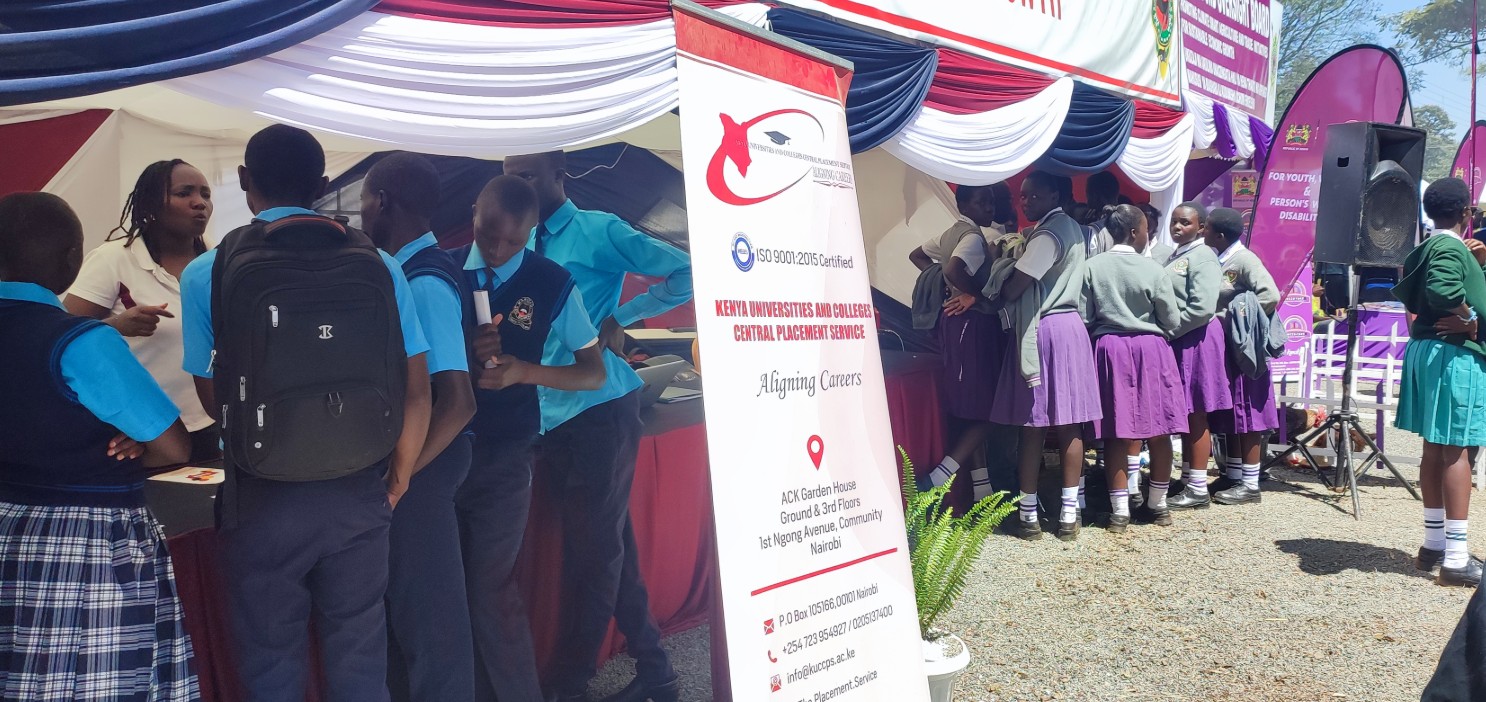
Going forward, KUCCPS said it will strengthen collaboration with stakeholders, improve awareness campaigns, enhance digital application support, monitor admissions and reporting by institutions, review placement processes and deepen partnerships in career guidance.















































Comments
Sign in with Google to comment, reply, and like comments.
Continue with Google