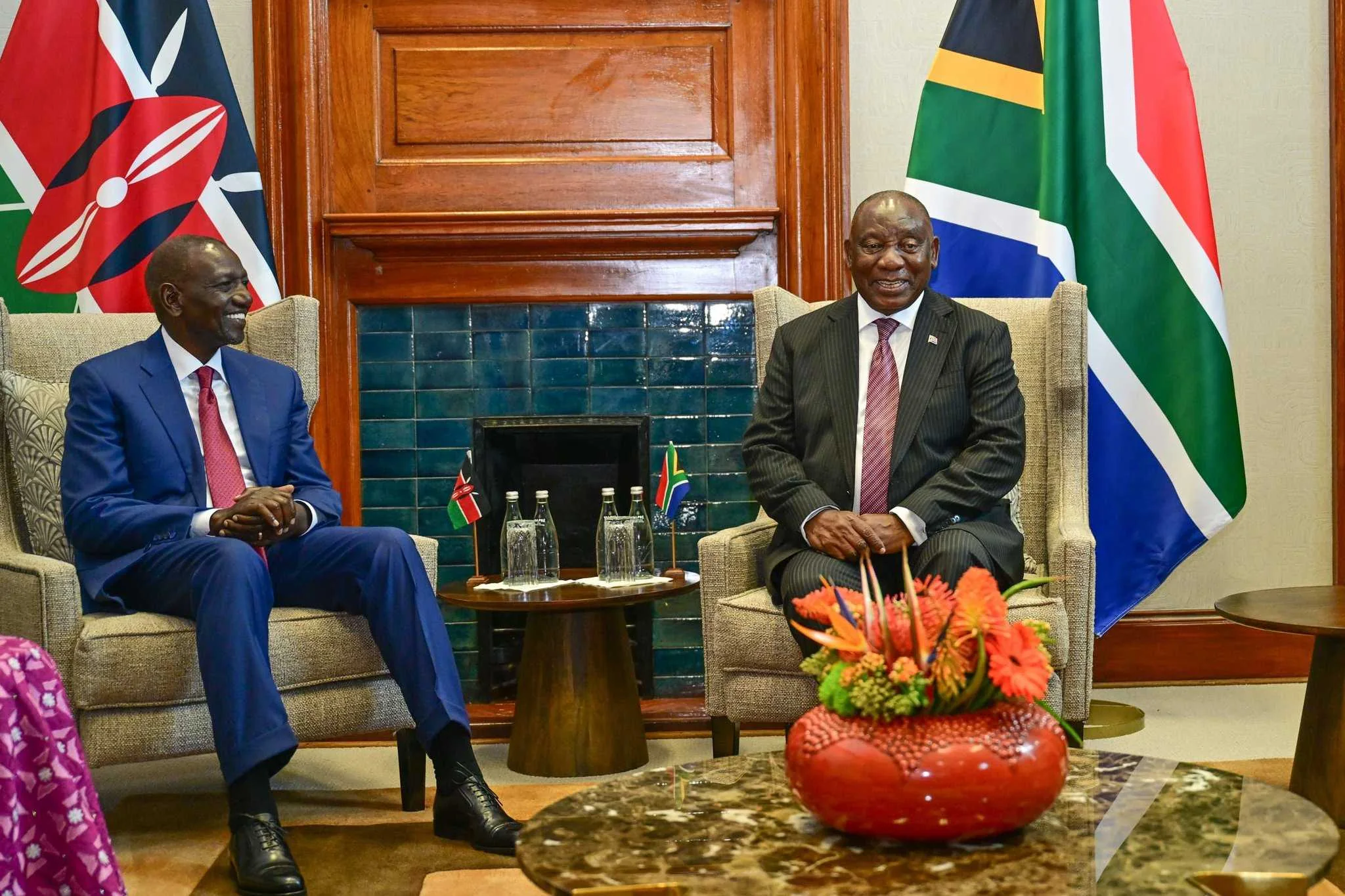
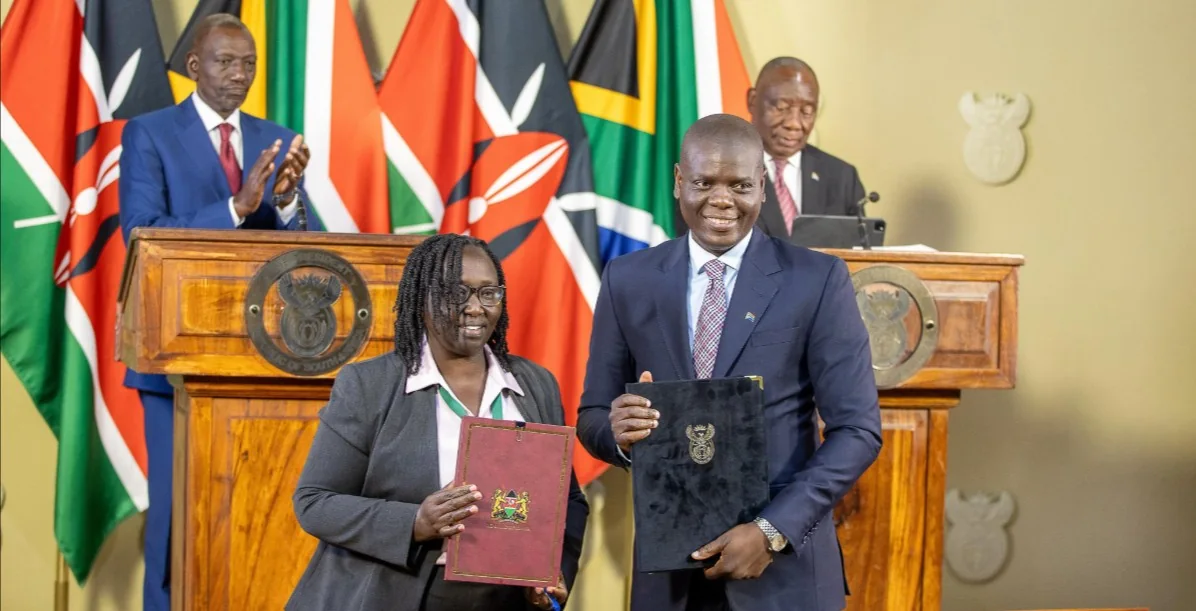
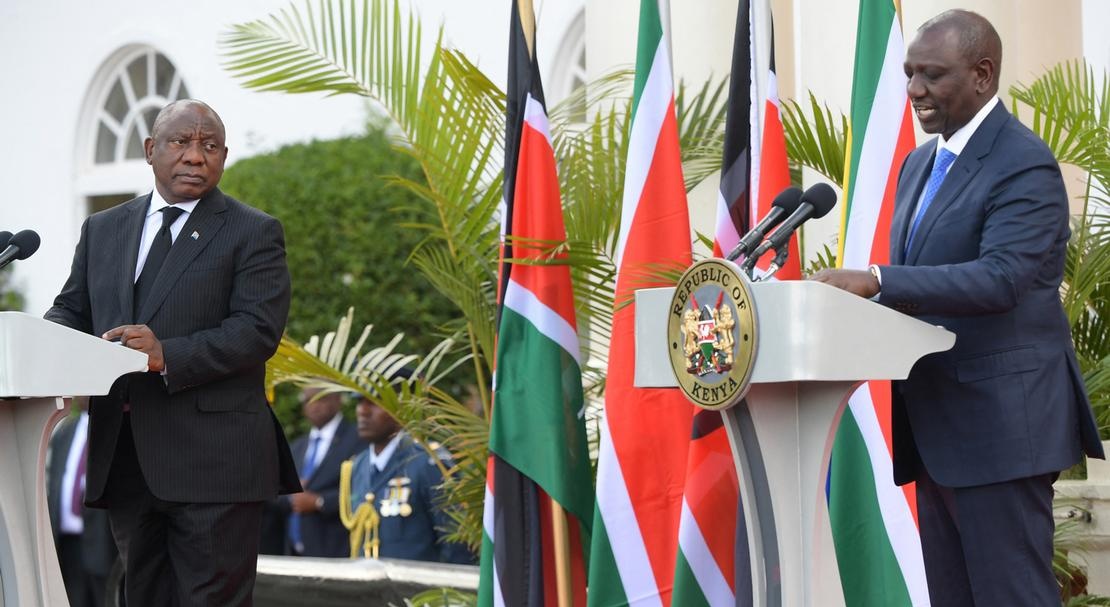
Geopolitics featured prominently in talks between President William Ruto and his South African counterpart Cyril Ramaphosa during Ruto’s state visit to Pretoria, with both leaders projecting unity even as their countries continue to pursue different pathways to influence on the continent and beyond.
In his characteristic style, Ruto dismissed the notion that African states must choose between competing global powers, invoking a famous dictum often associated with Ghana’s founding president, Kwame Nkrumah.
“We are neither looking East nor looking West. We are looking forward,” Ruto told a room packed with South African journalists.
The Kenyan leader argued that Africa should not be treated as an arena for external competition but as a space for the continent’s own growth, development and prosperity.
“The geopolitical space is Africa, is Kenya, is South Africa. Are we just spectators or are we making a contribution? Is our voice and our actions part of this whole equation?” Ruto asked.
“It is our considered view, working as people from the African continent, that for a very long time our voice, our ideas and our proposals did not find their way into the forums that influence global discourse. That has changed.”
The remarks captured a theme that repeatedly surfaced throughout the visit: Africa’s growing determination to shape global debates rather than simply react to them.
Yet beneath the diplomatic warmth lay a more complicated reality.
Kenya and South Africa are among Africa’s most influential economies and diplomatic actors. Both champion greater African agency in global affairs and support reform of international institutions.
But they increasingly represent competing visions of how the continent should engage an increasingly fragmented world.
While Kenya has positioned itself as a pragmatic bridge between Africa and Western powers, South Africa has embraced a more assertive Global South posture through platforms such as BRICS and its advocacy for a multipolar world order.
Perhaps mindful of this perception, Ramaphosa moved quickly to reject suggestions that Nairobi and Pretoria occupy opposing geopolitical camps.
“There is no truth to the assertion that Kenya is aligned to the West and South Africa to the East,” he said.
“Where we represent South Africa, we always speak about Africa first and last about South Africa. It’s important to promote the interests of our continent.”
Ramaphosa was equally keen to dismiss suggestions that the two countries were rivals.
“The two countries obviously do not want to overplay our status and importance vis-à-vis the African continent,” he said, adding that all African countries are equal.
Still, he acknowledged that Kenya and South Africa possess an elevated voice capable of influencing continental and global debates.
“We are complementary, and we have our own special strategic relationship that speaks to friendship, respect and equality.”
Ruto later echoed the same language of complementarity. Yet the relationship is increasingly shaped by episodes of competition. The Democratic Republic of Congo offers one example.
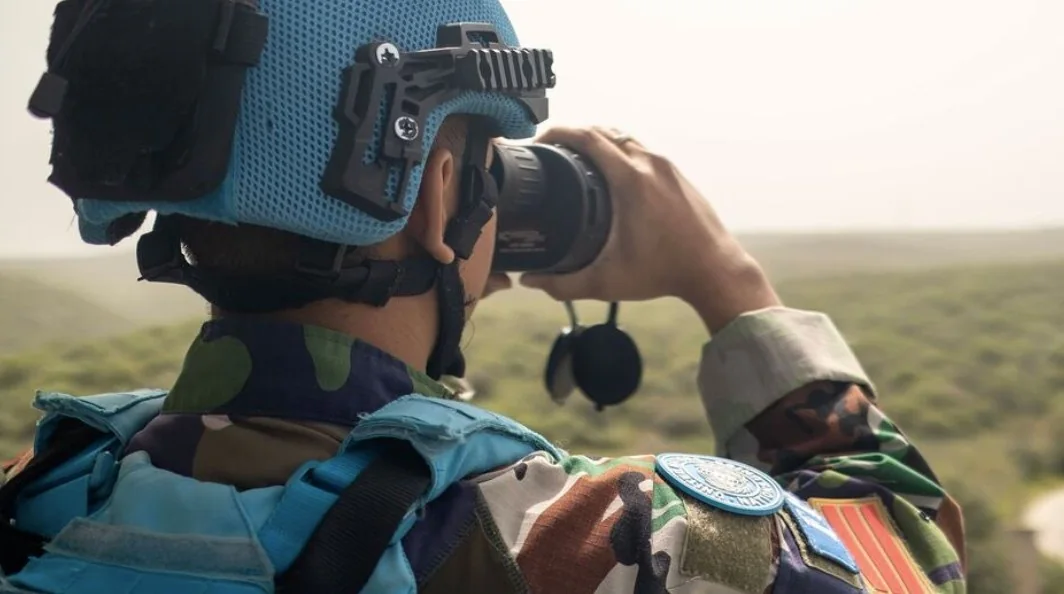
Kenya initially led the East African Community Regional Force (EACRF) in eastern Congo before deteriorating relations with Kinshasa led to its withdrawal.
South Africa later emerged as the principal troop contributor to the Southern African Development Community Mission in the DRC (SAMIDRC), adopting a more robust military posture.
While both missions were framed as contributions to regional stability, the transition highlighted a broader contest over influence in African peace and security architecture. A similar pattern has emerged in South Sudan.
South Africa has increasingly highlighted the role of the African Union Committee of Five, which it leads, in rescuing South Sudan’s delayed transition process.
Kenya, meanwhile, invested heavily in the Nairobi-led Tumaini Initiative, which ultimately struggled to produce a breakthrough.
The absence of any visible coordination between the two efforts highlighted how Africa’s leading diplomatic powers often pursue parallel rather than joint initiatives. Yet despite these differences, both leaders repeatedly emphasised cooperation over rivalry.
Ramaphosa cited the two countries’ engagement on regional peace efforts as evidence that they share more common ground than disagreement.
“When there were problems in the DRC, it was the two countries that fostered the whole quest for peace and resolution,” he said.
“I found that working together at close range, we were able to see eye to eye on a number of issues.”
The delicate balance between competition and cooperation was also visible in discussions about global governance.
Ruto praised Ramaphosa for hosting the 2025 G20 Summit, the first held on African soil, despite having skipped the gathering himself.
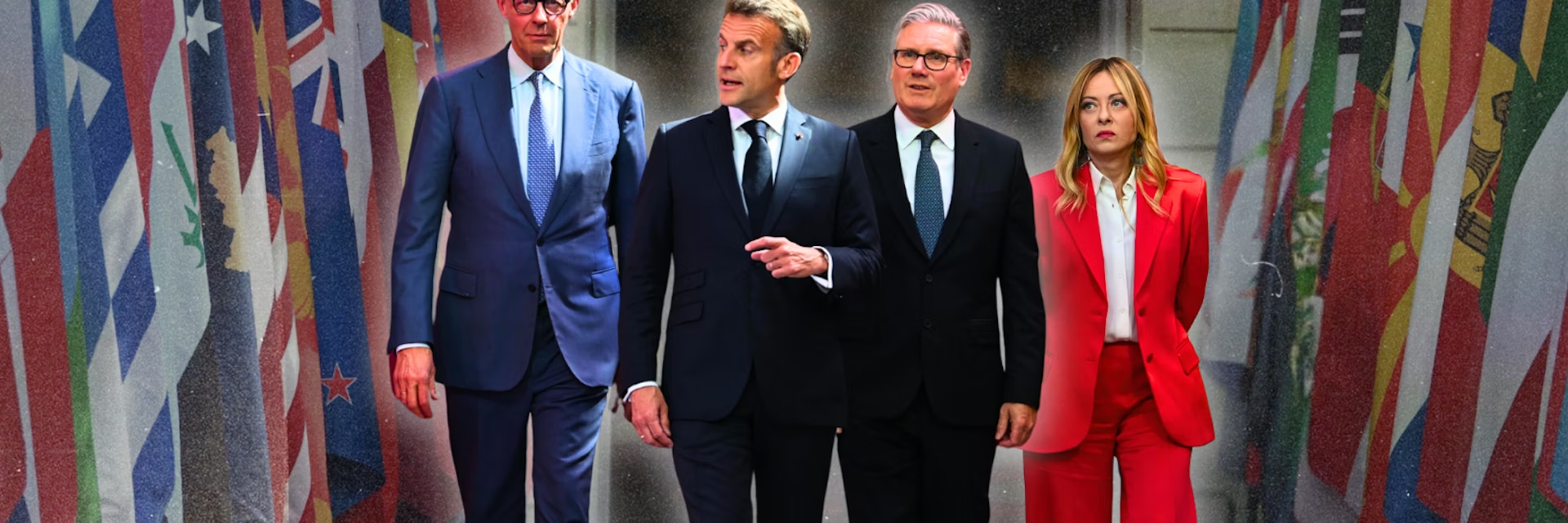
Ramaphosa, in turn, expressed support for Ruto’s participation at the upcoming G7 Summit in France.
“While President Ruto goes to France for the G7, he will be articulating the position of Africa,” Ramaphosa said.
“He will be speaking for the continent. He will deliver the agenda promoting African interests.” The symbolism was difficult to miss.
Both leaders had previously skipped major summits hosted by the other. Yet in Pretoria, they presented themselves as partners advancing a common African agenda.
Ramaphosa summed up the approach with characteristic enthusiasm.
“We have chosen not to be spectators, and we have also chosen not to be quiet,” he said. “We are noisy Africans. Ruto’s voice will be even more elevated when he speaks at the G7. We will be very noisy when we get there.”











Comments
Sign in with Google to comment, reply, and like comments.
Continue with Google