At Malaba, one of East Africa’s busiest border crossings, health workers stand at the frontline of Ebola Virus Disease (EVD) prevention.
The Point of Entry (POE) clears approximately 1,500-2,000 travellers daily, originating from multiple countries in the region, including Uganda, South Sudan, the Democratic Republic of Congo (DRC), Rwanda, Burundi, and Tanzania, reflecting high cross‑border movement that heightens the public health risks of disease importation and transmission.
As travellers stream through each day, officials check temperatures, monitor for signs of illness, and remain alert for Ebola. Their work is part of a broader effort across Kenya to strengthen preparedness following recent Ebola cases in Uganda and the DRC.
The Ministry of Health has said Kenya has accelerated training for rapid response teams, expanded laboratory capacity, assessed isolation facilities, and activated emergency operations centres. These efforts have been supported by the United States (US), which has provided funding, technical expertise, and hands‑on support across the full spectrum of health security.
According to its Nairobi Embassy Spokesperson, part of the $13.5 million (Sh1.7 billion) support package announced by Secretary of State Marco Rubio two weeks ago is helping strengthen surveillance and preparedness along key regional travel and trade corridors to support early detection of public health threats.
“Given the high volume of cross‑border movement and recent Ebola cases reported in Uganda, strengthening preparedness in Busia is critical to ensuring the rapid detection and response to potential cases and reducing the risk of cross‑border disease spread,” the Spokesperson said.
Efforts to curb the virus at the border led to the training of the National EVD Rapid Response Team, whereby approximately 120 national‑level responders, including public health officers and Kenya Defence Forces personnel, have since June 8 been equipped with standardised EVD training to cascade nationwide.
The Spokesperson said US‑supported trainings reached over 160 Rapid Response Team members across three high‑risk border counties: Busia (60 trainees), Turkana (48), and Trans‑Nzoia (54).
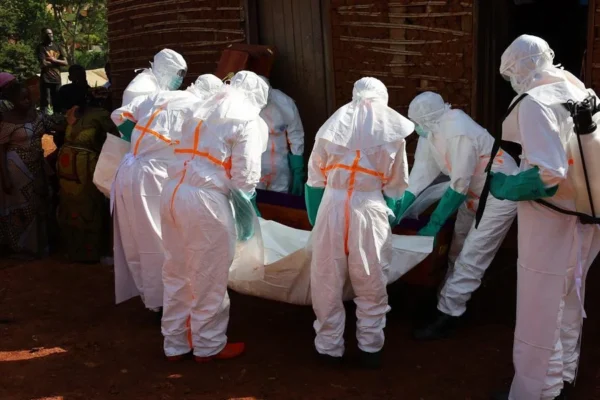 Medical workers in protective suits transfer the body of an Ebola victim in Mongbwalu, Ituri province, eastern Democratic Republic of the Congo (DRC), May 24, 2026. (Photo: Str/Xinhua)
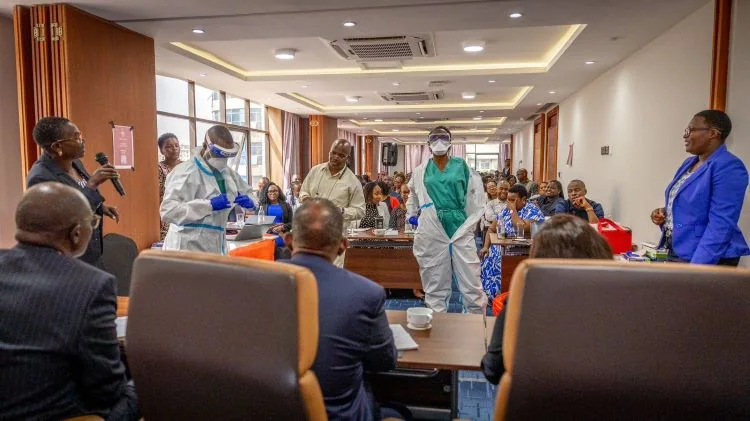
The training covered the full outbreak response cycle, including case management, disease surveillance, infection prevention and control (IPC), laboratory specimen handling, risk communication, and tabletop simulation exercises.
Efforts have also strengthened isolation and quarantine infrastructure in Busia County after a joint US‑supported assessment identified Alupe Sub‑County Referral Hospital as the most viable site for an EVD isolation centre.
“The assessment flagged critical gaps in personal protective equipment (PPE), staffing, and emergency transport, all of which will be prioritised for US support,” the Embassy said on Thursday.
At the same time, the US is supporting Kenya’s Ministry of Health, through the Kenya National Public Health Institute (KNPHI), in assessing designated quarantine and isolation facilities across 22 high‑risk counties.
Additional efforts include strengthening border health screening by procuring and distributing Ebola‑compliant PPE and thermal scanners, and supporting the pre‑positioning and strategic allocation of supplies at key crossings.
The US has further supported the development of a Kenya EVD risk map to guide preparedness and response planning nationwide. As a result, 12 high‑risk counties have been identified for US‑supported Emergency Operations Centres (EOC) establishment and operationalisation.
“A readiness deployment tool will be rolled out to these counties in the coming week,” the Spokesperson added.
The US has also supported finalisation of a national laboratory strategy for viral hemorrhagic fevers (VHFs) and other high‑consequence pathogens. The framework was developed with input from 35 experts across national, county, and partner levels.
Through CDC, the US has trained 1,740 Field Epidemiology and Laboratory Training Program (FELTP) residents who serve as Kenya’s frontline disease detectives, playing a critical role in outbreak preparedness, detection, and response.
Kenya is enhancing its capacity to detect and respond to cross‑border health threats by integrating the Population Connectivity Across Borders (PopCAB) methodology into the FELTP curriculum.
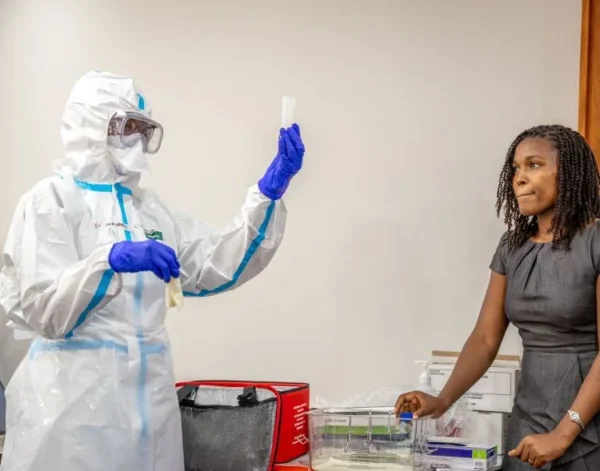 Ebola infection prevention and control training led by CDC Kenya’s Dr Linus Ndegwa. (Photo: Courtesy)
In May 2026, the US supported Ebola preparedness training for 50 healthcare workers in Busia County. CDC’s support is helping Kenya rapidly and safely detect and rule out Ebola cases.
Two of the four laboratories testing suspected Ebola samples in the country are CDC‑supported KEMRI labs in Nairobi and Kisumu.
The Spokesperson confirmed that CDC will further provide reagents to the mobile laboratory in Busia County for faster decentralised testing.
“As of June 10, CDC‑supported laboratories had tested 74 suspected Ebola cases, with all results negative,” he added.
Furthermore, CDC has trained 835 Kenyan laboratory personnel in biosafety and biosecurity to ensure safe handling of high‑risk specimens.
It has also trained staff from county referral hospitals in Busia, Bungoma, Trans Nzoia, Marsabit, Kilifi, Mombasa, and Mbagathi in Nairobi, as well as the National Public Health Laboratory, in polymerase chain reaction (PCR) testing to detect Ebola’s genetic material.
Additionally, CDC has supported training of more than 70 national and county staff through a Public Health Emergency Management (PHEM) fellowship program.
Meanwhile, the Ministry of Health has activated all 27 CDC‑supported county and national EOCs to support Ebola preparedness and response efforts.
The centres, located in 25 counties that are home to more than half of Kenya’s population, will be the backbone of outbreak response, coordinating surveillance, information sharing, and resource mobilisation to detect and contain threats quickly.
As of June 10, the US government had declared a total of $220 million (Sh28.5 billion) in Ebola response support towards preparedness activities in countries surrounding the outbreak, including Burundi, Kenya, Rwanda, and South Sudan.
“This funding is in addition to $350 million (Sh45.4 billion) for Ebola response and other humanitarian assistance in the DRC, South Sudan, and Uganda, as part of our $1.8 billion in assistance to UN OCHA announced on May 14,” the US government said on Tuesday.

























Comments
Sign in with Google to comment, reply, and like comments.
Continue with Google