The African Union Election Observation Mission (AUEOM) to Ethiopia’s June 1 general election has called on the government, political actors and other stakeholders to pursue “inclusive and sustained political dialogue” to foster national consensus, strengthen trust among political actors and advance democratic consolidation in the country
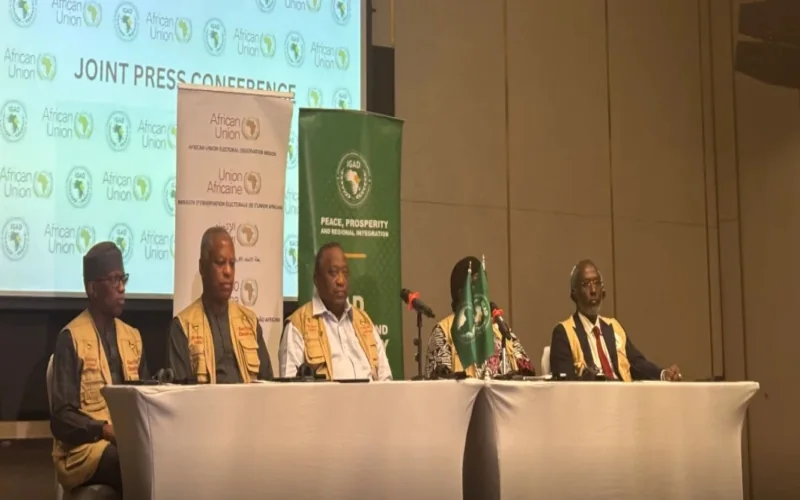
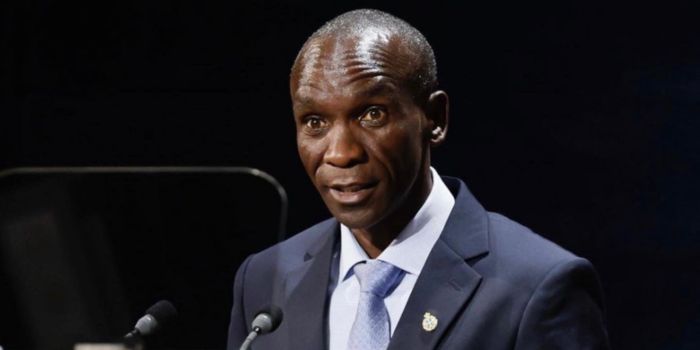
Presenting the mission’s preliminary findings in Addis Ababa on Wednesday, former Kenyan President and head of mission Uhuru Kenyatta said dialogue remained essential for addressing political differences and strengthening democratic governance.
Asked by Addis Standard why the mission had not included recommendations regarding the situation in Tigray and other areas where elections were not held, Kenyatta said officials of the National Election Board of Ethiopia (NEBE) had assured the mission that preparations were in place to conduct elections once security conditions improve.
“The people from NEBE have informed us that they are ready and prepared to pursue elections in Tigray and other constituencies as soon as the security situation improves,” Kenyatta said.
He indicated that the mission viewed the pending electoral activities as part of an ongoing electoral process and expected efforts to continue toward completing the remaining polls.
The issue of media freedom also surfaced during the press conference.
Addis Standard also asked the mission to clarify its assessment of media freedom during the electoral period, particularly in light of concerns raised by journalists and media organisations over regulatory actions and license revocation proceedings involving media outlets, including Addis Standard, Reuters and Deutsche Welle (DW) during the election period.
The mission, however, did not directly answer the question and did not provide a specific assessment of how restrictions on media operations may have affected the electoral environment. Instead, members of the mission referred generally to the findings contained in the preliminary statement and said further observations would be reflected in the final report.
Questions were also raised by Addis Standard about the competitiveness of the election and whether there was any realistic possibility that the ruling Prosperity Party could lose power through the ballot box.
Responding, Kenyatta defended the principle of electoral competition. “Yes,” he said when asked whether the election was competitive. The former Kenyan president argued that participation in democratic elections inherently involves accepting uncertainty regarding outcomes and the possibility of electoral defeat.
According to the mission, such dialogue should “support the meaningful participation of all citizens and communities in the political life of the country and contribute to the peaceful management of differences within Ethiopia’s constitutional framework.”
The AU mission further urged efforts to strengthen democratic institutions, promote political pluralism and enhance inclusive political participation.
“The Mission further encourages efforts to strengthen democratic institutions, promote political pluralism, enhance inclusive participation and create an enabling environment in which all citizens can freely exercise their democratic rights and contribute to national development,” the statement said.
The mission also reaffirmed the AU’s commitment to supporting Ethiopia’s democratic process, peace and stability, noting that it “remains seized of the outstanding electoral activities” and would continue observing the process before issuing its final report.
The recommendations came following the AU’s observation of Ethiopia’s seventh general election held on June 1 in most parts of the country.
However, the preliminary statement did not contain specific recommendations concerning constituencies where elections have yet to be conducted, including Tigray.
In its preliminary assessment, the AU mission commended the peaceful conduct of voting in many areas and acknowledged efforts by electoral authorities to administer the polls. At the same time, it encouraged continued reforms aimed at strengthening democratic governance, broadening political participation and creating an environment in which all citizens can freely exercise their democratic rights.
“The AUEOM remains seized of the outstanding electoral activities and reaffirms the African Union’s commitment to supporting Ethiopia in its efforts to consolidate democratic governance, peace, stability and sustainable development,” the statement said.
The mission is expected to release a final report in the coming months containing a more comprehensive assessment of the electoral process and additional recommendations.
The AU deployed 73 short-term observers drawn from 37 African countries to monitor Ethiopia’s seventh general election. The delegation included election management experts, diplomats, parliamentarians, civil society representatives, media professionals, women and youth representatives.
The election was held across much of the country on June 1, 2026. However, voting did not take place in several constituencies, including in Tigray, where electoral activities remain pending due to security and logistical challenges.
NEBE has previously indicated that elections in constituencies where voting was not conducted would be organised once conditions permit.
The Intergovernmental Authority on Development (IGAD) Election Observation Mission, on its part, has commended Ethiopia’s seventh general election as a significant milestone in the country’s democratic and electoral development, while highlighting security-related challenges that prevented voting in parts of Tigray and Amhara regions.
In its preliminary report released today, the regional bloc described the June 1 election as an “Election of Many Firsts” due to a series of institutional and technological reforms introduced by NEBE.
“The 7th General Election represents a notable milestone in Ethiopia’s democratic and electoral development, particularly the introduction of major technological and institutional reforms aimed at improving election administration and enhancing the inclusivity and credibility of electoral participation,” the mission said.
The mission, led by former Ugandan Vice President Dr Wandira Speciosa Kazibwe, deployed 26 observers across seven regional states and city administrations.
According to the report, more than 54 million voters were registered for the election, which was conducted in 501 out of 547 constituencies and across approximately 52,000 polling stations nationwide.
On election day, NEBE said 143 polling stations failed to open due to security concerns, while voting that had already commenced was interrupted in parts of the Oromia and Amhara regions. NEBE identified localities, including Bilonopa, Mekosachi, Qersa, and Kutaber, among areas where polling was disrupted after voting had begun.
The board said more than 50,000 polling stations opened across the country, but security-related incidents prevented voting in a number of locations. The disruptions came despite repeated assurances from security authorities that arrangements had been put in place to ensure a peaceful election process.
Prior to the vote, opposition parties and observers had raised concerns that ongoing conflicts in parts of Amhara and Oromia could affect voter participation and the conduct of the election. The election was also held without voting in Tigray, where parliamentary elections were not conducted.
Despite the disruptions, voting proceeded in most parts of the country. More than 50 million voters were registered for the election, whose final results are expected to be announced on 11 June.



















Comments
Sign in with Google to comment, reply, and like comments.
Continue with Google