15 Artificial Intelligence-focused startups from across Africa graduated from the Google for Startups Accelerator Africa programme on Thursday, marking a major milestone in the continent’s growing shift toward AI-driven, revenue-generating innovation.
The startups, drawn from Nigeria, Kenya, South Africa, Uganda, Tanzania, Senegal, Côte d’Ivoire, and Angola, completed a three-month hybrid accelerator programme that culminated in a Demo Day held in Nairobi.
The programme, which ran from April 13 to June 19, 2026, provided the founders with mentorship from experienced mentors and industry experts. They also gained access to technical workshops and resources focused on AI and cloud technologies, equipping them to scale their impact and prepare for funding.
According to programme data, 60 per cent of the participating startups are already profitable, generating an average monthly revenue of approximately $60,000 (about Sh9.5 million) and collectively raising $1.1 million (about Sh173 million) in early-stage funding.
Organisers say this reflects a growing trend toward “high-yield” innovation across African tech ecosystems.
Nairobi hosts AI innovation showcase
The 2026 Close-out Week and Demo Day in Nairobi brought together founders, investors, and Google leadership to showcase solutions built during the accelerator, which ran from March to June 2026.
Google paired the selected startups with engineers, product experts, and cloud infrastructure tools to help them scale operations and refine AI-driven solutions.
The programme is equity-free, meaning startups retain full ownership while gaining technical and strategic support.
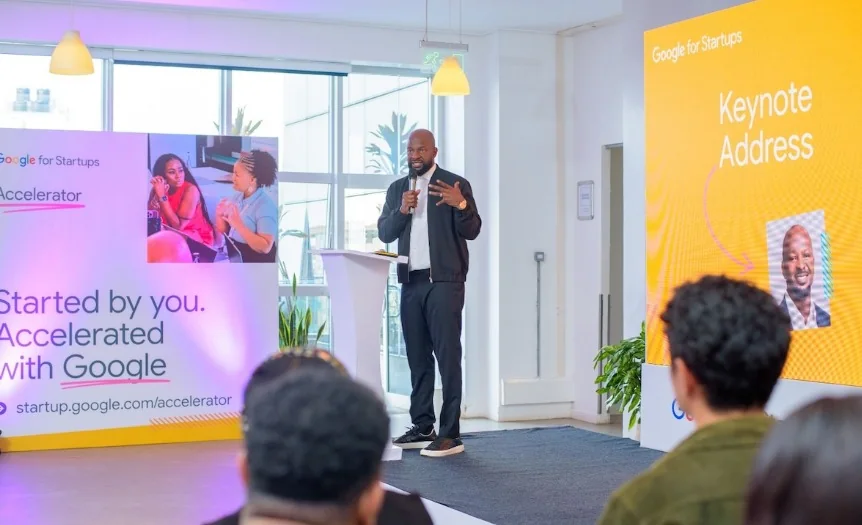
Speaking at the event, Alex Okosi, Managing Director for Google in Africa, said the cohort demonstrates how African founders are using AI to solve real-world problems at scale.
“We are proud to see how these startups are innovatively using AI to tackle real-world challenges across the continent,” he said.
“Through our equity-free support and connection to Google services, we are providing founders with a blended model that offers the much-needed mentorship and technical support to thrive.”
Focus on AI for social and economic impact
Folarin Aiyegbusi, Head of Startup Ecosystem for Google in Africa, noted that this year’s programme placed strong emphasis on machine learning and AI tools designed to address societal challenges.
He said startups are increasingly using data and automation to transform sectors such as financial services, healthcare, agriculture, mobility, and digital communications.
Across the cohort, founders are building platforms that aim to improve efficiency, reduce costs, and formalise informal economic systems that dominate many African markets.
Kenya was well represented in the cohort, with four startups building AI-powered solutions to address what founders describe as “invisible infrastructure gaps” in the economy.
Coamana (Kenya): Developing AI systems to help digitise informal food supply chains. The platform interprets real-time market data to make informal food markets visible and trackable for governments, traders, and businesses. This is expected to improve food distribution planning and transparency in Kenya’s fragmented supply networks.
Duck (Kenya): Focuses on retail intelligence, helping consumer brands prevent stockouts through real-time shop-floor data. By providing instant visibility into retail inventory levels, the platform enables faster decision-making for manufacturers and distributors across Kenya’s fast-moving consumer goods sector.
ReportsAI (Kenya): Offers an AI-first data platform that converts unstructured information into structured institutional knowledge. The system is designed to help NGOs, enterprises, and public interest organisations produce compliance-ready reports and improve decision-making using automated data processing.
VunaPay (Kenya): Targets Kenya’s agricultural sector by addressing delayed payments for smallholder farmers. The platform provides fintech and data infrastructure for agricultural cooperatives, enabling faster payments, improved financial tracking, and access to embedded financing for farmers.
Safiri (Tanzania): Building digital infrastructure to improve transportation of people and goods across East Africa, including Kenya. The platform aims to enhance reliability and efficiency in mobility and logistics systems, which remain major bottlenecks in regional trade.
Continental startups
Beyond Kenya, the cohort includes startups addressing financial inclusion, healthcare access, multilingual AI, and cross-border trade:
Anda Africa (Angola): AI-powered credit scoring for informal moto-taxi workers.
Bani (Nigeria): Cross-border payments infrastructure for African businesses.
Emaisha Pay (Uganda): Agro-trade payments and embedded financing.
Loop (South Africa): Mobility and payments digitisation platform.
Maad (Senegal): AI-powered omnichannel market expansion platform.
MasteryHive AI (Nigeria): Fraud detection, AML monitoring, and transaction reconciliation.
Meditect (Côte d’Ivoire): Digital pharmacy management system.
Since its launch in 2018, the Google for Startups Accelerator Africa programme has supported over 190 startups across 17 African countries, helping them collectively raise hundreds of millions of dollars and create thousands of jobs.
Google says this year’s cohort reflects a new phase in African tech development, where startups are no longer only focused on experimentation but are increasingly building profitable, scalable businesses powered by artificial intelligence.
The programme also spotlighted broader impact-driven innovation, including health-focused solutions addressing critical challenges in underserved communities.
One example is an alumni startup working on low-cost portable ultrasound technology designed to improve maternal healthcare access in rural areas, where preventable complications remain a major concern.
For Kenya, the presence of four AI-driven startups in the cohort reinforces Nairobi’s position as one of Africa’s leading innovation hubs.
The startups’ focus on agriculture, retail intelligence, and data infrastructure reflects key sectors of the Kenyan economy where inefficiencies remain high but digital transformation is accelerating.
As these startups graduate from the accelerator, attention now turns to scale and whether they can convert early traction and technical support into sustainable businesses that reshape industries across Kenya and the wider region.











































Comments
Sign in with Google to comment, reply, and like comments.
Continue with Google