When the phone rings at an ambulance dispatch centre, there is rarely time for hesitation.
On the other end could be a woman in labour with no way to reach a hospital, a victim of a road crash bleeding by the roadside, or a family desperately trying to save a loved one whose condition has suddenly worsened.
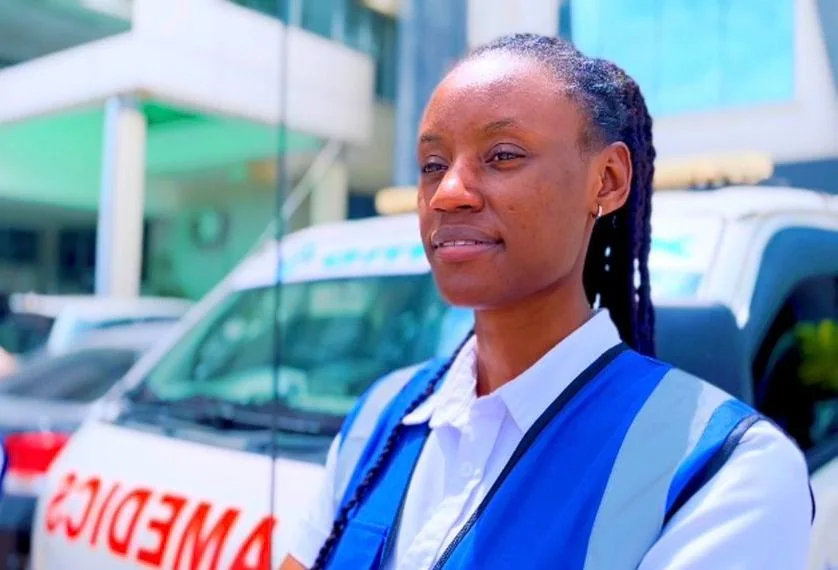
For 26-year-old paramedic and ambulance dispatcher Risper Onchomba, every call carries the weight of a life that may depend on decisions made within seconds.
"I don't like seeing people suffer when there is something I can do about it," she says. "If I can make someone's situation better, even a little, then I want to do it."
That desire to help others led her into emergency medical services, although her childhood dream was different.
"When I was young, I wanted to become a neurosurgeon," she recalls with a laugh. "But as I grew older, I realised paramedicine was actually my calling."
The choice was not entirely surprising. Risper comes from a family deeply rooted in healthcare. Apart from her father and one brother, nearly everyone in her household works in the medical field.
"My mother was my biggest inspiration," she says. "I looked up to her growing up, and she motivated me to pursue a career where I could be of service to others."
Today, she spends most of her days coordinating emergency responses from a dispatch centre. Her work involves receiving distress calls, assessing emergencies, and directing ambulances or emergency medical technicians to patients in need. A typical shift lasts 12 hours.
"You come in, receive a report from the previous shift, check pending calls, and monitor the locations of ambulances," she explains. "Then you stay alert because an emergency can come at any moment."
Every call must be assessed quickly. Dispatchers determine the type of help required, whether an ambulance is needed immediately or if another intervention can provide support.
The work becomes even more complicated because ambulance services are often expensive and largely operated by private providers.
"Not everyone can afford an ambulance," Risper says. "Sometimes you have to listen carefully to the situation and determine the best way to help."
She remembers one recent case involving a pregnant teenager who had gone into labour at home.
"She had no means of getting to the hospital. In such a case, you cannot just ignore it because someone cannot pay. It would be inhumane."
To improve response times, her organisation uses a network of trained emergency medical technicians stationed across different areas. Equipped with trauma kits and connected through a mobile application, they can reach patients on motorcycles long before an ambulance navigates through Nairobi's notorious traffic.
"They provide first aid and stabilise the patient while we organise evacuation if needed," she explains. But not every story ends well.
Like many emergency responders, Risper has witnessed death and tragedy firsthand. Some patients call too late, when their condition has already deteriorated beyond recovery.
 Risper Onchomba, a paramedic dealing with emergency response. (Photo: Courtesy)
"There is only so much you can do," she says quietly. "You prepare yourself psychologically based on the information you receive, but you never stop hoping for the best outcome." After difficult cases, she reflects on her actions.
"I ask myself whether I did everything I was supposed to do. That helps me process what happened."
One of the most emotionally demanding situations involves responding to mass-casualty incidents, where several people need urgent care at the same time.
In such moments, paramedics must make decisions that most people hope they never face.
"When there are many casualties, your goal changes from saving one life to saving as many lives as possible," she explains.
Using a process known as triage, responders categorise patients according to the severity of their injuries and their chances of survival. Those with critical but treatable injuries receive priority, while resources are directed where they can save the most lives.
"It is never about who is more important," she says. "Every patient matters. But you have to make objective decisions very quickly."
The emotional toll of the profession extends far beyond emergency scenes.
Emergency responders routinely witness road accidents, violent assaults, fires, building collapses, and sudden deaths. Yet mental health support remains limited.
"People think because we stay calm during emergencies, we are somehow immune to trauma," Risper says. "That is not true."
While her organisation offers counselling and debriefing services, she notes that many emergency workers across Kenya have little or no access to psychological support.
"We need more support from society and from government. Burnout is real. Trauma is real."
Even after six years in the profession, some memories remain vivid.
She laughs while recalling her first experience in an operating theatre as a student paramedic. Watching a Caesarean section nearly caused her to faint.
"I couldn't eat meat for almost two months," she says. "I honestly thought I would never eat it again."
With time, repeated exposure helped her adapt, though she admits no one truly becomes immune to the realities of emergency medicine.
"You learn to manage it, but you never stop being human."
Despite the long shifts, difficult decisions, and emotional strain, Risper remains convinced she chose the right path.
For her, being a paramedic is more than a profession.
It is an opportunity to be present when people are experiencing some of the worst moments of their lives and to offer help when it matters most.
And sometimes, that help begins with a calm voice answering a phone call.
Yet not every emergency call ends with paramedics rushing a patient to the hospital. Sometimes, responders are faced with a different challenge altogether: patients who refuse treatment.
Risper says many people are surprised to learn that patients have the legal and ethical right to decline medical care, even in serious situations.
"Patient autonomy is very important in healthcare," she explains. "If a patient is mentally competent, understands the risks involved, and can make an informed decision, we have to respect that choice, even if we disagree with it medically."
In some cases, patients may refuse transportation to the hospital or decline life-saving interventions. Similar principles apply to advance directives and do-not-resuscitate (DNR) orders, where patients have previously indicated they do not wish to undergo cardiopulmonary resuscitation (CPR) if their heart stops.
"Our responsibility is to explain the situation clearly, explain the risks and possible consequences of refusing care, and make sure everything is properly documented," she says.
However, when a patient is unconscious, confused, or unable to make decisions, emergency responders act under what is known as implied consent, providing treatment in the patient's best interests to preserve life.
"These situations can be emotionally difficult because our instinct is always to help," Risper says. "But ethical healthcare means respecting both human life and the patient's right to make decisions about their own body."
Mary Akinyi, a counselling psychologist at Furaha Infinity, underscores the importance of incorporating mental health support into emergency response efforts to help people recover from traumatic experiences.
She warns that survivors of disasters face a heightened risk of developing post-traumatic stress disorder (PTSD), depression, panic attacks, and other mental health challenges.
According to Akinyi, recovery should begin with individual mental health assessments to identify each survivor’s unique needs, followed by psychoeducation to help them understand and manage their emotional reactions.
She notes that the impact of traumatic events such as fires extends beyond physical injuries, often leaving deep psychological scars that require long-term care and support.
“The unpredictable nature of a fire can leave survivors feeling powerless and questioning whether they could have done more to protect themselves or their loved ones,” she says.
Many survivors also struggle with survivor’s guilt, repeatedly reliving the traumatic event and grappling with the fact that they survived while others did not.
“People often replay moments of fear and panic in their minds. Exposure to life-threatening situations can lead to persistent guilt, anxiety, and emotional distress,” Akinyi explains.
The loss of homes and personal belongings further compounds the trauma by stripping survivors of their sense of security and stability.
“Losing a home is not just a financial loss; it is also the loss of a place of safety, which can intensify grief and emotional suffering,” she adds.
To support recovery, Akinyi recommends establishing support groups where survivors can share their experiences with others who have gone through similar ordeals. She says strong social support systems, open communication with family and friends, and access to trauma-informed care are critical in helping individuals heal and rebuild their lives after a tragedy.
Mental health in Kenya is increasingly being recognised as a major public health concern, yet it remains one of the most under-resourced and misunderstood areas of healthcare. Experts estimate that nearly one in four Kenyans will experience a mental health condition at some point in their lives, with depression, anxiety, substance use disorders, bipolar disorder, schizophrenia, and post-traumatic stress disorder among the most commonly reported conditions. Despite this significant burden, access to care remains extremely limited, leaving a large proportion of those affected without diagnosis or treatment.

































Comments
Sign in with Google to comment, reply, and like comments.
Continue with Google