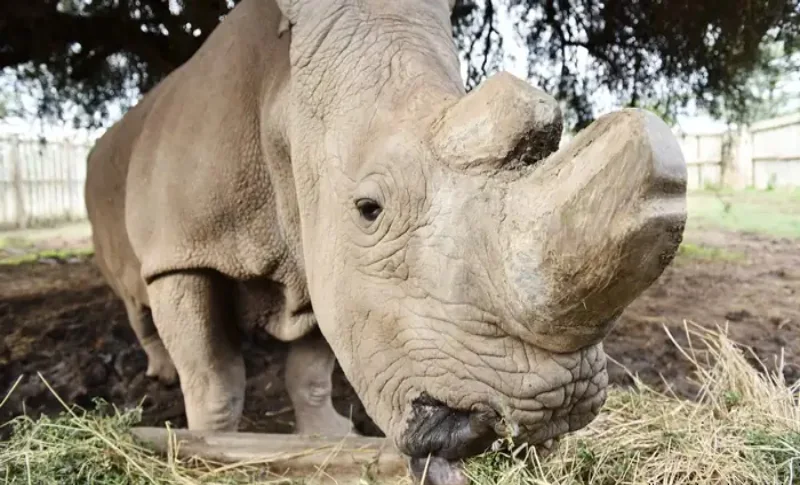
When Sudan, the world's last male northern white rhino, died in 2018 at Kenya's Ol Pejeta Conservancy, many believed they were witnessing the end of a species.
Instead, his death marked the beginning of one of the world's most ambitious conservation missions. Today, Kenya is at the centre of a global effort to rescue the northern white rhino from extinction.
At Ol Pejeta Conservancy in Laikipia County, the last two surviving northern white rhinos, Najin and her daughter Fatu, remain under round-the-clock protection while scientists race against time to restore the species through advanced reproductive technologies.
That extraordinary journey is the focus of The Caretakers, a new documentary that premiered at Nairobi National Museum last weekend, offering audiences a rare look at the people dedicating their lives to protecting what remains of one of Earth's most endangered mammals.
Set at Ol Pejeta Conservancy, the film follows rangers, caretakers, researchers and conservation teams working on the front lines. It explores the trust they build with the animals, the lasting scars left by poaching and the hope that science may one day reverse what human activity nearly destroyed.
"We wanted people to connect," Anthony Njoroge, the Editor of the film and also representing the Ol-Pajeta team, said during a panel discussion after the screening. "We didn't want this to be a story of people just going there to see rhinos. We wanted them to feel the emotions."
For producer Patel Mital, the documentary was inspired by the determination of those refusing to give up on the species despite overwhelming odds.
More than just a job
Among the film's central figures is Zackaria Mutai, one of the caretakers responsible for Najin and Fatu. What began as a job has become a lifelong commitment.
Having dreamed of becoming a conservationist since childhood, Zack now describes the two rhinos as family members.
Their daily routines revolve around ensuring the animals remain healthy, safe and comfortable while also serving as ambassadors for conservation.
The emotional toll of that responsibility became painfully clear following Sudan's death.
For the caretakers, losing him was not simply the loss of an endangered animal but of a companion they had cared for over many years.
The documentary captures that grief while highlighting the resilience required to continue protecting the species' final survivors.
Science against extinction
While the film is deeply personal, it also showcases the remarkable scientific work underway to save the northern white rhino.
With Sudan gone and neither Najin nor Fatu able to carry a pregnancy naturally, researchers are relying on advanced reproductive technologies, including in vitro fertilisation (IVF), embryo transfer and surrogate southern white rhinos.
Scientists involved in the BioRescue programme remain hopeful that another embryo transfer could take place in the coming months as research progresses.
The work is painstaking. A rhino's gestation lasts about 16 months, and every pregnancy attempt represents years of research, testing and international collaboration.
Researchers also revealed that scientists in Germany have successfully developed beating heart tissue from northern white rhino stem cells after years of research, an important scientific milestone that could support future conservation efforts.
When asked whether cloning could one day become part of the solution, researchers said it remains a possibility as technology advances.
"Destroying something is easy," one scientist remarked during the discussion. "Bringing it back is not."
Conservation takes a village
Beyond the laboratories and wildlife enclosures, The Caretakers illustrates that conservation depends on entire communities.
According to Mital, Ol Pejeta's work extends beyond wildlife protection to include tourism, cattle ranching, education and community engagement.
Tourism remains one of the conservancy's most important sources of funding, with growing numbers of Kenyan visitors supporting its conservation work. Environmental education programmes, school partnerships and public events are also helping inspire a new generation of conservationists.
The conservancy is also constructing a monument in memory of Sudan, allowing supporters to contribute by purchasing commemorative bricks that help fund conservation efforts.
For Mital, protecting endangered wildlife should not be left to conservation organisations alone.
"Don't admire conservation," he urged. "Be part of it."
An African story
The filmmakers said it was important that the story be told through African voices.
Rather than presenting wildlife as a tourist attraction, The Caretakers focuses on the people who spend every day protecting the world's last northern white rhinos and the emotional weight they carry.
The production also embraced new technology, using artificial intelligence to recreate selected scenes that would have been too costly or impossible to film conventionally. According to Mital, the AI-assisted sequences took months to produce and were used to support, not replace, the documentary's storytelling.
As scientists continue working towards the first successful northern white rhino births through assisted reproduction, the film leaves audiences with a reminder that extinction is not only about losing a species but also about losing part of the planet's ecological balance.
The fate of the northern white rhino remains uncertain, but at Ol Pejeta Conservancy, hope has not disappeared.
As The Caretakers makes clear, the race to save the species is no longer just a Kenyan conservation story, but a global effort, with Kenya at its heart.








































Comments
Sign in with Google to comment, reply, and like comments.
Continue with Google