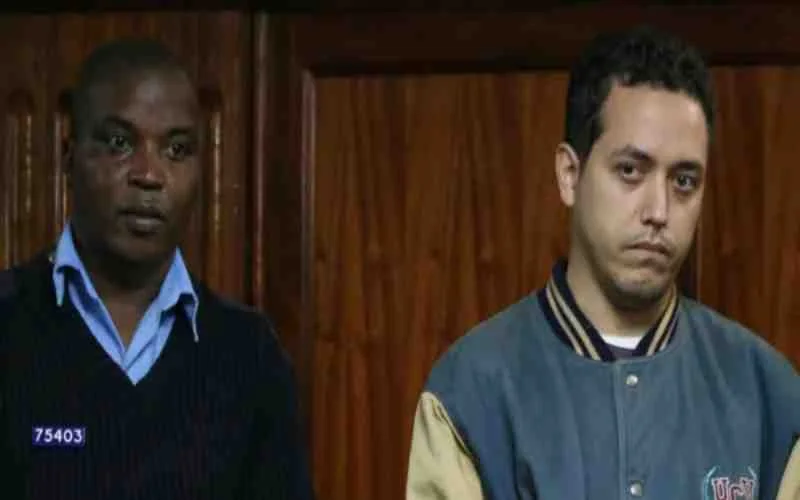
The Court of Appeal has certified that an intended appeal arising from the high-profile murder conviction of former Venezuelan embassy official Dwight Sagaray and his co-accused raises matters of general public importance, paving the way for the case to be heard by the Supreme Court.
In a ruling delivered on July 10, 2026, Justices Patrick Kiage, Jamila Mohammed and George Odunga found that the appeal raises substantial legal questions on diplomatic immunity, the standard of proof in criminal cases, and the doctrine of common intention.
"The matters which the applicants intend to raise before the Supreme Court raise a substantial point of law on diplomatic immunity, seek to settle a state of uncertainty in the law regarding the standard of proof in criminal cases where there is neither direct nor circumstantial evidence but where the allegation is that of motive," the judges ruled.
The appellate judges consequently issued a certificate under Article 163(4)(b) of the Constitution, allowing Sagaray and co-accused Ahmed Mujivane Omido to challenge the Court of Appeal's March 7, 2025 judgment before the Supreme Court.
The two were among four people convicted by the High Court for the 2012 murder of Venezuelan Ambassador Olga Fonseca, whose body was found at her residence in Nairobi's Runda estate barely two weeks after she arrived in Kenya to begin her diplomatic assignment.
The trial court sentenced each of the four convicts to 20 years in prison after finding that the prosecution had proved the case through circumstantial evidence. A fifth accused person was acquitted.
The Court of Appeal upheld both the convictions and sentences in March 2025, finding that Sagaray had lost his diplomatic immunity after Venezuela terminated his diplomatic posting and cancelled his diplomatic passport, thereby permitting Kenyan authorities to prosecute him.
However, in seeking certification to appeal, the applicants argued that both the High Court and Court of Appeal misinterpreted the Vienna Convention on Diplomatic Relations by treating the termination of diplomatic duties as equivalent to an express waiver of diplomatic immunity.
They also contend that the lower courts improperly relied on motive and inference rather than direct or sufficient circumstantial evidence to sustain the murder convictions.
"These applications meet the test set out in Hermanus Phillipus Steyn v Giovanni Gnecchi-Ruscone and warrant certification," the Court of Appeal held.
The judges said the Supreme Court should provide authoritative guidance on what constitutes an express waiver of diplomatic immunity, the scope of residual diplomatic immunity after a diplomat's functions cease, and whether motive alone can sustain criminal liability where direct evidence is lacking.
The Supreme Court will now have the final opportunity to determine the constitutional and international law questions arising from one of Kenya's most closely watched diplomatic murder prosecutions.














































Comments
Sign in with Google to comment, reply, and like comments.
Continue with Google