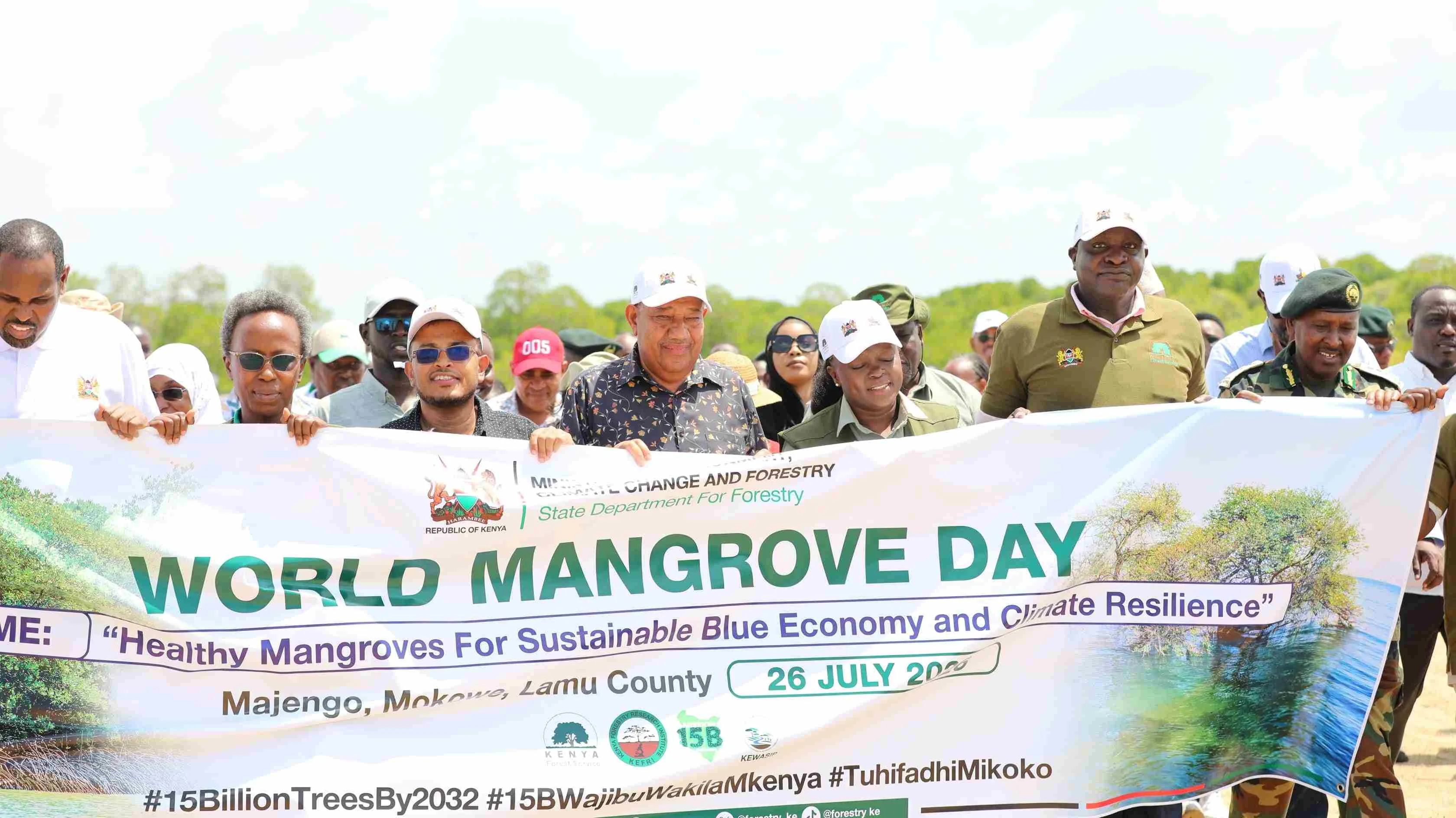
Kenya will integrate mangrove conservation into its broader national development agenda as it seeks to grow the blue economy and strengthen climate resilience, Environment, Climate Change and Forestry Cabinet Secretary Deborah Barasa said during World Mangrove Day celebrations in Lamu County.
Speaking at the event, Barasa said the government recognises mangrove forests as critical natural infrastructure that supports economic growth while protecting vulnerable coastal communities from the impacts of climate change.
She said healthy mangrove ecosystems are essential to unlocking opportunities in fisheries, tourism, climate finance and sustainable livelihoods, noting that protecting the forests is not only an environmental responsibility but also an economic and national development priority.
"The future of Kenya's blue economy begins in our mangrove forests. Protecting these ecosystems is not simply an environmental responsibility; it is an economic and national development imperative," Barasa said.
The celebrations, held at the Kenya Forestry Research Institute (KEFRI) grounds in Mokowe, followed the conclusion of a two-day National Mangrove Stakeholder Forum that reviewed the implementation of the National Mangrove Ecosystem Management Plan (2017–2027) and explored strategies to strengthen future conservation efforts.
The forum brought together policymakers, researchers, development partners, private sector players and community representatives to assess progress made under the current management plan and identify practical measures to improve governance, attract private investment and expand community participation in mangrove restoration programmes.
Participants also explored innovative financing mechanisms to support large-scale restoration and enhance benefit-sharing models aimed at creating sustainable income opportunities for communities living adjacent to mangrove forests. The recommendations are expected to inform Kenya's next National Mangrove Management Strategy.
Kenya has approximately 61,271 hectares of mangrove forests spread along its 536-kilometre coastline, with Lamu County accounting for about 61 per cent of the country's mangrove cover. The forests are also found in Kilifi, Kwale, Mombasa and Tana River counties.
Besides protecting coastlines from erosion and storm surges, mangroves provide breeding grounds for fish and other marine species, improve water quality, store significant amounts of blue carbon and support livelihoods through fisheries, ecotourism and sustainable harvesting of forest products.
However, the ecosystems continue to face growing threats from illegal harvesting, pollution, encroachment, rapid coastal development, sedimentation, reduced freshwater flows and climate change. Stakeholders expressed confidence that stronger partnerships, sustained investment and effective implementation of conservation policies will help safeguard Kenya's mangrove forests while advancing the country's blue economy and climate goals.




































Comments
Sign in with Google to comment, reply, and like comments.
Continue with Google