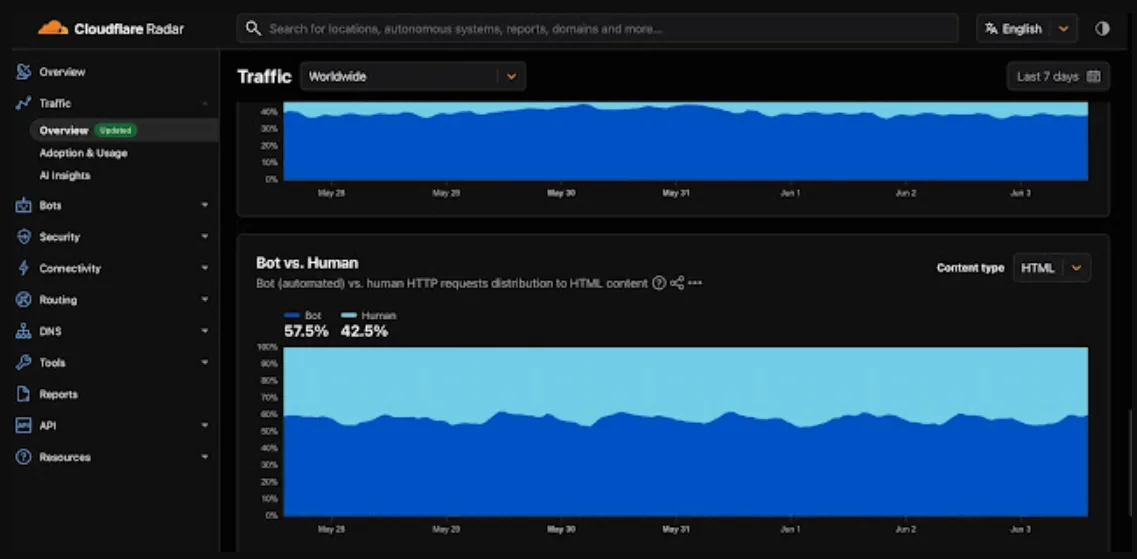
For the first time since the World Wide Web emerged more than three decades ago, automated bots now generate the majority of global web traffic, overtaking human users and signalling the arrival of a new AI-driven internet era.
According to new data from Cloudflare Radar, bots now account for 57.5 per cent of all HTTP requests to HTML pages worldwide, while human-generated traffic has fallen to just 42.5 per cent.
The findings represent a landmark moment in the evolution of the internet. What was once a network built primarily for human communication, commerce, and information exchange is increasingly becoming a machine-to-machine ecosystem dominated by artificial intelligence systems, automated crawlers, and autonomous software agents.
The trend is particularly pronounced in the United States, where bot traffic now represents an astonishing 71.5 per cent of web requests, highlighting how deeply automation has penetrated the world's largest digital economy. In Kenya, bot traffic generally makes up between 19 per cent and 45 per cent of all web requests, remaining notably lower than the US average.
While automation is rising, Kenyan internet users represent one of the highest rates of human AI engagement globally
A prediction arrives early
The shift has occurred years ahead of expectations, and this was confirmed by Cloudflare CEO Matthew Prince, who predicted early this year that bots would surpass human internet traffic by 2027.
Instead, the milestone has arrived significantly sooner as advances in generative AI accelerate the deployment of autonomous agents across the web.
Cloudflare's network, which handles traffic for roughly one-fifth of all websites globally, reported that automated systems accounted for approximately 53 per cent of HTML requests by the end of 2025.
The company's findings align closely with the 2025 Imperva Bad Bot Report, which found that automated traffic represented 51% of all internet traffic globally in 2024, the first time bots had crossed the halfway mark since systematic tracking began more than a decade ago.
The AI boom is fueling the explosion
At the centre of the transformation is the explosive growth of artificial intelligence. Modern AI systems require large amounts of online data to train, update, and improve their models.
Every day, AI crawlers scan billions of web pages to gather information, while AI-powered search engines and digital assistants continuously access websites to answer user queries.
Unlike human users, who browse a handful of websites during a search, AI agents can access thousands within seconds.
Industry experts estimate that a person researching a product online may visit five websites before making a purchase decision.
An autonomous AI shopping assistant performing the same task might scan 5,000 websites, compare prices, analyse reviews, and generate recommendations, all within seconds.
As organisations increasingly deploy AI-powered agents to conduct research, schedule appointments, compare products, negotiate services, and execute tasks on behalf of users, machine-generated traffic is expanding at unprecedented rates.
Cloudflare reports that AI-driven traffic surged by 187 per cent during 2025, growing nearly eight times faster than traditional human browsing activity.
The rise of the agent economy: Is Kenya ready?
Technology analysts describe the current transformation as the emergence of the "agent economy", a new digital ecosystem in which autonomous AI systems increasingly perform tasks that were traditionally handled by humans.
These AI agents are capable of conducting online research, comparing products and prices, booking travel arrangements, managing customer service interactions, monitoring financial markets, writing software code, gathering business intelligence, and generating reports and summaries.
Instead of millions of people individually browsing websites and interacting with online services, billions of AI-driven requests are increasingly being executed on their behalf. The result is a fundamental shift in internet behaviour.
"We are moving from a human internet to an agent internet," one cybersecurity analyst observed. "The majority of online activity is no longer being generated by people sitting behind screens, but by software acting on their behalf."
For Kenya, the rise of the agent economy presents both opportunities and challenges.
On one hand, AI agents could significantly boost productivity across sectors such as banking, e-commerce, logistics, agriculture, healthcare, tourism, and customer service.
Businesses could automate routine tasks, improve decision-making, and reduce operational costs. Consumers could rely on AI assistants to search for products, compare prices, make bookings, and access information more efficiently.
On the other hand, the shift raises critical questions about Kenya's digital readiness, cybersecurity capabilities, regulatory frameworks, and the ability of local businesses and institutions to adapt to an increasingly automated internet.
Security challenges intensify
Not all bot traffic is beneficial. Cybersecurity researchers warn that the growing dominance of automated systems creates significant security risks.
Globally, approximately 37 per cent of all bot traffic is categorised as malicious, commonly referred to as "bad bots".
These automated systems are responsible for activities such as:
Credential stuffing attacks
Account takeovers
Data scraping
Ticket scalping
Price manipulation
Spam generation
Distributed Denial-of-Service (DDoS) attacks
Only about 14 per cent of automated traffic consists of legitimate bots performing useful functions such as search engine indexing, website monitoring, and accessibility services.
The rapid advancement of AI is also making malicious bots harder to detect.
Unlike traditional automated programs, modern AI-powered bots can mimic human behaviour, navigate websites naturally, and evade conventional security systems.
For Kenya's growing digital economy, driven by mobile money, e-commerce platforms, fintech innovation, and digital government services, the rise of sophisticated AI-powered cyber threats could significantly increase pressure on organisations to strengthen cybersecurity investments.
The rise of bots is also creating new challenges for media organisations, advertisers, and digital publishers.
For decades, website traffic has been used as a primary measure of audience engagement and advertising value. However, as bots account for a growing share of online activity, these metrics are becoming increasingly unreliable.
A website may appear to be attracting record traffic while, in reality, a significant proportion of visits are generated by AI systems scraping content rather than human readers consuming it.
Cloudflare recently introduced measures allowing website owners to block AI bots by default unless explicit permission is granted. The company is also exploring mechanisms that would enable content creators to charge AI systems for access to their content.
The concept, commonly referred to as "pay-to-crawl", is gaining momentum across the global publishing industry.
Supporters argue that such models could help create a sustainable economic framework for journalism and content creation in an AI-dominated web ecosystem. Critics, however, warn that widespread restrictions could fragment the internet and limit access to information.
As AI assistants, autonomous agents, and machine-driven services continue to proliferate, experts expect the gap between bot and human traffic to widen dramatically in the years ahead.
















































Comments
Sign in with Google to comment, reply, and like comments.
Continue with Google