Kenya has joined Spain, the European Union and France in launching a global coalition aimed at protecting children from risks linked to Artificial Intelligence (AI), with the country committing to support efforts to detect AI-generated child abuse material and strengthen online safety measures.
The coalition seeks to bring together governments and international partners to promote safer artificial intelligence systems and ensure children’s rights are protected in the digital age.
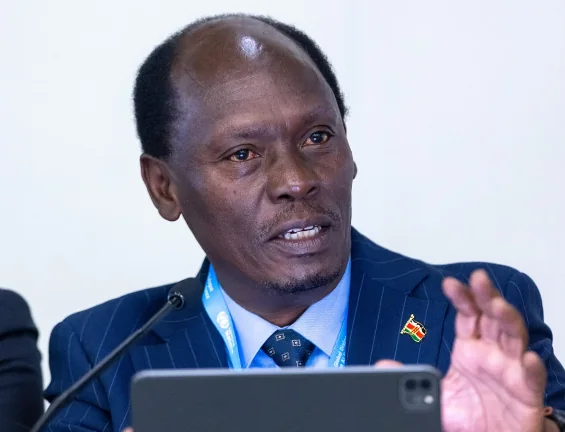
Information, Communications and Digital Economy Cabinet Secretary William Kabogo announced Kenya’s commitment during the launch of the Coalition for Children’s Rights and Protection in the Age of Artificial Intelligence at the AI for Good Summit and the World Summit on the Information Society (WSIS) 2026 in Geneva.
Kabogo said the initiative will help ensure children receive equal protection online regardless of their location, language or access to technology as artificial intelligence continues to create new opportunities and risks.
He noted that by 2050, one in four people globally will be African, but warned that many AI systems currently used by children do not adequately support African languages.
Kabogo said online safety measures developed for English-speaking users may not always work effectively for children using other languages, creating gaps in protection.
“Every child’s life is of equal worth in every language,” he said, highlighting the need for inclusive AI systems that consider different languages and cultures.
As part of Kenya’s role in the coalition, the country will serve as a regional node for the rapid takedown of AI-generated child abuse material. It will also provide practical tools for schools and child protection institutions to improve online safety for children.
Kenya will further contribute findings from its child online protection survey conducted across all 47 counties to support the coalition’s scientific work and development of policies based on evidence.
Kabogo said the partnership reflects Kenya’s commitment to encouraging responsible and ethical use of artificial intelligence while ensuring technological growth does not put children’s rights and wellbeing at risk.
The coalition will operate under the United Nations framework and aims to improve coordination between governments, technology companies and civil society groups in developing measures that protect children online.
The launch comes as countries continue discussions on how to manage the rapid growth of artificial intelligence and address risks facing children, including harmful content, manipulation and misuse of technology.
Spain’s digital transformation minister Óscar López called on the international community not to repeat mistakes made during the growth of social media as countries respond to challenges brought by AI.
Speaking at the UN Global Dialogue on AI Governance in Geneva, López said, “We were late with social media, and now we face the problem again. We see a real pandemic on mental health, suicides, bullying and many problems we didn’t face 15 years ago…We cannot be late on AI.”
Spain has joined other countries, including the United Kingdom and Australia, in introducing tougher measures on social media use among children. López also criticised technology companies for benefiting from children’s data.
“Some billionaires, and a certain trillionaire, have been making money out of our children’s data. We must put a stop to that,” he said.
So far, 20 countries and international organisations have joined the initiative, including the International Telecommunication Union, the Office of the High Commissioner for Human Rights and the UN children’s agency, UNICEF.
Members of the coalition have also committed to ensuring children’s views “meaningfully contribute to the design, deployment and governance of AI systems that affect them”.
UN Secretary General António Guterres also called on countries to adopt an AI child safety pledge requiring companies to prove that systems accessible to children are safe and have zero tolerance for sexual abuse.
“No child should be a guinea pig for unregulated AI,” he said.
More than 100 organisations, including Amnesty International and Save the Children, have also called on governments to introduce safety measures requiring technology products to meet certain standards before reaching the market and imposing penalties for companies that fail to comply.











































Comments
Sign in with Google to comment, reply, and like comments.
Continue with Google