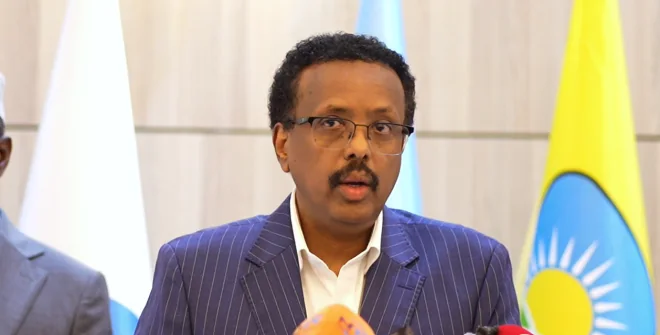
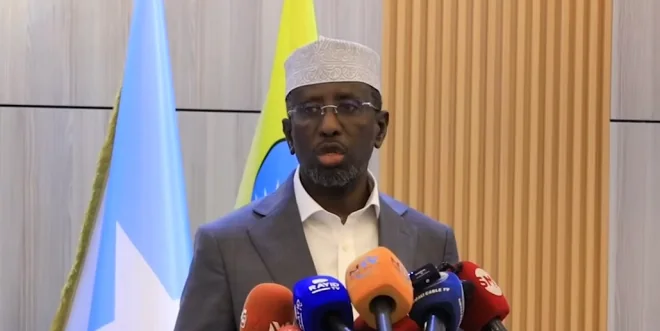
Former President Mohamed Abdullahi Farmaajo has called for urgent talks with President Hassan Sheikh Mohamud, saying Somalia’s political leaders must engage in dialogue to address growing disputes over elections, governance and national unity amid rising tensions in the country.
Speaking to reporters in Mogadishu, Farmaajo announced plans to formally invite President Mohamud to a meeting at his residence, where discussions would focus on the electoral process, the security situation and the country’s political future.
The former president said the meeting was necessary at a time when disagreements among political leaders were deepening, and concerns were growing over developments involving former President Sharif Sheikh Ahmed.
“Former President Hassan Sheikh's term is up. He must work with all stakeholders to keep Somalia together, not drive it apart. Former presidents Sharif Sheikh Ahmed and I have extended an invitation to him for a meeting to discuss the way forward on elections and the national future,” Farmaajo said.
His remarks come as political tensions continue to rise in Mogadishu over electoral reforms, constitutional changes and questions surrounding President Mohamud’s mandate.
Opposition leaders have accused the federal government of pushing ahead with major political reforms without adequate consultation, while government officials argue that the changes are necessary to prepare the country for one-person, one-vote elections and maintain stability.
Farmaajo said Somalia was facing a critical moment that required political leaders to work together rather than deepen divisions. He argued that the country’s challenges could be resolved through discussions among Somali stakeholders and that external involvement would become unnecessary if leaders were willing to engage and reach agreements.
“Somalia is at a critical political juncture, and disputes over the electoral process and governance have affected the country’s overall security and stability,” Farmaajo said.
The former president emphasised that dialogue remained the only viable path toward resolving the current political dispute and urged all sides to lower tensions and avoid actions that could worsen the situation.
According to him, progress on key national issues would only be possible if political actors participated in broad discussions aimed at reaching a political settlement that reflected the interests of all stakeholders.
He called on leaders across the political spectrum to prioritise the country’s interests and national unity over political competition, saying Somalia’s future depended on cooperation among its leaders.
Farmaajo also expressed his readiness to support efforts designed to bridge differences between political actors and help create conditions for constructive engagement. He said all parties should work toward finding common ground on issues affecting the country’s governance and future direction.
The former president warned that continued political divisions could have consequences beyond Mogadishu and affect relations between the federal government and regional administrations.
He pointed to challenges in different parts of the country, saying unresolved disputes were contributing to uncertainty and weakening confidence in national institutions. Farmaajo noted that Somaliland was continuing to move further away from the federal government, while Puntland remained in a difficult position as it awaited decisions from Mogadishu. He also said that disagreements involving Jubbaland had yet to be resolved and would require political negotiations.
According to Farmaajo, failure to address the current political deadlock could increase the risk of fragmentation and place additional pressure on Somalia’s state institutions.
His comments come amid heightened tensions following recent violence in Mogadishu and a growing political standoff between the federal government and opposition figures. The dispute has centred on elections, constitutional amendments and the broader direction of the country’s political system.
















Comments
Sign in with Google to comment, reply, and like comments.
Continue with Google