The much‑talked‑about Ol Kalou Constituency by‑election contest has left a sour taste in the political relations of United Opposition parties following a bitter fallout between the Jubilee Party and Democracy for the Citizens Party (DCP).
Former President Uhuru Kenyatta’s Jubilee Party had hoped to post impressive results, even if not winning the seat, but was handed a devastating defeat by the ex‑Deputy President Rigathi Gachagua‑led DCP.
Jubilee candidate Wilson Mwaniki Kigwa garnered only 198 votes, a stark contrast to the party’s dominance less than a decade ago when it swept the Mt Kenya region and helped secure Uhuru’s re‑election in the 2017 General Election. DCP's Sammy Douglas Kamau Waweru triumphed, after garnering 35,440 votes, while UDA’s Samuel Muchina Nyagah finished second with 5,450 votes.
As the dust of the Ol Kalou duel was settling, the Jubilee Party shocked its contemporaries in the Opposition ranks by openly condemning remarks made by Gachagua, who advised international tourists and investors to postpone their visits and investment until the forthcoming general elections are concluded.
On Tuesday morning, there was further disarray when one of its vocal leaders and top digital strategist, Pauline Njoroge, announced her exit from the outfit to join the Edwin Sifuna‑led political faction, Linda Mwananchi.
Njoroge, who was appointed to Jubilee’s National Executive Council (NEC) board in May 2023, confirmed to The Eastleigh Voice that the move was occasioned by her conviction to support Linda Mwananchi’s core goals of agitating for a change in leadership anchored in integrity and constitutionalism.
 Jubilee Party Deputy Organising Secretary and Digital Communications Strategist Pauline Njoroge has resigned from the party’s National Executive Committee (NEC) after 14 years. (X/Pauline Njoroge)
"Since February this year, I have had the privilege of being part of the Linda Mwananchi movement. Over the months, my conviction has only grown stronger that this movement represents an important platform for advancing the aspirations of our generation: a Kenya founded on good governance, the rule of law, constitutionalism, accountability and servant leadership," she said.
According to KANU Party Spokesperson Tony Gachoka, Njoroge’s resignation is a fresh move by Uhuru to abandon Jubilee and place his focus on the yet‑to‑be‑formed Linda Mwananchi Party.
"Uhuru Kenyatta has begun his exit from Jubilee to Linda Mwananchi. The resignation of pointwoman Pauline Njoroge shows his hand in the growing outfit, which also has Irungu Kangata. Rigathi Gachagua's win in Ol Kalou crushed Jubilee in Mt. Kenya; hence Uhuru. Now betting on Edwin Sifuna opening the Western front and has walked away from a Mt Kenya battle," he posted on his X account.
Tourism sector pushback
In its condemnation of Gachagua on Monday, Jubilee warned that calls for tourists and investors to boycott Kenya, which may have been interpreted as discouraging tourism or foreign investment, risk creating unintended consequences for millions of ordinary Kenyans whose livelihoods depend directly on these sectors.
The party said it believes tourism remains one of Kenya’s largest foreign exchange earners, supporting hundreds of jobs across various industries; hence, it cannot be interfered with by political actors who do not bear the full consequences.
“The people who bear the greatest cost of declining tourist arrivals or reduced investments are not those in positions of political authority. It is the hotel worker in Diani, the tour guide in Maasai Mara, the artisan in Mombasa, the farmer supplying fresh produce to hospitality establishments, the taxi operator, the young entrepreneur and thousands of families whose daily incomes depend on a vibrant economy,” the statement read in part.
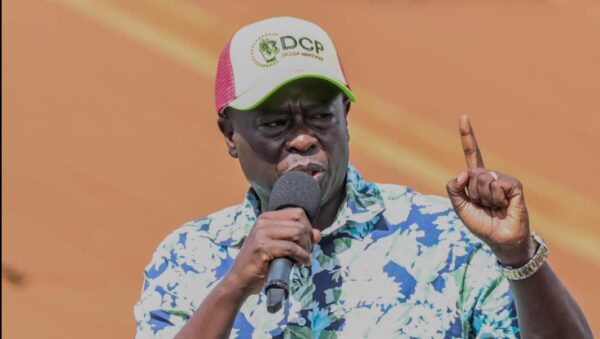 DCP leader Rigathi Gachagua addressing residents of Illasit in Kajiado South Constituency on May 3, 2026. (Photo: Facebook/Rigathi Gachagua)
Gachagua had urged tourists and investors to stay away from Kenya, citing rising insecurity that he blamed squarely on the government. He opined that the country was no longer safe and advised international visitors and investors to hold off until next year.
The remarks immediately drew condemnation from multiple stakeholders in Kenya, including the Kenya Tourism Federation (KTF), which warned of dire economic consequences.
KTF warned that such sentiments can puncture destination confidence and destroy a sector that sustains a significant economic ecosystem.
"Once confidence is damaged, rebuilding it can take years, sometimes even longer, regardless of how quickly political circumstances change," the Federation noted.
The Federation maintained that tourists visiting Kenya do not participate in domestic politics and are not targeted by political factions.
"They come to experience Magical Kenya’s wildlife, beaches, culture, hospitality, conferences and sporting events. They are neither involved in nor targeted by the political rivalries that occasionally play out within our country.”
Jubilee vs DCP rivalry
To understand Jubilee and DCP parties’ cold-blooded relations even as the Opposition is vouching for a joint presidential candidate to face President Ruto in his re‑election quest, former Ndaragwa Member of Parliament and top Jubilee Party official Jeremiah Kioni has often signalled their fractured positions.
Kioni earlier this month distanced himself from Gachagua’s continued use of the “cousin” narrative in his political messaging, saying he believes in a united Kenya rather than politics based on ethnic affiliations.
Speaking during an interview with a local media station on July 6, 2026, Kioni acknowledged that he and Gachagua differed politically despite being part of the opposition.
"The difference between Gachagua and me is that he believes in Kalonzo as his presidential choice, while I believe in Matiang’i. It’s pure politics; there’s nothing personal,” Kioni said.
He added that while he had no problem with leaders referring to communities as cousins, such messaging should not exclude other Kenyans.
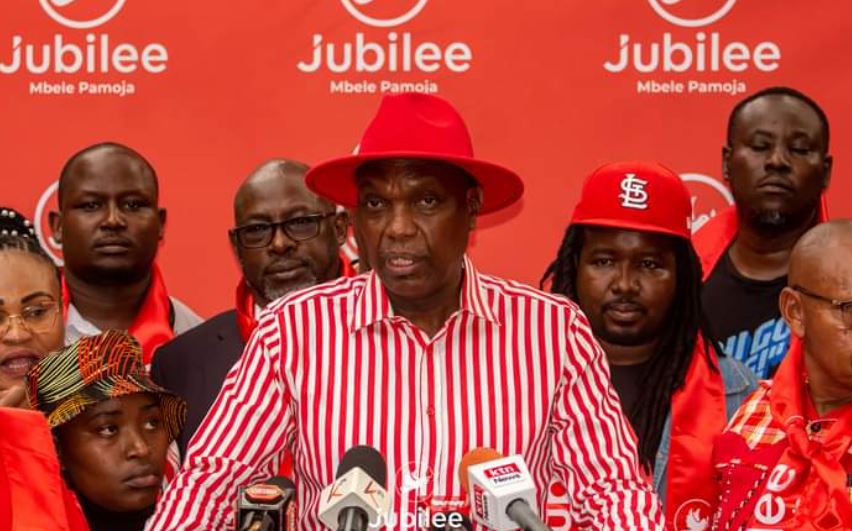 Jubilee Deputy Party Leader Jeremiah Kioni speaks during a past Jubilee presser. (Photo: Jubilee Party/X)
Formed in September 2016 through the merger of 11 political parties, including Uhuru’s The National Alliance (TNA) and Ruto’s United Republican Party (URP), Jubilee quickly emerged as Kenya’s dominant political force.
After forming the government following the 2017 General Election, Jubilee commanded majorities in both Houses of Parliament and controlled virtually every elective seat across the Mt. Kenya region.
However, the relationship between Uhuru and Ruto unravelled after the 2017 elections, triggering an internal power struggle that ultimately fractured Jubilee.
Ruto left the party ahead of the 2022 General Election to contest the presidency on the UDA ticket, carrying with him much of Jubilee’s traditional support base in the Mt. Kenya region.
Despite efforts to rebuild under Uhuru’s leadership, with Secretary‑General Moitalel Ole Kenta and Kioni, Fred Matiang’i and Jimmie Angwenyi spearheading the revival campaign, the Ol Kalou outcome suggests the party remains a marginal player in the region where it once enjoyed overwhelming support.







































Comments
Sign in with Google to comment, reply, and like comments.
Continue with Google