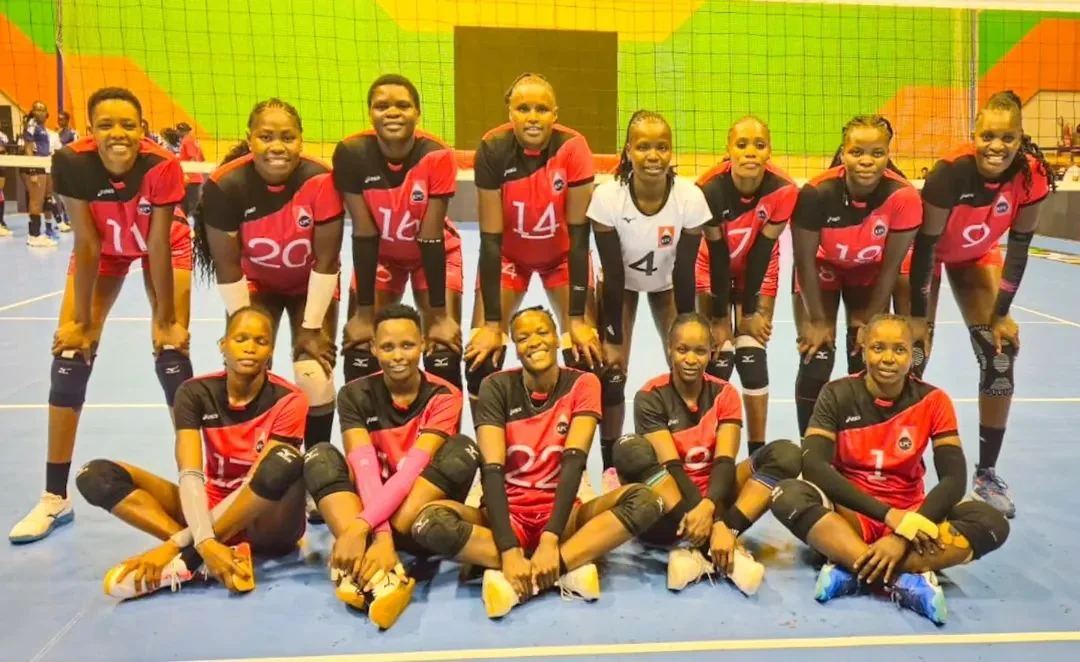
When Kenya Pipeline Volleyball Club players walk onto the court, opponents see one of Africa's most decorated volleyball teams.
What they do not see is the system that has quietly sustained the club's success for more than four decades.
Founded in 1984, Kenya Pipeline has grown into one of the most successful women's volleyball clubs in Africa, winning six African Club Championship titles and more than 14 Kenya Volleyball Federation league crowns while producing over 120 national team players.
Yet according to head coach Geoffrey Omondi, trophies are merely the end product of a philosophy built on one principle, merit.
"If you stick to merit as a coach, you always get the best," Omondi said during a media engagement in Nairobi. "Don't look at where a player comes from, don't look at the language they speak. Look at what is required in that position and stick to those requirements."
The coach, who previously spent more than a decade as a player with KCB before transitioning into coaching, believes the club's consistency is rooted in standards rather than reputation.
That approach has helped Pipeline remain among the dominant forces in Kenyan volleyball. The club reclaimed the KVF National League title last season and currently sits at the summit of the standings as it seeks to retain its crown.
But Omondi insists success begins long before players reach the senior team.
Unlike many clubs that rely solely on recruiting established stars, Pipeline actively scouts schools across the country, working closely with coaches and identifying talent at an early age.
The result is a steady production line that continues to replenish the squad while feeding players into the national team.
Among the beneficiaries of that system is club captain Gladys Ekaru, who also serves as assistant captain of Kenya's national women's team, the Malkia Strikers.
Leading a squad packed with experienced internationals and emerging talents, Ekaru believes the club's culture has played a major role in maintaining high standards.
"Our target is to lift the trophy again," she said. "We are doing well, and we are prepared. The upcoming matches against teams like KCB and DCI will determine whether we stay at the top, but we are ready."
Pipeline's hunger has only intensified after another strong continental campaign.
The club travelled to Cairo, hoping to reclaim the African title that last came to Nairobi in 2005. Although they fell short of that objective, they returned home with a bronze medal, marking a third consecutive podium finish at the African Club Championship.
For Ekaru, the tournament exposed areas that require improvement.
"We wanted to come back with the trophy. We didn't manage it, but the bronze medal is not a bad result. We identified challenges in reception, service and court coordination and we are working on them."
Her own volleyball journey mirrors the opportunities Pipeline has created for generations of players.
Introduced to the sport by a neighbour in 2014, Ekaru developed into a national team regular and one of the country's most reliable middle blockers. She credits experienced teammates and coaches for helping shape her career.
Away from the court, however, the captain's routine is surprisingly simple. Before major matches, she prefers spending time with her family and listening to gospel music, a ritual she says helps her stay calm and focused.
Behind the scenes, Pipeline's success is supported by a broad network of coaches, medical staff, strength and conditioning experts, communications personnel and administrators.
Omondi believes that collective effort is often overlooked when discussing the club's achievements.
"People see the players on the court, but there is a whole team working behind them every day," he said. "It is everyone working together that allows us to be consistent."
The immediate focus now shifts to a demanding run of league fixtures and the Kenya Cup knockout stages. There is also the Rwanda Genocide Memorial Tournament, which Omondi views as another opportunity to measure his team's progress against international opposition.
For a club that has spent more than 40 years setting standards in Kenyan volleyball, the ambition remains unchanged.
The trophies may define Kenya Pipeline's history, but inside the club, the emphasis is firmly on the process that keeps them competing for the next one.

































Comments
Sign in with Google to comment, reply, and like comments.
Continue with Google