Kenya's environmentalists are casting doubts on President William Ruto's administration's commitment to the protection of the environment and ensuring its sustainability.
Even as the country commemorates this year’s World Environment Day in Nyandarua County on Friday, placing the spotlight on the protection of the Aberdare ecosystem, one of the country’s most critical water towers, environmental protection groups have raised an alarm on the government's action towards green spaces and forests in the country.
At the forefront is the Green Belt Movement that has been at the forefront in pointing out the wrongs perpetrated by the government on environmental conservation.
Environment and Climate Change Principal Secretary Festus Ng’eno said the government has selected Ol Kalou in Nyandarua County as the national venue for the celebrations because of the county’s ecological significance and its role in sustaining millions of livelihoods countrywide.
The PS described the Aberdare Mountains ecosystem as a significant water tower and biodiversity hotspot whose forests, rivers, wetlands and wildlife habitats underpin Kenya’s food security, water supply, climate resilience and economic development.
This year’s World Environment Day celebrations are being held under the theme, “Inspired by Nature, For Climate, For Our Future."
He warned that Kenya is already experiencing the effects of climate change, citing findings from the country’s latest State of Climate Change Report, which shows average temperatures have risen by approximately 0.88 degrees Celsius since 1960.
He noted that some parts of northern Kenya have recently recorded temperatures exceeding 41 degrees Celsius, while extreme weather events continue to threaten livelihoods, ecosystems and economic stability.
The Green Belt Movement, at the same time, has raised concerns over the proposed development of an airport facility, state lodge, and a golf course in Imenti Forest in Meru County.
The movement has expressed outrage over reports that senior government officials are pursuing plans that could lead to the destruction of parts of the forest.
On September 18, 2025, the organisation had previously opposed the establishment of a State Lodge and a golf course within the same forest.
The group now says its fears are being realised after learning that on May 6, 2026, the Principal Secretary for Forestry issued concurrence to the Chief Conservator of Forests following a formal request related to the project.
The request sought the issuance of a Special User License to facilitate the construction of a 17.5-kilometre Meru Bypass under the Horn of Africa Gateway Development Project.
According to the statement, the project is financed by the World Bank’s International Development Association.
The organisation has also strongly opposed proposed amendments to the Forest Conservation and Management Act, 2016, warning that the changes could open Kenya’s public forests to unchecked infrastructure projects, commercial encroachment, and eventual destruction.
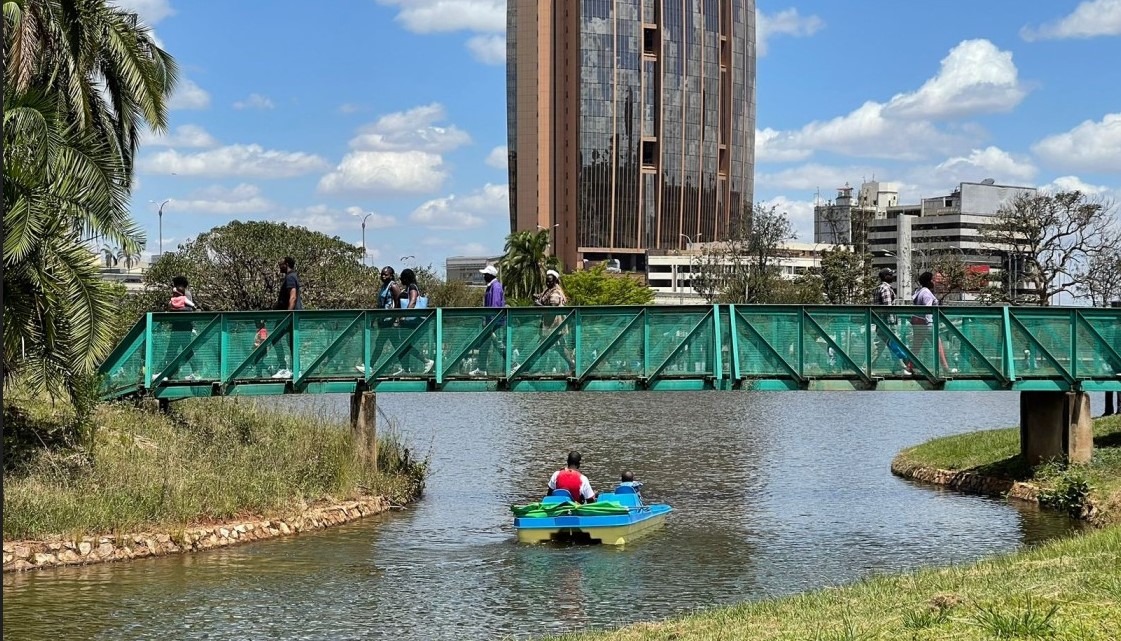 Visitors enjoy a boat ride at Uhuru Park, Nairobi. (Photo: Nairobi County).
The organisation claims the government was attempting to create what it termed a “dangerous legal pathway” that would allow roads, utilities, and public installations to be introduced inside protected forests under the guise of development.
The proposed amendment to Section 56 (2) of the Forest Conservation and Management Act seeks to give the Kenya Forest Service (KFS) authority to grant easements for public roads, utilities, and other installations within public forests.
But the Green Belt Movement says the language being used to justify the changes should not deceive Kenyans.
“Kenyans must not be deceived by the language of ‘public utility’ and ‘public installations.’ This amendment is not innocent,” the organisation said in the statement.
“It is a dangerous legal pathway being created to open up our public forests to roads, infrastructure, utilities, commercial interests and eventual destruction through administrative processes disguised as development.”
The movement argues that forests are not idle public land available for allocation but critical ecosystems that sustain the country’s water security, biodiversity, climate resilience, and livelihoods.
“Our forests are not empty land waiting to be allocated. They are our water towers, our climate shield, our biodiversity, our heritage and the lifeline of future generations,” notes the organisation.
The organisation pointed to recent battles over forest land as evidence of what it described as a growing pattern of gradual encroachment through administrative approvals and infrastructure projects
Among the cases cited was the controversial attempt in 2024 to excise 51.64 hectares of Karura Forest for the expansion of Kiambu Road.
The proposal triggered public outrage, court action, and sustained opposition from environmental groups before the courts halted the planned allocation.
“It took public outrage, legal action and the intervention of the courts to stop the destruction,” the Green Belt Movement said.
The organisation further claimed that Karura Forest continues to face pressure from attempts to introduce security installations and barracks within the protected area.
The lobby also highlights ongoing opposition to a proposed 25-kilometre road through the Aberdare Forest ecosystem, which environmentalists argue threatens one of Kenya’s most critical water catchment areas.
“The Aberdare Forest is not just a forest. It is the source of rivers, livelihoods, agriculture and water security for millions of Kenyans. Yet infrastructure interests continue to threaten its survival,” the movement said.
The group also raised alarm over what it describes as increasing commercial encroachment at Ngong Road Forest, citing the construction of a luxury hotel and plans to allocate 10 hectares of forest land for a road linking the Bomas of Kenya to Talanta Stadium.
According to the movement, such developments follow a predictable pattern that gradually erodes protected forests.
“This is not a coincidence; it is a pattern where first comes a road, then utilities, then ‘temporary access’, then commercial developments. Slowly, public forests disappear piece by piece until nothing remains,” the group argues.
The organisation warned that the proposed amendment risks weakening constitutional protections governing public forests and could create room for abuse, corruption, and environmentally harmful projects.
“The Constitution of Kenya is clear. Public forests are public land held in trust for the people of Kenya. They cannot become corridors for unchecked infrastructure expansion under vague claims of public interest,” the lobby added.
It has now called on Kenyans, civil society organisations, faith groups, students, professionals, and environmental activists to mobilise against the proposed legal changes.
The group; that was once led by the late renowned environmentalist Professor Wangari Maathai, is also alarmed by reports that parts of Uhuru Park and Central Park could be taken for the expansion of Uhuru Highway in Nairobi, triggering a fresh public debate on the future of the city’s shrinking green spaces.
The group recently revealed that it had received reports that survey beacons had already been placed inside sections of the two parks, suggesting that early groundwork for the project may already be in motion. It warned that the move, if confirmed, would raise serious legal and environmental questions.
The group argues that Nairobi’s green spaces are already under pressure from infrastructure growth and commercial interests. It says continued loss of public parks would affect biodiversity, worsen climate risks in the city, and reduce access to clean recreational space for residents.


















































Comments
Sign in with Google to comment, reply, and like comments.
Continue with Google