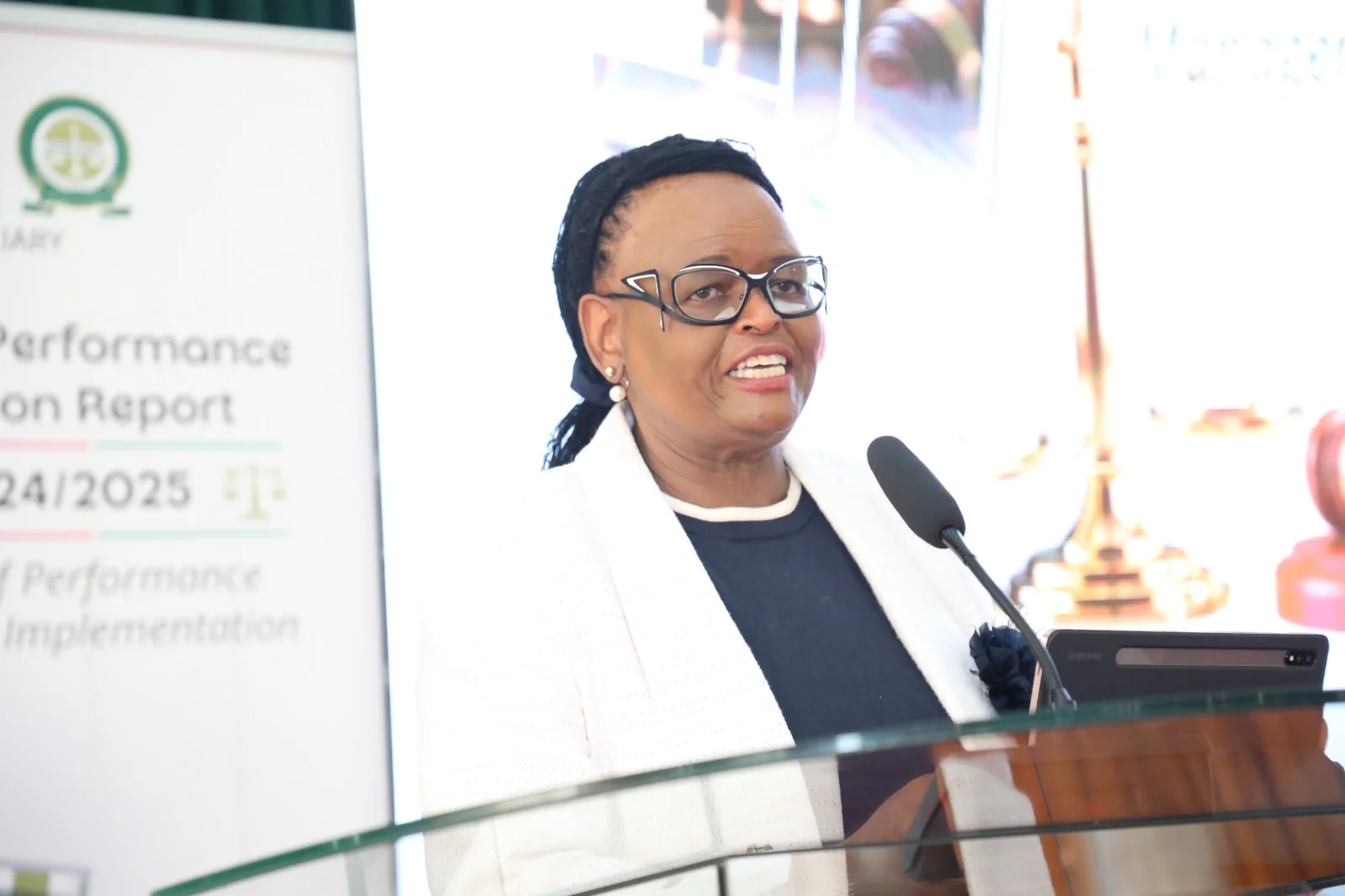
The Judiciary resolved more cases than were filed during the 2024/2025 financial year, reducing the national case backlog by 27 per cent despite a decline in its overall institutional performance, Chief Justice Martha Koome has announced.
Launching the Judiciary's Performance Management and Measurement Understanding (PMMU) Evaluation Report at the Milimani Law Courts on Friday, Koome said courts determined 647,686 cases against 621,425 new filings, achieving a 104 per cent case clearance rate, an indication that the Judiciary disposed of more cases than it received during the reporting period.
The Chief Justice said the case backlog had reduced from 272,678 cases to 244,267, describing the achievement as evidence that reforms aimed at improving efficiency and access to justice were yielding results.
"In practical terms, the Judiciary resolved more cases than it received during the reporting period," Koome said. "These achievements demonstrate that deliberate reforms, effective leadership and sustained institutional commitment are producing measurable results."
However, the report shows the Judiciary's overall performance score fell to 88.12 per cent, down from 95.29 per cent recorded in the previous financial year, although it remained within the "Good" performance category.
Koome attributed the decline to mounting operational pressures, including increasing caseloads, inadequate court infrastructure, staff shortages, ICT limitations and growing demand for judicial services.
"Increasing caseloads, inadequate infrastructure, staffing shortages, ICT constraints and growing operational demands continue to affect performance in some court stations and administrative units," she said.
She urged sustained investment in modern court infrastructure, recruitment of additional judicial personnel and expansion of digital systems to improve service delivery.
"The future of justice is increasingly digital. We must accelerate transformative initiatives, including the Integrated Case Management System, e-Filing, virtual court services and digital transcription," Koome said.
According to the report, the Supreme Court emerged as the best-performing court with a 96.30 per cent score, while the Kadhis' Courts followed closely with 95.41 per cent. The report also noted improved performance by the Court of Appeal, while Magistrates' Courts maintained strong performance.
Koome said the evaluation covered 351 implementing units, comprising 330 courts and 21 administrative units, up from 227 units assessed when the performance framework was first introduced in the 2015/2016 financial year.
She also announced the introduction of the Chief Justice's Merit Award, a new recognition programme intended to honour judges, judicial officers, staff, teams and court stations whose exceptional contributions may not be fully reflected through conventional performance metrics.
Koome said the awards are intended to promote innovation, excellence and accountability as the Judiciary implements its Social Transformation through Access to Justice (STAJ) Blueprint aimed at delivering timely, accessible and people-centred justice.
















































Comments
Sign in with Google to comment, reply, and like comments.
Continue with Google