Organised crime in South‑East Asia has transformed into a highly interconnected, technology‑driven criminal ecosystem that is outpacing law enforcement, with online scam losses across East and South‑East Asia, Australia and New Zealand estimated at $88.3 billion (Sh11.41 trillion) to $114.1 billion (Sh14.75 trillion) in 2025.
According to the UN Office on Drugs and Crime (UNODC) threat assessment, “An Interconnected Criminal Ecosystem: Transnational Organised Crime Threat Assessment for Southeast Asia 2026”, once‑fragmented syndicates have evolved into transnational networks that share financial infrastructure, cyber capabilities and illicit services across multiple criminal markets, from online fraud and money laundering to human and drug trafficking.
The report says criminals are weaving these different types of crime into a single, shared financial and operational infrastructure, enabling a thriving ecosystem that leaves little trace and is far harder to seize or attribute to any single actor.
The assessment, released Tuesday in Bangkok, warned that the increasingly sophisticated ecosystem poses growing risks to governance, economic stability and development both within the region and beyond.
“What we are seeing is a shift in which groups that stayed within their own geographic domain and criminal speciality are now operating across multiple illicit markets at once, relying on the same service streams. Their operating model looks like corporate franchising: imagine specialised departments for laundering money, trafficking people, smuggling migrants, and harvesting data, all plugged into the same service‑based interconnected network,” said Delphine Schantz, UNODC Regional Representative for South‑East Asia and the Pacific.
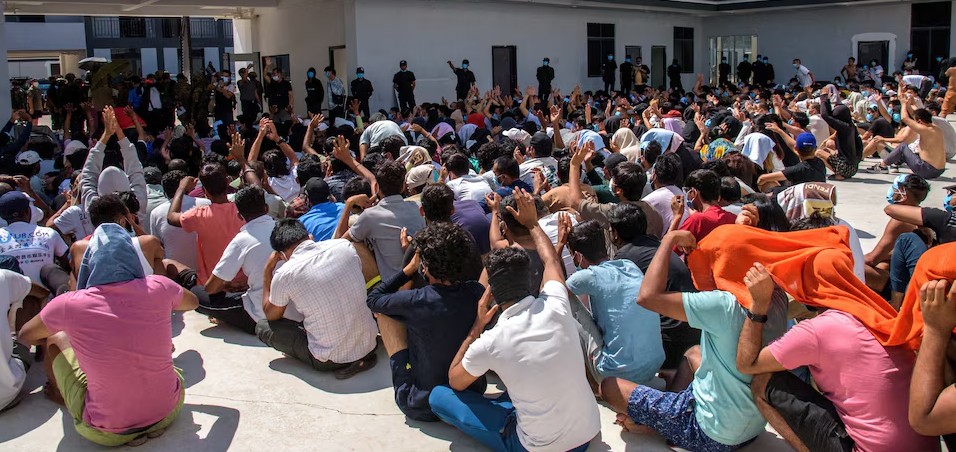
The shift has led to a surge in trafficking in persons for forced criminality across the globe.
“Individuals from at least 80 countries and territories have been identified in scam compounds in the region, with recruitment networks documented as operating through multiple transit hubs in Asia, the Middle East, and Africa. Communication channels linked to South‑East Asia’s scam industry point to growing efforts to widen the recruitment pool toward Europe and North America, with advertisements targeting individuals with German, Polish, Dutch, Spanish, Italian, French, Swedish, Norwegian, and English language skills,” the report shows.
Additionally, the report reveals emerging criminal markets including illegal gambling, online child sexual exploitation, tobacco crime, and firearms trafficking.
It says criminals are using the same structure of online casinos to gamify gambling and make it appealing to younger targets, creating a dangerous mix of gaming’s addictive nature and mobile accessibility that puts young users at risk.
“The line between online gaming and online gambling is becoming more and more blurred. While online gaming initially refers to interactive digital play without mandatory monetary stakes, the two sectors have converged through design features that deliberately exploit this ambiguity, making the crime more dangerous,” Schantz said.
At the same time, emerging technological trends, including generative AI, deep fakes and automated fraud requiring minimal human interaction, are flagged as areas of concern. The report warns that “Malvertising”, the exploitation of legitimate advertising networks to deliver malware passively and at scale, has become a highly efficient cybercrime channel, with incidents rising 42 per cent year‑on‑year in 2025.
“A counter‑organised crime strategy focused on disruption alone does not work. We have to address all the drivers, including prevention and following the money. Seizing criminal proceeds hits these networks where it hurts, and makes potential victims more cautious. To follow the money, in the new crypto context, law enforcement in the region needs specialised training to identify, seize and recover these funds,” she added.
The report further cites the expansion of synthetic drugs, heroin and cannabis from South‑East Asia trafficked into Africa, Europe and South Asia as compounding the challenge.
The Golden Triangle remains the region’s main production hub, with a combined annual retail value of methamphetamine, ketamine and heroin markets estimated at $75 billion (Sh9.69 trillion) to $109.7 billion (Sh14.18 trillion), resources sustaining and expanding organised crime operations, it warns.
“Beyond the Golden Triangle, the Sulu and Celebes Seas Triangle has emerged as an increasingly important smuggling corridor for transnational organised groups from within East and South‑East Asia, and beyond. The maritime triangle connecting Indonesia, Malaysia, and the Philippines is an area of growing strategic importance that has received comparatively limited analytical attention. The large volume of traffic through the region allows transnational organised crime groups to embed their illicit cargoes in legitimate trade flows to conceal their activity. This includes technology enablers of scam operations, such as low‑earth orbit satellites, that can be moved undetected through the tri‑border maritime region,” the report says.
Overall, the report estimates combined annual losses from scam offences across East Asia, South‑East Asia, Australia and New Zealand at $88.3 billion (Sh11.41 trillion) to $114.1 billion (Sh14.75 trillion) in 2025 alone, a sum that, even at the low end, exceeds the GDP of several countries in the region.
“The growth we are seeing has fueled an entire ecosystem of ancillary services, many of them operating under the appearance of legitimate commercial activity. The scale and complexity of this expanding organised crime economy are outpacing existing responses, which were not structured to address such sophisticated criminal activity,” said UNODC lead analyst Inshik Sim.









































Comments
Sign in with Google to comment, reply, and like comments.
Continue with Google