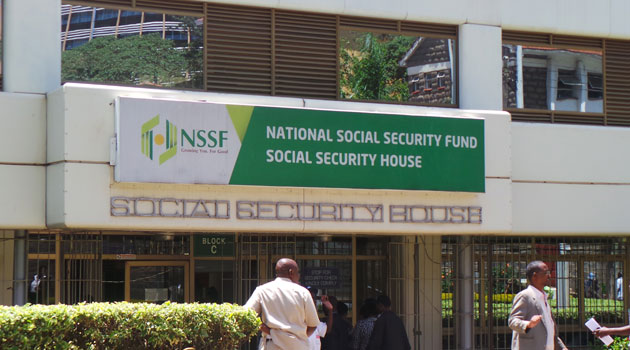
The Law Society of Kenya (LSK) has emphasised that adherence to court orders is a constitutional obligation binding on all persons, institutions, and state agencies, warning that disregard of judicial rulings in the ongoing dispute over the National Social Security Fund (NSSF) Act, 2013, undermines the rule of law.
In a statement, LSK President Charles Kanjama SC said the legal position surrounding the NSSF Act remains unsettled due to ongoing litigation before the courts, and that all parties are required to comply strictly with existing court orders.
“The Constitution of Kenya is founded upon the rule of law. Central to the rule of law is the obligation of every person, institution, and state agency to obey and comply with court orders,” the statement reads.
LSK said the legal status of the NSSF Act remains contested following years of litigation spanning the Employment and Labour Relations Court (ELRC), the Court of Appeal, and the Supreme Court of Kenya.
The Society noted that in Nairobi, ELRC Petition No. 38 of 2014, the ELRC declared several provisions of the NSSF Act, 2013, unconstitutional and invalid. While the Court of Appeal later set aside that judgment in 2023 on jurisdictional grounds, the Supreme Court in February 2024 overturned that decision and remitted the matter back to the appellate court for determination on the merits.
LSK further pointed to the Court of Appeal’s ruling of May 29, 2026, in which the court declined to grant a stay of execution of the ELRC judgment.
“The legal consequence of this ruling is straightforward: there presently exists no stay order suspending the operation and effect of the ELRC judgment,” LSK said.
The Society warned that court orders are not optional and must be obeyed by all parties regardless of disagreement with their content.
The Law Society cautioned employers, state agencies, and other stakeholders against continuing actions that contradict existing court orders, warning that such conduct risks legal consequences. It further noted that continued enforcement of contested statutory deductions could expose employers to liability, including possible contempt proceedings and restitution claims.
“Employers who continue making deductions under the NSSF Act, 2013, do so at their own peril and may face legal liability. Employees whose earnings are subjected to unlawful deductions may have recourse in law. including claims for restitution,“ it noted.
The LSK said it will closely monitor compliance with court orders and may pursue lawful action against individuals or institutions found to be in deliberate disobedience.















































Comments
Sign in with Google to comment, reply, and like comments.
Continue with Google