A team of Kenyan student innovators has won the first‑ever postpartum haemorrhage (PPH) hackathon after developing a digital platform that supports community health promoters (CHPs) and helps pregnant women identify life‑threatening complications early.
The winning innovation, Mama na Mtoto Plus, was crowned the best solution during the inaugural Postpartum Haemorrhage Conference, the first of its kind in East and Central Africa. The hackathon brought together eight teams pitching technology‑driven solutions aimed at tackling PPH, the leading cause of maternal deaths worldwide.
Designed as a digital upgrade to Kenya’s maternal health booklet, commonly known as the purple booklet, Mama na Mtoto Plus combines a mobile application with a USSD platform, allowing even mothers without smartphones to access maternal health services.
Speaking after receiving the award, team leader Ashley Kopio said the innovation was inspired by the need to make maternal healthcare more interactive and responsive.
"We realised that although the purple booklet contains important information, it is passive. It doesn't remind mothers about clinic visits, monitor their health, keep records, or alert them when they experience danger signs," she said.
Through the platform, expectant mothers can record their daily symptoms. If they report danger signs such as excessive bleeding, severe headaches, or reduced fetal movement, the system automatically alerts the nearest health facility and the CHP assigned to them, enabling faster medical intervention.
The application also sends reminders for antenatal and postnatal clinic appointments, helping mothers stay on track with routine care. An anonymous chat section allows mothers, particularly adolescents and first‑time mothers, to seek health information and support without fear of stigma.
Kopio said many mothers fail to recognise pregnancy danger signs despite the information being available in the maternal health booklet.
"If you are eight months pregnant and your baby has not been moving for several hours, would you know that is a danger sign? Would you know who to call or where to go? For many Kenyan mothers, the answer is no, not because the information doesn't exist, but because it is often forgotten after the first antenatal visit," she said.
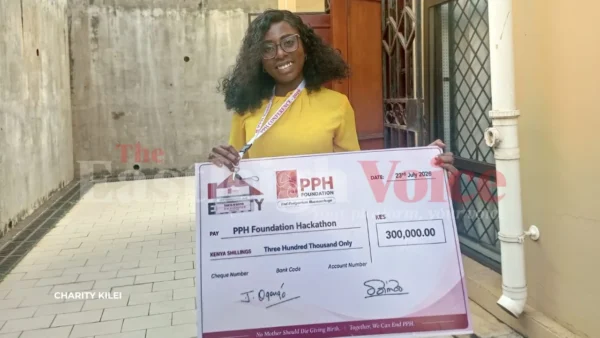 Ashley Kopio, team leader of the Mama na Mtoto Plus research innovation. (Photo: Charity Kilei)
She explained that daily symptom monitoring allows complications to be detected before they become life‑threatening.
"Most pregnancy complications don't happen suddenly. They begin with warning signs. Our application helps mothers identify those symptoms early so they can seek treatment before the condition becomes severe."
Besides postpartum haemorrhage, the platform screens for maternal infections, neonatal sepsis, pre‑eclampsia, and eclampsia, which remain among Kenya’s leading causes of maternal and newborn deaths.
According to Kopio, the innovation is designed to address the three delays that contribute to maternal mortality: delays in recognising danger signs, delays in reaching healthcare facilities, and delays in receiving appropriate treatment.
Mark Njeru, the research lead from Jomo Kenyatta University of Agriculture and Technology (JKUAT), said the application was developed after extensive consultations with mothers, nurses, and community health promoters.
"We obtained the maternal health booklet, developed questionnaires, and collected feedback from mothers, nurses, and community health promoters. Their experiences helped us identify the gaps and guided the design of the application," he said.
Njeru explained that the platform links mothers directly to CHPs and healthcare workers through both the mobile application and the USSD platform, ensuring women can access support regardless of the type of phone they own.
"Our goal is to bridge the gap between mothers, community health promoters, and healthcare facilities so that women receive timely care whenever danger signs are identified," he said.
The team now plans to scale up the innovation by integrating it into existing health facility digital systems and expanding its features. They are also seeking funding to enhance the platform, add a Swahili version to reach more mothers, and strengthen its integration with Kenya’s existing digital health infrastructure.
The innovators believe the platform has the potential to improve maternal and newborn outcomes by ensuring complications are detected early and mothers receive timely care before emergencies occur.
The student team was awarded Sh300,000 to support the pilot phase of the project and further develop the Mama na Mtoto Plus platform. Health officials also pledged continued mentorship, technical guidance, and institutional support to help refine the innovation, integrate it into existing health systems, and ultimately bring it into use across healthcare facilities.
 Mama na Mtoto plus team members pose for a photo after winning the award. (Photo: Charity Kilei)
Prof Kireki Omanwa, President of the Kenya Obstetrical and Gynaecological Society (KOGS), described the event as a historic milestone, noting that it was the first conference dedicated to postpartum haemorrhage in Kenya and Sub‑Saharan Africa.
He said the conference’s inaugural PPH hackathon brought together professionals from different disciplines to develop innovative solutions to one of Kenya’s biggest maternal health challenges.
"The hackathon focused on postpartum haemorrhage, which claims the lives of between 5,000 and 6,000 Kenyan mothers every year from preventable causes. This is something that has never been done before. It is a Kenyan solution that brings together different groups to ask what more we can do to save mothers," he said.
Prof Omanwa said the organisers received more than 50 proposals from across the country. Following a competitive selection process, the entries were shortlisted, with six teams advancing to present their innovations during the conference.
"The finalists were all young people from different professions. We had engineers, pharmacists, social scientists, and many others because postpartum haemorrhage affects all of us. Solving it requires contributions from different sectors," he said.
He urged the Ministry of Health, industry, and development partners to invest in promising innovations emerging from the hackathon so they can be tested and eventually rolled out to benefit mothers across the country.
"Some of these proposals deserve support and mentorship so they can be developed into solutions that reach mothers and save lives," he said.
Prof Omanwa expressed hope that the hackathon would become a permanent feature of future conferences, alongside other initiatives such as the PPH Foundation’s training school, which is introducing virtual reality technology to strengthen obstetric training.
He also announced plans to expand public awareness and workforce training, including a campaign expected to attract one million participants in support of maternal health and efforts to reskill and retool healthcare workers.
"Hackathons like this bring together different ideas to solve one problem. Out of these innovations, one or two could become groundbreaking solutions that transform maternal healthcare in Kenya," he said.
Speaking during the event, Dr Edward Serem from the Ministry of Health commended all eight teams that participated in the inaugural hackathon, saying their innovations demonstrate the critical role of young innovators in addressing maternal health challenges.
He said the government is committed to fostering more innovation to accelerate efforts to reduce maternal deaths and improve the quality of care for mothers and newborns.
"We are going to support more innovations that will propel this agenda forward," Dr Serem said.
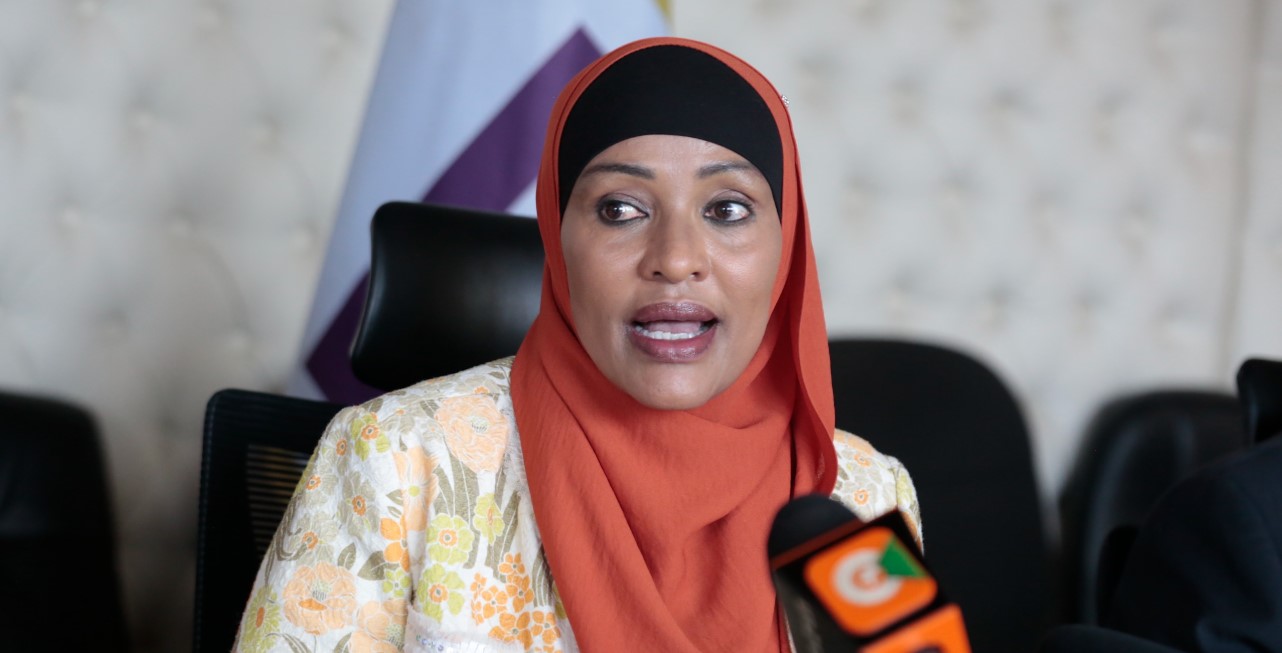
 Head of the Maternal and Reproductive Health Division at the Ministry of Health, Dr Edward Serem. (Photo: Justine Ondieki)
He noted that initiatives such as E‑MOTIVE and the Reproductive, Maternal, Newborn, Child, and Adolescent Health (RMNCAH) program are already helping strengthen maternal healthcare but stressed that innovation and collaboration remain essential to saving more lives.
Dr Serem said the government has also taken steps to ensure lifesaving maternal health commodities are available in health facilities but emphasised that success will require the involvement of all stakeholders, including government, healthcare workers, development partners, innovators, and communities.
"There is a need for all stakeholders to work together to ensure that no mother dies from preventable causes," he said.
The hackathon attracted innovative solutions from multidisciplinary teams made up largely of young professionals and students from Kenya, Tanzania, Malawi, and Nigeria, highlighting the power of cross‑border collaboration in tackling maternal health challenges.
The competition featured ideas ranging from technologies to improve the early detection and management of pre‑eclampsia and eclampsia, systems to detect counterfeit oxytocin, and innovations to transport blood using boda bodas to reduce delays during obstetric emergencies.
Other teams showcased wearable technologies, including a smart bracelet capable of monitoring a pregnant woman’s blood pressure and automatically sending alerts to healthcare providers when dangerous spikes are detected.
The diversity of innovations reflected the broad range of expertise brought into the competition, with engineers, pharmacists, software developers, social scientists, and other professionals working together to develop practical solutions aimed at reducing maternal deaths and improving maternal healthcare.














































Comments
Sign in with Google to comment, reply, and like comments.
Continue with Google